The Weekly Sedra – Chayei Sara – Talk is Cheap – Put Your Money Where Your Mouth Is!

by Rabbi Yoseph Kahanov Shliach to Jacksonville, FL

After an impassioned lecture on the virtues of patriotism and the Marxist system of government, a local communist party leader was asked: “Sir, what would you do if you were to own two houses?”

Barely able to contain his proud grin, the official cried out, “Why, of course I would give one away to my comrades!”

“And what would you do if you were to own a second automobile?”

Again the politician declared with smug determination, “Naturally I would give-up one to the people!”

Finally the leader was asked: “And what if you happened to possess two pair of shoes?”

This time the official seemed caught off guard. He began to hem and haw – stammering and stuttering.

When asked later by a close underling, why he did not hesitate to part with a second house or automobile, which are rather valuable items, yet could not say for certain that he would give-up a measly pair of shoes, his response was remarkably simple: “You see, I do not own a second house and probably never will, the same is true of an automobile. But a second pair of shoes? That I do own; and I’m not inclined to give it up!”

“Say a little and do much” – Avot 1:15
Mazal Tov's View More

The Weekly Sedra – Parshas Chayei Sarah

The Rebbe says:

1. The first verse of this week’s Torah portion is, “Sarah’s lifetime was one hundred years, and twenty years, and seven years; the years of Sarah’s life”.

The Zohar learns out from this verse that Sarah signifies the body of a person, and Avraham Avinu (Abraham our Forefather) signifies to the soul of a person .

2. The Rebbe now asks a question based on this:

Earlier on in the Torah the Torah told us that Hashem (G-d) instructed Avraham Avinu to listen to whatever his wife Sarah said because she had a greater power of prophecy .

However, according to this abovementioned Zohar which says that Sarah was like the body and Avraham was like the soul, how does this make sense? Why should the soul listen to the body?

Recording of a Beautiful Yechidus With the Rebbe!

Attached is a Audio Yechidus of the Rebbe in English. This private audience took place in the summer of 1977 with an American student who was studying in Kfar Chabad. Concerned about his next step in life; he sought the Rebbe’s advice. The Rebbe guides the young student with his learning, as well as provides advice on finding a Shidduch. To learn more about the Rebbe visit: www.InspiringAGeneration.org

The transcript below was taken from the audio recording (attached) of Yechidus with Rabbi Jacobs and his mother. In this Yechidus, the Rebbe directed Rabbi Jacobs to return to Israel, stating that his future wife would be easily found there. Two weeks later, Rami Antian OBM ‘dragged’ Rabbi Jacobs out of his yeshiva dorm bed at 3:00am excitedly notifying him that he had found him his future wife. Rabbi Antian had no knowledge of this Yechidus at the time. Finally, it was in this Yechidus that Rabbi Jacobs was told to begin learning for Smicha (Rabbinic Ordination).

<%FlashMP3(yechidus jacobs with the rebbe.mp3)%>

Time: 2:00 a.m.
Present: The Rebbe, Rabbi Jacobs and his mother (both seated facing the Rebbe)

Youth at Risk and This Week’s Torah Portion (Vayero)

by Rubin Danziger – Rudistettner.com

Through the book of Genesis, the narrative focuses first on the ancestors of mankind and then upon the ancestors of the Jewish people. After an initial compelling story, those whose history parted with that of the Jewish people such as Ishmael and Esau fade out with a detailed genealogy that is devoid of personal narrative in the written text.

A particular compelling story in this week’s Torah portion is that of Hagar and Yishmael, who was sent away at Sarah’s urging by Abraham, as detailed in this week’s parsha, Parshas Vayero (Bereshis 21:8-20. Bereshis 21:8-20

I have always found the emotions and events in this week’s parsha vividly compelling. Even as I accepted the need for sending away Ishmael, I was always haunted by this set of biblical imagery.

As I assumed the responsibilities of fatherhood, my empathy with the suffering of Yishmael and Hagar became almost painful. One day, the doors of a yeshiva closed behind me and one of my children. We left with heavy hearts and a refund check.

Rebbe, Why Does G-d Create Evil?

The following is a fascinating Yechidus of the Rebbe that took place in the winter of 5722/1962. To learn More about the Rebbe Vsit: www.inspiringageneration.org

Question: How would you define Judaism in a nutshell?

The Weekly Sedra – Parshas Vayeira!

The Rebbe says:

1. This week’s Torah portion tells us about how Avraham Avinu (Abraham our forefather) was the first and only Jew in this world and the whole world was against him . However once the people saw how Hashem (G-d) was with Avraham Avinu in all that he did and protected him from any harm, even Avimelech King of the Philistines wanted to make a covenant of peace with Avraham Avinu .

Towards the end of the Torah’s description of Avraham Avinu’s life in the land of the Philistines the Torah tells us that Avraham Avinu planted an “Eishel – (simply translated as) a tree” there , he publicized G-dliness and faith there , and he lived there for many days. Immediately after this the Torah begins discussing the Akeida (the Binding of Isaac) .

2. The Rebbe now questions the Torah’s narration of this story with the intention of uncovering the Torah’s deep messages:

The Weekly Sedra – Vayera – A Foot In Each World – Sitting On The Fence Syndrome

by Rabbi Yoseph Kahanov Shliach to Jacksonville, FL

Sitting on a fence is a man who sees no sense in fighting
Sitting on a fence is a man who sees no sense at all
Sitting on a fence is a man who strokes his twenty beards
Sitting on a fence is a man who drinks real ale
But the real problem with this man
Is he says he can’t when he can
He’d rather not get his hands dirty
He’ll still be there when he’s thirty
I told myself to keep my mouth shut
But I still end up saying if and but
I lied to myself right from the start
And I’ve just worked out that I’m falling apart
Sitting on a fence is a man who looks up to his guardian
Sitting on a fence is a man who swings from poll to poll
Sitting on a fence is a man who sees both sides of both sides
Sitting on a fence is a man who looks down on opinion
But the real problem with this man . . .

(Song by Housemartins) How long will you vacillate between two opinions – 1 Kings 18, 21

The Weekly Sedra – Lech Lecha – Transcend Yourself

by Rabbi Yoseph Kahanov Shliach to Jacksonville, FL

The renowned Chasid, Reb Yechezkel (Chatche) Faigin, was said to have been a very strong hearted individual. Few were the times he was wont to allow himself the luxury to breakdown and cry. One such rare occasion, however, was when he served as secretary of the previous Lubavitcher Rebbe – Rabbi Yosef Yitzchak Schneerson.

The times were extremely dire and the means extraordinary meager. Much of the weight of the underground activities, carried out by Chassidim who risked their lives in defiance of the communist government, fell on his shoulders.
Reb Chatche toiled day and night with compete self-sacrifice, in order to sustain the holy work of the Rebbe – underground Day schools, Yeshivas, Mikvaos, etc. He carried out his responsibilities loyally and honestly, never a complaint or a thought of self pity.

However, there was one problem. His time was so absorbed with his work that he had no time for his own spiritual nourishment. Oh how he ached to study a Chassidic discourse; to spend a little more time meditating in prayer. His soul was parched for the spiritual waters of Chassidus, but the clock did not allow.

One day, when he could take it no more, he decided to present his case to the Rebbe. Perhaps, when hearing how distressed he was over his situation the Rebbe will agree that he ought to snatch some time from his holy work for his own spiritual needs. He pleaded with the Rebbe four a half hour; just a half hour!

After pouring out his broken heart to the Rebbe, he waited in anticipation for the Rebbe to reply. The Rebbe listened carefully to his passionate and painful plea and then tuned to him saying: “But in this and this place there is still no Yeshiva, in that place there is still no Mikvah. . .” Reb Chatche understood the response, but he could not control his emotions and burst into tears.

Upon seeing this, the Rebbe, himself in tears by now, waited several long minutes and then said: “If we afford ourselves the luxury to do ‘what we desire,’ what will be with the work that must get done? Do you think this is the Divine desire!?

This Desk has Heard the Cries of Many Jews

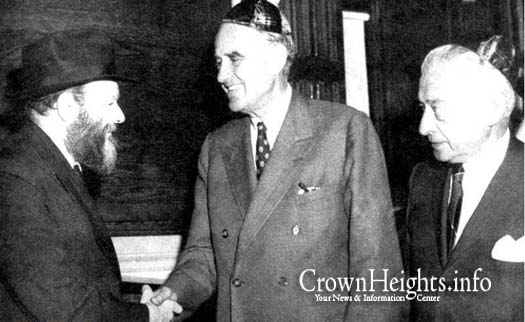
Although the late Israeli President, Zalman Shazar OBM, visited the Rebbe several times throughout his lifetime, one particular visit in the summer of 1966 was of special significance, as it was the first made in his official capacity as head of the Jewish state. The following is a description of some the controversy that led to the meeting and a glimpse of what was discussed during the Yechidus. to learn more about the Rebbe Visit: www.portraitofaleader.blogspot.com

The Weekly Sedra – Parshas Lech Lecha

The Rebbe says:

1. At the end of this week’s Torah portion the Torah tells us that Hashem (G-d) came to Avraham Avinu (Abraham our Father) and told him to circumcise himself .

2. The Rebbe now asks a question on this :

The Talmud tells us that Avraham Avinu kept the whole Torah even though it was not given yet to the Jewish people . If so, why did Avraham Avinu wait for Hashem to instruct him to give himself a circumcision if he did not wait to fulfill all the other Mitzvos (commandments) until he was instructed?

3. The Rebbe begins the answer:

The Weekly Sedra – Noach – A Tale Of Two Souls

by Rabbi Yoseph Kahanov Shliach to Jacksonville, FL

A Peak into the Human Psyche

Like it or not, we are each engaged in a battle against our own set of mean genes. They are wily opponents too. Masters of the visceral, they control through satisfaction, pain, and pleasure. -(Dr.’s Terry Burnham and Jay Phelan, Mean Genes)

Destroy man’s desire to sin, our sages tell us, and you would destroy the world. Not that anyone needs to sin. But one who lacks the desire to sin is not a citizen of this world. And without citizens, who will effect lasting change? -(Tzvi Freeman)

As a child, Reb Herschel of Krakow was once scolded by his father for not arising early for prayer service. “I can’t help it,” complained the boy. “It’s that yetzer hara of mine. It keeps telling me to turn over and go back to sleep – that it’s too early to awake.”

“But Heschele,” countered the father, “don’t you see? The yetzer hara is just doing his job. The yetzer hara is an angel created by G-d with the assignment to divert people from observing His will. You ought to be smart enough to do as he does, not as he says. Next time the yetzer hara entices you to stay in bed, tell yourself: ‘Aha! He’s at it again – he’s up bright and early fulfilling his duty. I too have a mission; I must get out of bed quickly to get on with my task as well.’”

“Oh father,” retorted the child with a twinkle in his eye, “you make it sound so simple. But since when does the yetzer hara have to contend with a yetzer hara that tries to stop him of his assignment? Perhaps that’s why he is so efficient. I, on the other hand…”

The Floodgate: A Jewish Response to Recession

By Getzy Markowitz – Jewish Thought in Simple Words

The Hachnosas Safer Torah procession going down the Victoria Harbor.

Earlier this week, I was honored to attend a ceremony marking the completion and inauguration of a new Torah scroll. My good friends, the Kamhin family of Hong Kong, inscribed themselves into eternity by fulfilling the Torah’s final bidding of acquiring a scroll for themselves. Following formalities, hundreds of participants paraded by way of Victoria Harbor to the scroll’s new home.

The Weekly Sedra – Parshas Noach

The Rebbe says:

1. This week’s Torah portion discusses the flood which Hashem (G-d) brought onto the world because of their immoral behavior .

2. The Rebbe now explains a deeper aspect of the flood:

The Alter Rebbe (Reb Shneur Zalman of Liadi) explains that the flood was not only a punishment for the inhabitants of the world because of their terrible behavior, it was also a cleansing for the world .

3. The Rebbe now shows how this aspect of the flood, it being a cleansing, clearly affected the flood’s characteristics:

A Word for the Shabbos Table – Bereishis

“In the beginning God created the heaven and the earth.” (Genesis 1:1)

“The word “bereishis” is also an [divine] utterance” (Talmud, Rosh Hashanah 32a).

In the very beginning of chapter five of פרקי אבות we are taught that בעשרה מאמרות נברא העולם (“the world was created by the means of ten [divine] utterances”). For example, when the Torah relates “And G-d said: Let there be luminaries,” the sources of light in this world came into being; and when “G-d said: Let the earth bring forth living creatures,” at that moment all animal kinds and creatures were created.

The Weekly Sedra – Bereishis – Let Us Make Man

by Rabbi Yoseph Kahanov Shliach to Jacksonville, FL

In 1798, Rabbi Schneur Zalman of Liadi was imprisoned. He was held in the Peter-Paul Fortress in St. Petersburg, Russia, on the charge that his teachings of Chassidism undermined the imperial authority of the Czar.

Among his interrogators was a government minister who possessed broad knowledge of the Bible and Jewish studies. On one occasion, the minister asked the Rebbe if he could explain the verse: “And G-d called out to the man and said to him: Where are you?” (Genesis 3:9). Did G-d not know where Adam was?

Rabbi Schneur Zalman first offered him the simple explanation that is presented in the classic commentaries: “Where are you,” was merely a prelude. . .

“What Rashi says I already know,” replied the minister. “I was hoping to hear a deeper interpretation .”

The Rebbe then offered the following explanation: G-d inquired of Adam “Where are you in the world?” I.e. Do you understand the nature and purpose of your existence? G-d obviously knew where Adam was; His question was did Adam know where he was. “Where are you?” continued the Rebbe, “is G-d’s perpetual call to every man.”

Man’s essential quality is his image; his higher human form. – The Magid of Mezritch

Moving (Forward) In Circles? Beware Of the Cheshvan Blues

by Rabbi Yoseph Kahanov Shliach to Jacksonville, FL

Reb Shneur Zalman of Liadi, founder of the Chabad movement, was for a time, a disciple of Reb Menachem of Vitebsk (until the latter left Russia for the Holy Land in 1777).

One year on Simchas Torah, before Hakkafos (the circular procession for which the holiday of Simchas Torah is renowned), the entire synagogue was waiting for Reb Menachem Mendel to begin the recitation of the preceding verses, beginning with Atoh Hareisa. After a long unexplained silence, R’ Menachem approached R’ Shneur Zalman and said: “I perceive a hundred different ways to interpret this passage, but I cannot translate them into practice. I would hence prefer to refrain from reciting it.”

Reb Shneur Zalman protested: “But a person can never stand at the place which his eyes behold; for when he reaches that point he will see even farther. This is the typical order of things. So Rebbe, when you have realized these hundred ideas in practice, you will perceive yet more ideas and insights, and there will be no end to the matter.”

The Rebbe was quite pleased with this answer, and at once proceeded to recite: “Atoh Hareisa. . .”

Sukkos – Don’t Lose Your Spine!

by Rabbi Yoseph Kahanov Shliach to Jacksonville, FL

You’re sitting on a plane buckled-up in your seat, as the plane is pushing back. You’re ready to relax – read a book, close your eyes and catch up on some badly needed sleep — but there’s one more important bit of business to be taken care-of before you can kick back; the airline safety demonstration. This, we all know, is when the flight attendant gets up to do her/his little buckle-vest-mask ditty.

“. . . The cabin is pressurized for your comfort and safety. In the unlikely event of a cabin decompression, oxygen masks will automatically drop from a compartment above your seat. To start the flow of oxygen reach up and pull the mask closest to you, fully extending the plastic tubing. Place the mask firmly over your nose and mouth, slip the elastic strap over your head and breathe normally. Tighten by pulling on the ends. The bag does not need to inflate for oxygen to be flowing to the mask.”

Then, almost as a side note, comes a little piece of additional advice: “If you are seated next to a small child or someone needing assistance, ‘secure your own mask first and then assist the other person!’”