

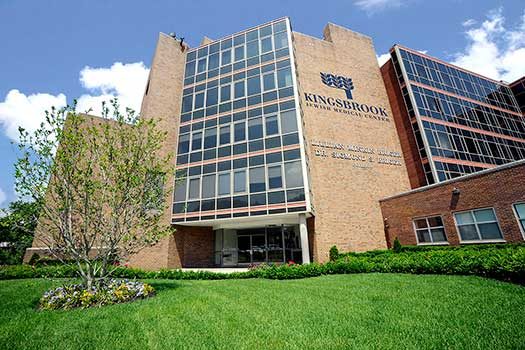
From 266 Units to 402: Vital Brooklyn’s Kingsbrook Estates Grows Taller, and the Shuttered Kingsbrook Shul Watches Its Courtyard Shrink
by CrownHeights.info
The state-financed affordable housing project that has loomed over the future of one of Crown Heights’s oldest Shuls just got significantly bigger, and taller. New York State Homes and Community Renewal (HCR) last week finalized $193.6 million in bonds and subsidies for Vital Brooklyn’s Kingsbrook Estates, clearing the way for a single 14-story tower with 402 apartments on the former Kingsbrook Jewish Medical Center campus in East Flatbush, a dramatic jump from the 266-unit, multi-building design first announced under Gov. Andrew Cuomo in 2019.
For the congregation of the historic Kingsbrook Shul, locked out of its grounds since the early days of COVID-19, the news lands at a delicate moment: the building itself appears safe from demolition after Governor Hochul’s personal intervention late last year, but the footprint of the massive development around it keeps changing.
According to the recent filings, the state is putting $193.6 million toward demolishing the four former hospital buildings and constructing a 14-story building with 402 affordable apartments for residents earning at or below 70 percent of the Area Median Income, including 142 units with supportive services for older adults and veterans. That’s a striking departure from the original pitch.
Back in 2019, Monadnock Development, CB-Emmanuel Realty and Brooklyn Community Housing and Services were selected to turn the Kingsbrook Jewish Medical Center North Campus into a 266-unit development spread across three buildings, with three existing structures demolished and a fourth, the Leviton Building, converted from hospital use into housing. That plan promised amenities like a therapeutic garden, outdoor kitchens, walkways and a PACE center for elderly care, all wrapped around what was described as a shared courtyard.
Seven years later, the unit count has grown by more than 50 percent and the multi-building campus has been consolidated into a single high-rise nearly quadruple the height originally discussed. According to site plans and a June 2026 Decision Document filed with the state Department of Environmental Conservation as part of the project’s Brownfield Cleanup Program review, the current design steers clear of both the main “synagogue” building, and its attached Shul. But the new footprint dips into the courtyard space on both the eastern and western sides of the site, encroaching on open space that earlier renderings had shown surrounding the shul.
The housing project’s growth is unfolding against the backdrop of a bitter, years-long dispute over the fate of Congregation Chaim Albert, universally known as the Kingsbrook Shul.
The congregation has been active on the hospital grounds since at least 1928, when Kingsbrook Jewish Medical Center was founded partly in response to antisemitism at other area hospitals. The original Shul building was torn down to make room for X-ray rooms in 1950, and the marble-floored, stained-glass structure that replaced it was named for Joseph Chaim Albert, father of longtime hospital president Isaac Albert.
The current standoff traces back to 2020, when the Shul was shuttered under COVID-era restrictions and hospital officials told congregants they could return once those restrictions were lifted. The truth was that access was never actually restored. The building today sits covered in tarps, with standing water on the floor and stains creeping across the ceiling, according to congregants. Before the closure, the shul held services every Shabbas and Yom Tov, drawing about 40 people a week, and roughly 60 people still consider themselves members who would return if allowed, according to filings form the Shul.
Congregation Chaim Albert filed suit against One Brooklyn Health System in June 2025, asking the court to establish a trust preserving the building for religious use after the hospital system’s development plans surfaced with no provision for the shul’s survival. A 2019 Q&A distributed by state officials had explicitly promised the synagogue would not be part of the redevelopment and that the building would be preserved.
The dispute drew growing public attention through late 2025, including a menorah-lighting rally outside the locked building during Chanukah. The rally was led by a young man who had recently been assaulted in an antisemitic attack on the subway while returning from Chanukah outreach. Days later, Governor Hochul announced she had personally intervened to prevent the synagogue’s demolition, praising the shul’s century of history and its symbolism for the Jewish community. Her office did not specify exactly how the intervention was carried out.
State Attorney General Letitia James and Crown Heights communal leaders welcomed the move, though the celebration was tempered. Rabbi Zalman Goldstein, a longtime congregant, told CBS New York that hospital management only admitted in June 2024 that it had no intention of reopening the shul, confirming what members had long suspected. Fellow congregant Mendy Rendler said the community has lost the kind of large gathering space that once brought families together. Saving the walls from a wrecking ball, congregants have noted, is not the same as reopening the doors. Goldstein put it simply: a saved synagogue that stays closed is “not in use.”
What’s changed since Hochul’s intervention is not the fate of the synagogue building itself, but the scale of everything around it. The jump from 266 to 402 units, confirmed in HCR’s July 9 funding announcement, effectively locks in a far larger structure than the one originally described to the community and to the congregation in 2019.
With bond financing now finalized, Kingsbrook Estates appears close to breaking ground on demolition of the four remaining former hospital buildings, a separate matter from the synagogue itself, which current site plans continue to route around. But with the courtyard space shrinking on both flanks and the unit count nearly 50 percent above what neighbors were originally shown, the questions facing Congregation Chaim Albert are no longer only about whether its building survives. They now include what kind of neighborhood will surround it once 402 apartments and a 14-story tower rise where a low-slung hospital campus, and an unlocked shul, once stood.











Duke of Kingsbrook
Once they start construction on this 14 story 402 unit building on the SE Corner (KJMC) of Rutland & Schenectady, it’s only a matter of time until the church on the NW corner of Rutland & Schenectady goes beyond the 12 stories that it asked for a few years ago and instead asks for 14 stories.
The 3 person (mayor, Speaker, BP) ULURP Appellate Board can now overrule any rejection by city council.
Why Isn't Jewish History Being Preserved as Part of Project
https://www.governor.ny.gov/news/governor-hochul-announces-12-million-historical-centers-across-new-york-state – Gov Hochul gives $1.2 to Weeksville Heritage Center to help preserve Black history a few blocks north of historic Kingsbrook Synagogue.
https://www.kingsbrookshul.com/_files/ugd/36b35b_0d3a220396024708807de5f1635072b4.pdf – p 5, par 3, Blumberg Pavillion had small synagogue pre 1950
anonymous
has anyone spoken to harav chazan?
Jay Sorid
has anyone spoken to
1) NYS Governor Kathy Hochul who appoints the commissioner of NYS HCR which is funding development at Kingsbrook?
2) Assemb Cunningham or NYS Sen Myrie about demanding that KIngsbrook Congregation get access to synagogue to assess roof repairs needed
3) OBH Secy/ Kingsbrook Boss Henna White (frum) & asked her to resign?
https://onebrooklynhealth.org/about-obh/leadership
anonymous
I have heard that their are some lubavitchers still working there!
A real Jew
There is no money in the deal so forget it