


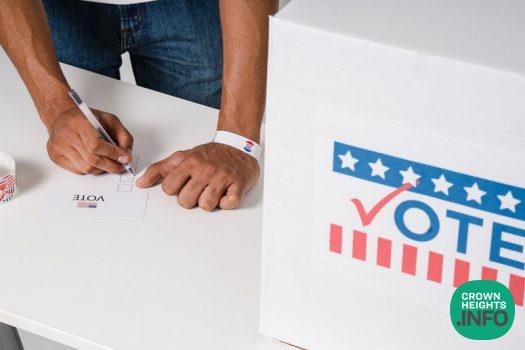
Op-Ed: Where Is the ‘Get Out the Vote’ Campaign?
by Anonymous
For years, Crown Heights activists and community organizations have delivered a consistent message to residents: register to vote, turn out on Election Day and demonstrate that the Jewish community is a constituency elected officials cannot afford to ignore.
Voter-registration drives, community-wide appeals, social media campaigns and coordinated outreach to local shuls and schools have sought to transform Crown Heights’ political potential into tangible influence in Albany and City Hall. Yet with New York’s gubernatorial election approaching on November 3rd, a question is emerging among residents: Where is that same sense of urgency now?
This election is a showdown between incumbent Democratic Gov. Kathy Hochul and Republican Nassau County Executive Bruce Blakeman in a race that could have significant consequences for issues ranging from public safety and education to taxation, housing and the state’s relationship with its Jewish communities.
For a community that has repeatedly been told its political strength depends on turnout, they are asking: Whats going on?
A Community That Was Told “Its Vote Matters”
The case for increased voter participation in Crown Heights has been made forcefully in recent years.
In November 2024, the New York Jewish Week, in a report published by the Jewish Telegraphic Agency, documented a coordinated campaign by the Jewish Future Alliance to increase voter turnout among Chabad-Lubavitch residents. The initiative included postcards, advertisements, testimonials and direct appeals encouraging residents to vote, even in an election in which New York was widely expected to favor the Democratic presidential candidate.
The argument was straightforward: Voting was about more than determining who would win a particular contest. It was about demonstrating to elected officials that Crown Heights had a politically engaged constituency whose concerns warranted attention.
Rabbi Yaacov Behrman, founder of the Jewish Future Alliance, told the publication that elected officials pay attention to community turnout when making policy decisions. The campaign emphasized issues including antisemitism, public safety, Jewish education and the ability of the community to influence government decisions.
The effort built on years of work to increase registration and participation. In September 2025, CrownHeights.info reported that more than 60 Crown Heights shuls, schools and organizations were joining a weeklong voter-registration drive led by the Jewish Future Alliance, alongside the Crown Heights Shuls Association, Vaad Hakohol, Crown Heights N’tzigim and other community leaders.
The message was emphatic: Registration and participation were essential to the community’s future.
The effort continued in 2026. In May, the Vaad Hakohol announced another voter-registration initiative ahead of the Democratic primary, with the stated goal of reaching every eligible adult in the neighborhood. The campaign was described as apolitical, encouraging residents to vote for whichever candidate they believed would best represent the community.
Why The Silence?
The argument, as voiced in neighborhood discussions, is that the Crown Heights Jewish community has demonstrated strong Republican leanings in recent national elections, while many of the elected officials and political figures with whom local activists maintain relationships are Democrats.
Publicly promoting a Republican gubernatorial candidate, or organizing an especially visible campaign that could help him, might complicate those relationships at a time when Democratic candidates remain well positioned in statewide politics.
The issue is not whether a nonprofit should endorse a candidate. Organizations with nonprofit status may face legal restrictions on political campaign intervention, depending on their tax classification. A nonpartisan voter-registration initiative need not—and generally should not—tell residents which candidate to support.
The issue is whether encouraging eligible residents to participate remains a priority even when the likely beneficiaries of greater turnout may not be the politicians with whom community leaders have the closest relationships.
There is a meaningful distinction between neutrality and silence. A community organization can refrain from endorsing either candidate while still reminding residents of registration deadlines, explaining early-voting options and encouraging participation regardless of party preference.
A Republican-Leaning Community in a Democratic State
Crown Heights occupies an unusual position in New York politics.
New York State is a Democratic stronghold in statewide and federal elections, and Brooklyn is a particularly difficult political environment for Republican candidates. Yet the Orthodox Jewish electorate, including the Chabad-Lubavitch community in Crown Heights, has often leaned Republican, particularly in national elections.
The 2024 New York Jewish Week report highlighted this contrast, noting that Orthodox Jewish voters nationally have historically been substantially more Republican than American Jews overall. It also described Crown Heights as a Republican-leaning pocket within a heavily Democratic city.
That political orientation was visible in the 2022 gubernatorial election, when Republican Lee Zeldin attracted significant support from Orthodox Jewish communities. In October of that year, the Crown Heights Republican Committee publicly endorsed Zeldin, citing his positions on antisemitic violence and issues affecting the community.
The present race brings that tension into focus. Blakeman has sought to position himself as an alternative to Hochul, criticizing her administration and emphasizing affordability and public safety. Hochul, meanwhile, has emphasized her record and portrayed Blakeman as aligned with President Donald Trump.
Relationships, Representation and Accountability
The debate over voter mobilization comes amid a broader discussion in Crown Heights about how the community should exercise political influence.
In June 2026, CrownHeights.info published an opinion article by former City Council candidates Benny Rosenberger and Yehuda Shaffer arguing that community activists and voters sometimes approach politics differently. The authors contended that activists tend to value established relationships with incumbent politicians, while many residents increasingly judge those relationships by whether they produce tangible results.
Maintaining relationships with elected officials can be valuable. Access to government agencies and decision-makers can help communities address individual cases, secure resources and raise concerns that might otherwise be overlooked.
At the same time, political access should not become an end in itself. A community that is told repeatedly to build its voting strength is entitled to ask whether that strength is being used to advance its interests, and whether its leaders are willing to maintain an independent voice when their political allies disagree with the electorate.
The Clock Is Ticking
The practical stakes are immediate.
According to the New York State Board of Elections, applications to register for the November 3rd general election must be received by October 24th. Early voting is scheduled for October 24th through November 1st.
With those dates approaching, there is still time for community organizations, shuls, schools and local leaders to remind eligible residents to verify their registration, understand their voting options and make a plan to cast a ballot.
Such an effort would not require endorsing Hochul, Blakeman or any other candidate. It would simply put into practice the principle that community leaders have invoked for years: participation matters.
The governor’s race may ultimately be decided by voters far beyond Crown Heights. But the question facing the neighborhood is more local and more enduring: Will the community continue to be urged to exercise its political power regardless of which party stands to benefit?
If voting is essential to the future of Crown Heights, as activists have repeatedly argued, then the call to vote should not depend on whether the outcome is politically convenient.











Behrmanure
This just shows again that the self-appointed narcissists who pretend to represent us, repeatedly put their own personal interests ahead of the community. They’re afraid they might lose their own personal connections if we vote for people who are actually good for us. Just like when they met recently with the horrendously antisemitic mayor, despite the tremendous damage caused.