Celebrating 20 Years, New Jersey’s Jewish Law Symposium Hosts 800 Judges and Attorneys
by Shloimy Galperin – chabad.org
The first names on Rabbi Shalom Lubin’s invitation list were scribbled on a napkin.
Lubin, co-director of Chabad-Lubavitch of Southeast Morris County in New Jersey, was leading a lunch-and-learn with three or four people around the table, and he wanted the opinion of a lawyer in the group. Would he and his colleagues be interested in an evening that explored contemporary law in the light of the Talmud’s ethics and teachings?
The Jewish lawyer wasn’t convinced, but jotted down some contacts on a napkin anyway, setting off a chain of events that led to the establishment of the New Jersey Jewish Law Symposium.
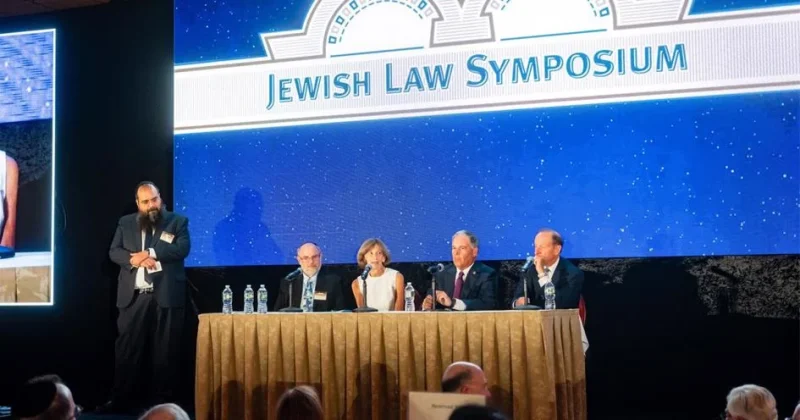
The symposium held its twentieth annual gathering in September, drawing 800 attorneys and judges to Birchwood Manor in Whippany, N.J. Called the premier educational event in the New Jersey legal community, it has become a fixture on the state’s legal calendar, bringing prominent judges, leading attorneys and scholars of Jewish law together for an evening of Torah and civil law.

‘Proud to be a Jew and a Lawyer’
The symposium grew out of the relationships Lubin and his wife, Aharona, built in the early years of Chabad of Southeast Morris County, which they established in Parsippany in the fall of 2002, and it began unexpectedly.
“I had set up a meeting with an attorney friend to discuss supporting the Chabad center’s work here,” recalled Rabbi Lubin. “The attorney started describing how difficult business had been over the previous three months. Of course, I put the fundraising aside and changed the discussion.”
Instead, the two spoke about law, the Talmud and what the ancient Jewish legal tradition might offer attorneys working through modern questions.
“By the time I left,” says the rabbi, “an initial idea was already taking shape.”
The next step was tapping into a larger audience that would benefit from such conversations. That’s where the napkin of contacts came in. Lubin went to work dialing each of the numbers, finding enough interest to launch something.

In June 2007 a small group gathered at the Rabbinical College of America in Morristown for the very first Jewish Law Symposium. Rabbi Shlomo Yaffe presented the Talmudic perspective, and attorneys Stuart Lederman and Howard Danzig. The following year, the program became a panel discussion. Attendance grew, and law firms began taking tables.
Jason Navarino saw some of the work behind those early gatherings up close. As a clerk for New Jersey Supreme Court Justice Barry Albin, he watched Lubin visit the justice’s chambers to invite him to address the symposium. Albin considered the request and agreed, and Lubin helped him prepare his remarks. For the young attorney, watching the rabbi and the justice work together was fascinating.
Years later, Albin gave the audience another reason to remember him. At the 2019 program, which drew ethical lessons from Fiddler on the Roof, the justice broke into “If I Were a Partner,” a parody he had written as a young lawyer. In a firsthand account in the New Jersey Law Journal, attorney Marc Garfinkle recalled that Albin “brought down the house.”
Over two decades, the programs have covered considerable ground. Early sessions examined individual rights and professional ethics during an economic downturn. Later ones took up cancel culture and redemption, and turned to the biblical story of Joseph for questions of family conflict, vigilantism and forgiveness. More recently, participants have considered the ethics of war and peace and the place of truth in the pursuit of justice.
This year’s subject was “The Ethics of Conflicts of Interest.” Defense attorney Abbe David Lowell delivered the keynote address, and Lubin moderated a panel with federal appeals court Judge Patty Shwartz, New Jersey State Senator Jon Bramnick and Rabbi Michael Broyde, a professor at Emory University School of Law.
For Navarino, now a corporate and tax partner in the Newark office of McCarter & English, the evening brings much of his life into one room.
“It brings together all my worlds,” he says. “My social group, professional group, and even friends from synagogue.”
A graduate of Oxford, with degrees from Yale and New York University, Navarino advises businesses on transactions, mergers and tax matters. He has served as president of his Jewish community and was recently elected to the board of the Jewish Bar Association of New Jersey.
His relationship with Chabad began in college, and he says the symposium has deepened it by connecting Jewish learning with his professional life.
“It makes me proud of being a Jew and a lawyer,” he says.
Looking back, Lubin wonders what would have happened had that early fund-raising attempt gone according to plan.
“Imagine if I got that donation that day 20 years ago,” he says. “I might have walked away with perhaps an $1,800 check in my pocket, but the conversation that conceived the symposium might never have happened.”

A New Year’s Ritual
For retired Judge Lisa Chrystal, the symposium’s place on the calendar, between Rosh Hashanah and Yom Kippur, is part of what gives it meaning.
“It’s part of my High Holiday experience,” she says.
Chrystal served for 22 years as a New Jersey Superior Court judge, eight of them as presiding judge of the Family Division in Union County, hearing cases of divorce, custody, domestic violence and other matters affecting families and children. Since retiring from the bench in 2022, she has continued that work at Brach Eichler, where she is counsel and chairs the alternative dispute resolution department, helping parties settle conflicts through mediation and arbitration.
The ethics discussed at the symposium, she says, have a place in those daily decisions.
“If you’re a Jew, the ethics of the Talmud carry into your day-to-day practice.”
A member of the symposium’s advisory board, Chrystal values the way it brings together people of different ages, backgrounds and levels of religious observance. It is a chance to see colleagues and friends, and to spend an evening learning alongside them.
“We’re learners and want to continue learning,” she says.
For many in the room, the evening has become a New Year’s ritual of sorts, an opportunity to consider the responsibilities of their profession as they prepare for the year ahead.

Donald Scarinci first heard about the symposium from associates at his firm. They attended, enjoyed it and invited him to come along. One year he went, and he felt a connection right away.
The founding and managing partner of Scarinci Hollenbeck, Scarinci is not Jewish. He reads Scripture, but it was Jewish learning that introduced him to the Mishnah and to a depth of legal discussion he had not encountered before. He found that the symposium spoke to the questions at the center of his working life, such as what law means for an individual, how it shapes a society and what responsibilities fall on those who practice it.
He became a major supporter of the program and a close friend of Lubin, whom he describes as generous and knowledgeable, with a spiritual presence that people respond to.
“Every year there is an interesting topic that weaves Jewish law and secular law,” he says. “You can’t leave the symposium without realizing how Jewish law impacted everyone.”
Behind each evening’s discussion stand centuries of legal thought, from Roman law and the Byzantine codes to English common law and the American system it helped shape, traditions that have influenced how societies understand justice, responsibility and the rights of the individual.
“Judaism has always been part of the legal tradition,” says Scarinci. “You could almost say that the legal tradition started with Moses and continued to influence not only the Jewish community, but society at large.”
A lawyer’s day fills quickly with contracts, tax questions and disputes, and there isn’t always time to step back and ask what any of it has to do with something higher. At the symposium, attorneys join that longer conversation, considering familiar questions in light of teachings passed down for millennia.
“It’s truly remarkable,” Scarinci says. “To gather nearly a thousand attorneys in one room, with everyone fully engaged and not a single person checking their phone, is extraordinary. For two hours, we step away from the daily grind and reconnect with the broader purpose of our profession, leaving with a renewed and lasting appreciation for the true meaning of justice.”