
Weekly Stoty: Vov Tishrei – Rebbetzin Chana
by Rabbi Sholom Dovber Avtzon
As we begin our 12Th (L) year of posting the Weekly Story, I thank Hashem for enabling me to share Chassidishe stories, anecdotes and history of the Rebbeim and Lubavitch with the community at large. I also take the opportunity to personally thank those of you who have shared with me, stories etc., in order that I should make it available to all Anash.
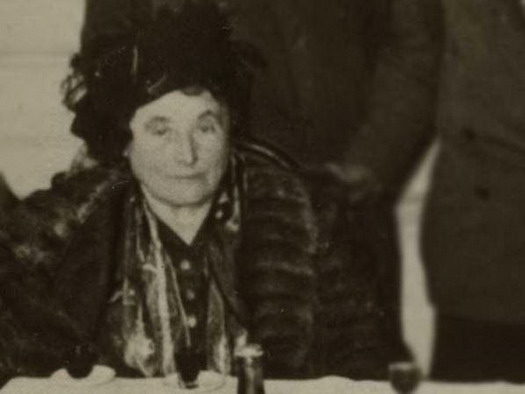
As yesterday (Thursday) was Vov Tishrei – the 62nd Yahrzeit of the Rebbe’s mother, Rebbetzin Chana, I decided to note part of her biography.
As always, your comments and feedback are greatly appreciated and most welcomed.
The story of her petira
Rebbetzin Chana was born on the 28th of Teves 5640 (1880), in the city of Nikolayev, Ukraine. Her father, Rav Meir Shlomo Yanofsky succeeded his maternal grandfather Rav Avrohom Dovid Lavut as the Rov of the city. Rav Avrohom Dovid’s eldest daughter Bella, married Rav Yisroel Aryeh Leib Yanovsky, but he passed away while his father-in-law was still alive, and Rav Avrohom Dovid requested that the city leaders appoint his grandson Rav Meir Shlomo as his successor.
In addition to Rebbetzin Chana, Rav Meir Shlomo and Rebbetzin Rochel, had three other children, Gittel, Ettel and Yisroel Aryeh Leib (who sadly passed away in his youth).
Growing up in the house of the Rov’s, she saw first-hand what communal work entailed and how her mother assisted her husband, the Rov, in many details and easing his burden by taking care of communal situations before they festered into becoming communal issues.
This influenced her, that she too decided to help others. But she was only a teenager, who assisted her parents in their activities, but what could she do on her own. She noticed that the chassidim would often come to her father, to borrow a copy of one of the Rebbe Rashab’s maamorim. She decided, being that she has a nice clear handwriting, that after a copy of a recent maamar would arrive from Lubavitch, she would write a copy of it, so that more chassidim can study it.
Later on during WWI when her husband was the Rov in Yekratinloslav, she spearheaded the relief effort of providing the Jewish refugees food, clothing and shelter. This included housing some of them in her own house.
It is also said that she was fluent in a few languages.
Around the time that she became twenty years old, the Rebbe Rashab proposed a shidduch between her and his cousin, HaRav Levi Yitzchok Schneerson. Their marriage took place in Yekaterinoslav, on the 11th of Sivan 5760 (1900). Sometime later, her younger sister Miriam Gittel married Rav Levi Yitzchok’s brother, HaRav Shmuel.
In 5687 (1927) HaRav Levi Yitzchok was appointed to become the Rov of Yekatrinoslav, however, being that it was a major Jewish city, with many factions, including a large percentage of anti-religious Jews, initially there was significant opposition to his appointment. Over the next year and a half or so, Rav Levi Yitzchok personally spoke to all of the groups, and his warm demeanor won them over. His official appointment was delayed for around two years. Subsequently there are conflicting dates as to when the family moved there.
They were blessed with three sons: the Rebbe, who was born a few months before their second anniversary, DovBer, who is known as Berel, and Yisroel Aryeh Leib, who is known as Leibel. Rebbetzin Chana often expressed her pride and happiness about her children saying, [people say] I have shaina Mehbul (beautiful furniture – meaning children). Meubul (when spelled in Yiddish) consists of the letters Mem (and an Ayin), Beis and Lamed, which are the first letters of the names of her three sons.
While much is talked about how HaRav Levi Yitzchok led the battle against the Communist regime after the Frierdiker Rebbe left Russia, which ultimately led up to his arrest etc., little is talked about the time and opportunity he had to leave Russia.
In 5699 (1939), he was offered the position of Chief Rabbi of Boston. It is said that they turned it down, because at that time their son Berel was hospitalized for long term care, and they didn’t want to leave him alone without any family visits etc.
Shortly after that he was arrested.
Just as her husband HaRav Levi Yitzchok wrote in detail how every aspect of his arrest, how many prisons he was in and for how long etc., were all an act of Hashem’s clear presence, Rebbetzin Chana once mentioned, that whatever happened between them and their son, the Rebbe, was not merely occurrences, but it was similar to what happened between Yaakov and Yosef.
One of the happenings she mentioned was that they were not present at the Rebbe’s wedding, (just as Yaakov was not present at Yosef’s). I will add that just as Yaakov and Yosef spent seventeen wonderful years together, (after Yaakov thinking that they will never meet again,) so too, Rebbetzin Chana’s final seventeen years were spent in the company of her son, who every afternoon/evening visited her, and for a period of time visited her in the morning as well.
Furthermore, just as Yaakov saw how Yosef was faithfully running the country on behalf of the king, so too, Rebbetzin Chana saw how her son was directing the activities of her mechutan, the (Frierdiker) Rebbe.
Rabbi Shmuel Lew relates that the last time he visited her was on Chof-Av 5724 (1964). As he and other were about to leave her apartment, she said, “[During my lifetime] I saw great people. My husband and father were nothing to be ashamed of, and many Rabbonim and great people came to visit and discuss things with them. But none of them are as great as my son. The greatest thing of him is, he carries his greatness with such simplicity.”
She then added, “I am not saying this merely because he is my son, but because this is the plain truth.”
Another important point to understand, is the tremendous respect that Rebbetzin Chana had for her son, the Rebbe.
Yje Alter Rebbe’s father Teb Boruch visited his son, and obviously the Alter Rebbe showed him the proper respect, such as standing up when he entered the room. However, Reb Boruch said, “How can I allow one, who the Shechina speaks through him, stand up for me?” So Reb Boruch left the town, never to visit his son again.
Rebbetzin Chana relished every moment she had together with her son. She looked forward to his daily visit etc., yet she set certain limits on the time and place of her interactions. She did not want to interfere with his holy schedule and work.
A Taste of Chassidus
האזינו השמים ואדברה Likkutei Torah p. 71C (142)
Our sages note that when the Jews requested from Hashem to be treated like rain, it was not the appropriate request. As Hashem replied, I will treat you like dew.
So in this maamar the Alter Rebbe is going to explain what rain and dew represent, and the major difference between them, thereby clarifying why Hashem replied to them that He would treat them like dew.
Rain comes from the moisture that rose from the earth and settled in the clouds. In other words it is a reaction of the clouds when they become over saturated, they send the water back down. While dew originates from heaven on its own.
In Chassidic terminology, this is the difference between isarusa dilitata and isarusa dilieila, when the initial step is done by those who are in this world or if the process is initiated by Hashem.
So in essence the Jewish people were saying to Hashem, depending on the level of our Teshuva, so should be your response. In other words, to them Teshuva is like every other mitzvah.
Our sages say that the 248 positive mitzvos correspond to the 248 limbs that are in a man’s body. Chassidus explains, just as each limb draws down a specific G-dly power to itself that is not appropriate for any other limb to receive, for example sight goes to the eyes, hearing goes to the ears, and speech goes to the mouth, etc., the same thing applies when a Jew fulfills any positive commandment, each fulfillment of a mitzvah causes a unique G-dly light to come down into this world. Additionally, even when Jews do the exact same Commandment, they could bring down different levels of G-dliness depending on the quality of their fulfillment of that mitzvah.
The same thing is when a Jew does Teshuva, depending on the quality of their Teshuva, that will make a difference of how much or what level of G-‘¾dliness comes down.
This is the inner meaning of the words that Hashem told Moshe, סלחתי כדבריך – I forgive the Jews as you said, meaning it is dependent and in accordance to the way you expressed your Teshuva.
However, the Jewish people failed to recognize that Teshuva is much greater than any other mitzvah, as the Alter Rebbe explained last week in Likkutei Torah, that when the possuk says, This mitzvah that I אנכי am commanding you, is referring to the mitzvah of Teshuva which is higher than all other mitzvos, and therefore the possuk states I am commanding you and not that Hashem is commanding you as it comes from a much higher level. This is because the word אנכי, is referring to Hashem’s essence, which is much higher than any name of Hashem.
To clearer understand what we mean when we say that the mitzvah of Teshuva is higher than every other mitzvah, we will first have to clarify what our sages meant when they said that Teshuva was created before the world was in existance. If Teshuva means as we commonly translated it as repentance, how can there be the concept of repentance before Man was created? Before Man was created it was not possible to do something wrong so how could we say regret and repent for the action that you did, if there was no man to do an action?
Chassidus explains that the true meaning of teshuva is to return to your G-dly source, as the Hebrew word of תשובה is ה תשוב – You should return to ה i.e. Your source. Hashems holy name of Yud, a Hei, a Vov, and another Hei, and the similar word Havayu are also the root for the Hebrew word Mihava which means to create.
Chassidus explains the reason this holy name is connected to the process of creation is because it symbolizes and describes how creation of the world and the creation of any concept comes into being. The first letter is a Yud, which is the smallest letter in the Aleph Beis, it’s just a DOT. That symbolizes a concept in the rarest form just the concept, the thought of something. The second letter is a Hei. The letter Hei has width, length and depth to it, meaning this initial concept is being expanded, it is being explained and the details are broken down into separate entities. The third letter is a Vov, which symbolizes that the Yud the initial concept which is the top of the Vov is being brought down into the world in a meaningful manner. While the final letter is a Hei, for the second time which again is an expression of expansion that is actually settling and finds its place in the world.
In Chassidic terminology the raw concept is referring to Chochma – wisdom, the first Hei is referring to Bina knowledge, the Vov is referring to the first six attributes which bring out the feelings that that wisdom and knowledge evoke, while the final Hei is represented by Malchus which is the action in this earth.
This concept helps us understand why our Sages say that Shabbos has the quality of Teshuva, and they point out that when one rearranges the three letters of שבת, you have the word תשב to return.
During the six days of Creation, Hashem brought out the concept of His desire that there would be a world which doesn’t automatically feel His aura and presence, yet those creations would declare Him as the Creator and their ruler/king. On Shabbos, being that all the work was completed before Shabbos, Hashem rested from the mode of work (the second Hei (malchus), the Vov (being drawn down by the six attributes), the first Hei (Bina)) and he returned not only to chochma – the original concept but even higher than that. So in essence Shabbos is the ultimate returning to your real essence, and that is what Teshuva is. The Alter Rebbe notes that Hashem gives us every day to have ” A Taste” of that aspect of Shabbos and that is when we daven Shemone Esreh, when a person detaches themselves from all worldly concerns and focuses on what is real, their connection to Hashem.
Yom Kippur which the possuk calls שבת שבתון, the Shabbos of all Shabbosim is even higher and compared to that lofty level where in comparison every Shabbos is compared or seen as a regular weekday.
Hashem in His tremendous kindness granted us the ability to have “A Taste” of Shabbos every day of the week, and that is when we daven Shemoneh Esreh and detach ourselves from our worldly worries and concerns and focus only on our connection to Hashem. So then also our worldy aspirations and thoughts are non-existant, just as Hashem rested from those thoughts on Shabbos.
Rabbi Avtzon is a veteran mechanech and the author of numerous books on the Rebbeiim and their chassidim. He is available to farbreng in your community and can be contacted at avtzonbooks@gmail.com.