

Denmark’s Mainland Gets High Holiday Services—and First Jewish Center in Decades
by Moshe New – chabad.org
Two weeks before Rosh Hashanah, Rabbi Levy Loewenthal drove out to Aarhus to scout a spot on the water for tashlich. He found a bench, a view of the harbor and a man in a hoodie sitting alone.
The man looked up. “Are you a Jew?” he asked the rabbi.
He was from Odesa, a refugee of the war in Ukraine, living in Aarhus with no idea that a rabbi—let alone a Chabad center—existed anywhere near him. “There are a lot more Jews here that I don’t know about,” Loewenthal tells Chabad.org.
Aarhus, Denmark’s second-largest city, is a Viking-founded port of some 350,000 people about three hours by train from Copenhagen that calls itself the “world’s smallest big city.” It is also the largest city on the Jutland peninsula, which juts north from Germany and makes up most of Denmark’s mainland.
Though Aarhus’s Jewish history goes back centuries—its Jewish cemetery dates to 1824—it has not had a synagogue or rabbi for many years. At the same time, aside from local Jewish families, Aarhus University brings in tens of thousands of students and no small number of Jewish faculty and researchers.
To meet the current needs, Rabbi Levy and Chana Loewenthal opened the doors of Chabad-Lubavitch of Jutland (Jylland) this past January, Aarhus’s first address for living Judaism in decades.

The First Aarhus Bar Mitzvah in 100 Years
Loewenthal grew up in Copenhagen, where his parents, Rabbi Yitzi and Rochel Loewenthal, have served as Chabad emissaries since 1996. As a child, the young rabbi remembers driving four hours each way to Silkeborg for chol hamoed Sukkot with his family to join the Jews in Denmark’s north.
When, in 2007, his parents ran Aarhus’s first public Passover Seder outside the capital, it became clear to them just how many Jews were scattered across the small Scandinavian country. By 2016, the younger Loewenthal, then a yeshivah student, was making the drive himself. He would organize the annual Passover Seder, eventually expanding into a yearly Chanukah party.

In 2020, he married Chana Shemtov, from Toledo, Ohio—whose parents run the Chabad House-Lubavitch of Greater Toledo—and the two decided to build their lives in Denmark. At first, their mandate was to service the young Jews in Copenhagen, as well as to continue Loewenthal’s previous work with the Jews of Denmark’s smaller cities. They landed in Copenhagen just after the pandemic, in the winter of 2021, making regular trips out to Aarhus for Jewish calendar events.
But driving back and forth to Aarhus every few weeks eventually became untenable for the young couple and their two young sons, Mendel, 4, and Mottel, 3. So in January of this year, they opened a permanent Chabad center in Aarhus. The first thing they did was hold a bar mitzvah for a local Jewish boy. According to the rabbi, this marked the first the city had seen, as far as anyone could recall, in a hundred years.

‘There’s a Place People Can Feel Jewish Locally’
Three weeks before Rosh Hashanah, the Loewenthals held a pre-holiday gathering replete with shofar, and a talk about the High Holidays; 30 people showed up. The rabbi then spent a few days going door to door meeting Jews. Word moved faster than he did. An American family who’d taken the High Holidays for granted back home found him and asked where they could go. People started stopping by Chabad just to pick up challah.
Rosh Hashanah itself drew 115 people over the course of the two days—60 for the Friday night minyan and meal and smaller group Shabbat morning. Then a minyan, shofar and a children’s program—that itself had 15 or 20 participants—on Sunday before more than 50 people sat down to lunch.
One man simply appeared on Friday night. That afternoon, he’d been listening to the radio when something in him insisted he needed to do something Jewish; he called a friend, learned Chabad had opened, and walked in. He came back Sunday with his family, and later wrote to the Loewenthals that it was exactly the Jewish boost they’d needed.
A 53-year-old Danish Jewish veteran called a few days before the holiday and asked if he could come pray. He opened a machzor for the first time in decades and it all came flooding back.
“It used to be that being a Jew in Denmark meant living in the big city of Copenhagen,” the rabbi says. “Now there’s a place where people can feel Jewish locally.” More than one person has told him the Chabad House already feels like a second home.

199 Antisemitic Incidents in 2025
The Jews Aarhus are a genuine mix: Danes who have lived there for generations, an international contingent drawn by the university, and Israelis, who by Loewenthal’s estimate make up about half the community. Conversation moves between Danish, Hebrew and English depending on who’s in the room.
Security must unfortunately be top of mind. According to the Danish Jewish Museum, Jews were the largest non-Christian minority in Denmark until the late 1960s. Yet in 2025 Denmark recorded 199 antisemitic incidents, marking a historic high for a third straight year, following a rise that began after Oct. 7, 2023. One man who joined Chabad of Aarhus’s email list three years ago told the rabbi he’d been “finished with religion” until Oct. 7 left him lying awake at night, worrying about family in Israel and asking himself why he felt so disconnected. He called Loewenthal and asked for a menorah and candles. He’s been a regular ever since.
“Growing up in Copenhagen, I understand the mentality, I speak the language, I feel at home here; and I understand what people are looking for,” the rabbi explains.
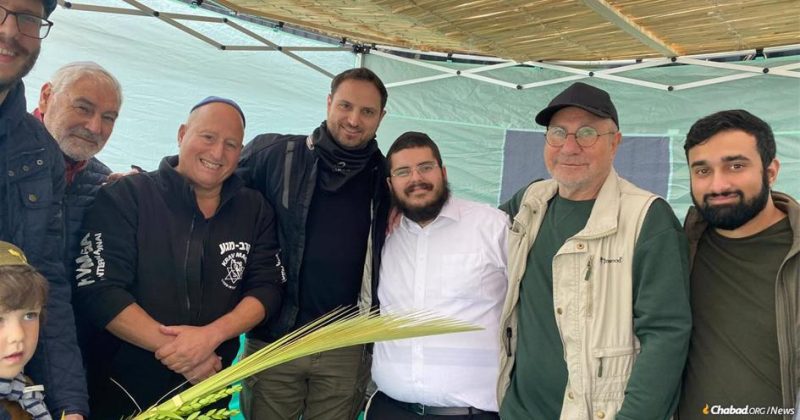
Next up for Chabad of Aarhus is Yom Kippur, followed by the 26-year-old tradition started by his parents of a Sukkah party in Silkeborg, about 30 miles west of Aarhus.
“It’s exciting, but I don’t think we’ve come close to meeting everyone who’s out here,” Loewenthal says. “This is only the beginning of what Jewish life in Aarhus is going to be.”