


Weekly Story: It Is Our Obligation
by Rabbi Sholom DovBer Avtzon
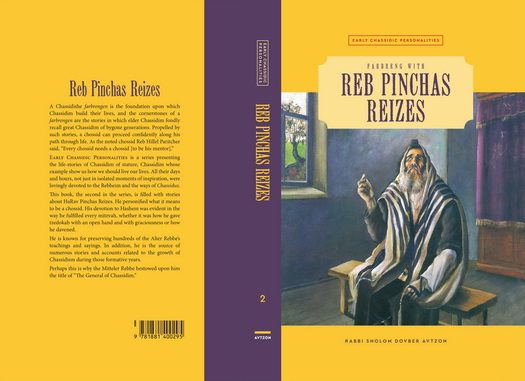
Recently I received the following message, concerning the translated edition of my book about Reb Pinchas Reizes into Russian. The message came from a principal who noted that the students discuss and sometimes vigorously debate the thoughts and lessons that I wrote as a takeaway and because of that the students often refer to the stories as pointers in their everyday conduct.
He concluded with his own takeaway from a specific story, and that is what I am sharing with you this week
As always, your feedback and comments are greatly appreciated and most welcomed.
The Story:
Once, when Reb Pinchas was walking alongside with the Alter Rebbe, a poor person approached him and asked for tzedakah. Reb Pinchas apologized, saying, “I am sorry, but at this moment I don’t have any money with me”
Reb Pinchas took the Rebbe’s admonishment to heart. From then on ologized, saying, “I am sorry, but at this moment I don’t have any money with me.”
The Alter Rebbe told Reb Pinchas, “It is not proper for a person like you to walk outside without any money. As you see right now, ” he continued, “had you had money with you, you certainly would have helped him generously. Because of your negligence, the poor received nothing and is still in dire need. From then on he always made sure to carry money with him.
I wrote my thought, on the point of being prepared, as like having a pair of tefillin always available. But I did not focus on the point that people are coming to you, since you are the wealthy individual.
He wrote, the lesson I took from that story is: When we meet another Jew, we must remember we are the wealthy one. Hashem blessed us that merited to learn from the Rebbeiim Chassidus Chabad.
We see that chassidim from all communities, chassidim who have learned Chassidus Chagas, have a thirst to understand Chassidus with a clarity that is only accessible to them through Chassidus Chabad.
So when another Jew meets us, he is asking and perhaps beseeching that we share with him a Torah, (teaching or thought) of the Rebbe or of one of the previous Rebbeiim.
When a person is anticipating to hear Chassidus Chabad, how disappointed would they be, if we reply I have nothing to share with you?!
This is what the Alter Rebbe said to Reb Pinchas, [the person came to you knowing you are the wealthy magnate. That person came thinking that you would definitely give him some money to revive his soul. Therefore,] it is not proper that you left your house, empty handed.
The same thing is with us, the entire Jewish world, thirsts to hear a teaching of the Rebbe.
As in the above story, the (Alter) Rebbe is telling each one of us, “It is not proper that you have nothing to say and satisfy that Jews’ thirst for a thought of Chassidus.
We normally refer to Chassidus as דא”ח, which is an acronym for, דברי אלקים חיים – the words of the Living G-d. However, I noticed in the Mitteler Rebbe’s Chassidus that he often refers to it simply as, דברי חיים – the words of life.
So how can we withhold “life” from another Jew.
To bring this point out in real time, I remember when I was learning in New Haven, fifty years ago, whenever we knew that the Rebbe would be farbrengening that Shabbos, Reb Josh Sandman a”h, arranged that we had a 12 or 15 passenger van to drive in on Friday.
One winter Motzei Shabbos, we decided on the way back to stop off in the newly opened yeshiva in Stamford.
The Litvishe Bochurim greeted us very warmly and brought out some mezones and additional food and drinks. They then demanded, not merely asked, that we review for them some thoughts that the Rebbe said in the farbrengen.
I believe this is what the Rebbe Maharash meant when he said, There are certain things that are appropriate for every chossid, and certain things that are inappropriate for every chossid, [I enumerated them in his biography pp……..]
It was always appropriate for a chossid to share what he saw or heard in Lubavitch with everyone on his way home. This was a takanah that the Mitteler Rebbe instituted. But then it was fellow chassidim who longed and thirsted for it. Nowadays, being that all Jews thirst for it, not only is it appropriate, but because of the mitzvah of Ahavas Yisroel it is our obligation.
A Taste of Chassidus,
ציון במשפט תפדה: Likutei Torah Devorim 1A
In order to explain the different meanings of Tzion and its captives and why Tzion’s redemption will be through Torah study, while its captives’ redemption would be through the fulfillment of mitzvos, the Alter Rebbe first explains a different concept, which is one of the fundamental aspects of the teachings of Chassidus. Namely, why or for what reason did Hashem cause our Neshama to descend into this physical world?
In this ma’amar, the Alter Rebbe explains that the question is not merely (as it is often presented), that our neshama originally stood in awe and total nullification to Hashem, as then it was up close and recognized Hashem’s greatness, and now that it is distanced from Hashem’s throne, and it can no longer automatically see from this vantage point, and therefore not only isn’t it in a state of awe, but furthermore, it faces the possible potential of rebelling against Him. Here he explains that the descent is much deeper than that.
Our sages teach us that before Hashem created the world, the Neshomos of all Jews existed. While there is a discussion about whether the angels were created on the second day of creation or the fifth.
One of the primary differences between something that was in existence before creation or came into existence as part of creation, is how it came into existence.
The possuk states clearly, that Hashem created everything through the power of speech. But being that the Neshomos were already in existence before creation, they were created through the power of Hashem’s thought, which is higher than speech. As speech reveal the perspn’s thoughts.
The proof to this is simple.
When each one of us wish to communicate our thoughts to someone else, we speak. In other words, we use the power of speech when we are dealing with another entity. However, when there is no one else to communicate with, we think, or simply said, we use the power of thought. Creation by definition means that now there is an additional and separate entity. And for a separate entity you must convey your thoughts through speech.
However, being that the Neshomos were in existence before creation, that means that they are not a separate entity, rather they are a part of Hashem. So, when one is alone the power of thought is used.
Subsequently, the question really is why did Hashem separate the Neshomos from being a part of Him, to be enclothed in a physical body that is not only distanced from Him but is separate and sometimes antagonistic and opposes Hashem?!
Regarding this, Chassidus answers that every descent is in order to ascend to higher than our original place.
The question then becomes, how can we become higher than being a part of Hashem?!
The answer can be understood by understanding another paradox; the combination of a Neshama with a physical body. We say in the beginning of Birchos Hashachar (the morning blessings), Hashem, the soul which You placed in my body is pure. So, if the Neshama is essentially spiritual and the body is essentially material, how can they coexist as one?
The explanation given is when, for example, the king’s two main advisors disagree in how or what is the best way to execute the kings wishes and therefore they can’t present the king with a plan. However, after the king listens to each one’s thoughts, and either chooses one over the other, combines them or presents his own plan, they make peace and work as one.
So, the way to bring two opposites together as one, is by utilizing a power that is greater or higher than those two factions.
The same thing is here: yes, the Neshama and body are polar opposites, but there is a higher level of G-dliness that has the power and ability to make it that they can and actually do coexist. That is the level of Soivev kol Almin, whereas the Neshama before creation was connected to the lower level of G-dliness, the level of Memaleh kol Almin.
In order to understand how a person can attain this higher level which by its own definition is above him and seemingly beyond his reach, we first have to clarify what is the difference between Memaleh and Soivev. Memaleh means the G-dly aspect fills the entity it is in, while Soivev means that the entity is not able to contain it.
In practical terms, Memaleh means that the thing that entered my life is tangible to me, I feel it in one way or another. I thoroughly understand the thought or concept you presented. I identified with my taste buds the various ingredients you placed in the food. In other words, I am able to relate to it in a meaningful way. However, Soivev is that you discussed a concept, that even if I repeat it verbatim, I really don’t understand the message that you are trying to convey. I see your art, but I don’t comprehend why people are raving about it. In other words, it doesn’t really connect with me. So, before creation, when the Neshama is part of Hashem, and is in a state of total self-nullification, that demonstrates that it felt a connection which caused it to self-nullify. That is the level of Memaleh.
But now, we are trying to attain the higher level, that of Soivev. That that too should be part of me that I can feel in a tangible way.
The question becomes, if it is intrinsically higher than me, how can I internalize it so that it becomes connected and part of me?
For example, Emunah, pure unadulterated faith is something that is above raw intellect. It is something we have but don’t really comprehend or feel.
To answer this, the Alter Rebbe explains the first few pesukim of Shema Yisroel.
Shema doesn’t just mean, listen, it also means pay thoughtful attention. Chassidus explains that the possuk of Shema is saying that Hashem is the only entity. So then comes the question, how is that possible when there is such a vast universe. And furthermore. If I don’t exist how can I have love for Hashem?
And the answer is given with the inserted possuk of Boruch Shem, that the entire universe was created by a sliver of Hashem’s Radiance, but not even by the Radiance itself but from the speech (as malchus[o] represents speech) that emanates from it.
So, when a person contemplates how they and everything in the entire universe is only connected to an offshoot of an offshoot of Hashem’s essence, the person is going to have a drive and desire, to become connected, not to that aspect of G-dliness that they were connected to until now, but to Hashem’s real essence, which is much higher.
But as stated above, how can a person connect himself to something that is beyond him? For example, is it possible for an eighth grader who is knowledgeable in whatever subject, to appreciate an advanced college lesson in that subject? Or a student who just began Mesivta, would he be able to follow the deliberations of Rabbonim discussing a difficult question in halachah? Obviously not, so how are we expected to unite with Soivev in a tangible way?
Therefore, after the possuk of ואהבת – And you shall love Hashem, the next possuk says “And these things that I am commanding you today”.
There is a major difference between an ability, talent and desire.
The power of sight is in the eyes, the power of smell in the nose, speech in the mouth, and walking in the feet. While the place of the person’s will/desire is in the neshama which is all over the body equally. Therefore, the moment one desires to twitch his nose, squint his eyes, move any limb of the body, it happens instantly. Because his will is throughout the entirety of his body.
In other words, a person’s will is his essence. Therefore, when a Jew fulfills a mitzvah of Hashem, he is connecting himself to Hashem’s will and essence.
[Chassidus explains that the word אנכי, “I” is referring to Hashem’s essence which is much higher than any of His holy names. And the possuk states that we were commanded to fulfill the mitzvos from אנכי.]
And that is the level of Soivev.
So specifically, and exclusively , only when the Neshama is in this world does it have the ability of becoming connected to Hashem’s essence, which is being described as the higher level of Soivev.
This opportunity was not given to our Neshama before creation, when it was connected to the lower level of G-dliness.
We can now understand the difference between Tzion and its captives, and why the redemption of each one is different.
Tzion refers to the essence of a Jew, or as it is commonly called, the Pintele Yid, which is not tangible or visible. That refers to the pure Emunah of a Jew which never strays from Hashem. However, there is a possibility that it is unable to express its tremendous love to Hashem. But then there is the way the person expresses himself [from the chitzoniyos of the heart], and instead of expressing its happiness with its connection to Hashem, it expresses its happiness with his material success.
Similarly, instead of expressing its bitterness on its distance and lack of appreciation of G-dliness, it expresses it over a lack of material satisfaction.
At that point no longer is it just not able to express itself, but its expression is in captivity, as it was conquered and utilized by its enemy for their own purposes.
So, to redeem the essence of the Neshama, that can be done by Torah, as Torah is light which illuminates its surroundings and once it clearly sees the greatness and beauty of G-dliness, it will no longer be tongue tied, and it will express its appreciation and happiness with being close to Hashem. However, if it was already captured, the way to free it, is through Tzedakah, acts of kindness and charity. For just as you had compassion for that person and free them from their “captivity”, so too will Hashem have compassion on you and free you from your predicament.
Rabbi Avtzon is a veteran mechanech and the author of numerous books on the Rebbei’im and their chassidim. He is available to farbreng in your community and can be contacted at avtzonbooks@gmail.com.











Tzedakah Request to JCM
Wouldn’t it be nice if the Jewish Children’s Museum, who received a $4.5 mil from NYS, gave 5 percent ($250k) of this gift back to NYS, and asked them to redirect it to OBH on the condition that said hospital repair the roof of the Kingsbrook Shul, which shul benefits the kinderlach.
https://crownheights.info/crown-heights-news/890181/jewish-childrens-museum-awarded-4-5-million-from-nys-grant/
Yochevet
Lesson of story: When a person has “assets” (midos, Torah, etc.), they shouldn’t be left at home or locked in a vault. The person must carry them with him and have them accessible..