

Here’s My Story: Warning! Your Blessing is Overdue
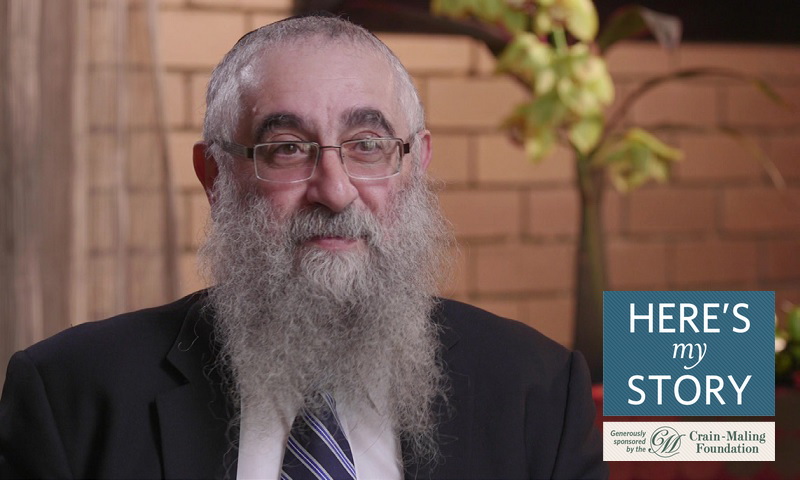
Mr. Avrohom Procel
Click here for a PDF version of this edition of Here’s My Story, or visit the My Encounter Blog.
I was born and raised in Melbourne, Australia, where my parents settled after World War Two. My father was a Holocaust survivor from Poland, while my mother emigrated from Egypt, which was then a British protectorate. Although both originally came from religious homes, they were not Torah observant, but they had strong Jewish identities.
In 1966, as my Bar Mitzvah drew near, they moved from West Preston, a predominantly non-Jewish suburb of Melbourne, to the more Jewish East St. Kilda. They did this just so that I could attend the Chabad school there and learn a little about Judaism. However, I took what I learned very seriously and, while this was not their intention, I ultimately became fully religious, as did the rest of my family.
After high school, I was accepted into the dentistry school at Melbourne University, but what I really wanted to do was study Torah at Chabad’s Yeshivah Gedolah. My parents were initially worried that I would squander a great opportunity for a higher education and a lucrative profession, but they agreed to a short deferment, and I got to learn Torah for one more year before going on to university. Incidentally, I never did become a dentist; instead, I became a fundraiser for the Yeshivah Gedolah. I like to joke that I do extractions of a different nature — pulling money out of people instead of teeth.
During the years that followed, I became a true Chabad chasid and I visited New York a number of times to see the Rebbe — I merited four private audiences with him between 1973 and 1980. But the story I’d like to relate here is what happened in 1983 while my wife, Gita, was pregnant with our second child.
Our first child, Yossi, had been delivered by C-section, what we call a Cesarean in Australia. Afterwards, the doctor told us that once you had a Cesarean, every subsequent delivery will have to be by Cesarean, which can only be done a maximum of four or five times.
Naturally, my wife and I were not happy about this news. We sought a second opinion from another obstetrician, who told us that this didn’t necessarily need to be the case. Natural delivery might be possible after all, depending on the circumstances.
When my wife became pregnant for the second time, the pregnancy proceeded normally. However, when she was ten days overdue, the doctor said that this situation could not continue. The baby was getting bigger, which meant that the chances of normal delivery were diminishing by the day. It was a Thursday, and he booked an operating room for a Cesarean on the following Tuesday.
That Thursday night, I called New York and spoke with the Rebbe’s secretary, Rabbi Binyomin Klein. I wanted him to ask the Rebbe two things — should my wife proceed with the Cesarean, and should I proceed with a tonsillectomy to remedy a recurring infection that was not responding to antibiotics.
The next day, Friday, I called Rabbi Klein again numerous times to see if there was an answer from the Rebbe. But the phone was constantly busy. I did not manage to get through until Sunday, when Rabbi Klein informed me that he had an answer from the Rebbe. The Rebbe gave us blessings but he had responded to my two questions in completely different ways. And as he often did, the Rebbe wrote in shorthand so Rabbi Klein needed to explain his words to me.
As far as the tonsillectomy, the Rebbe answered that we should act “according to the advice of the doctor.” As far as the Cesarean, the Rebbe answered, “meanwhile the Nine Days.”
We were about to start the “Nine Days” — the period of mourning for the destruction of Jerusalem which begins on the first day of the Hebrew month of Av, and which culminates on the ninth of Av — known as Tisha B’Av — the terrible date on the Jewish calendar when both the First Temple and Second Temple were destroyed by invaders. Rabbi Klein explained that the Rebbe meant that the “Nine Days” are not a good time for operations, so we should wait until they are over.
I called the doctor on Monday and informed him that I had consulted the Rebbe and he had advised to postpone the Cesarean. Both my wife and I agreed on this. Although we realized that we were putting both my wife’s life and our baby’s life on the line by listening to the Rebbe and not to the doctor, we trusted the Rebbe one hundred percent.
The doctor was very respectful of our decision, but he also said that if the baby goes into distress, it would not be possible to wait until after Tisha B’Av since, in any case, the birth was already almost three weeks overdue.
As it happened, our daughter, Rivki, was born totally naturally on the following Sunday, the seventh of Av, during the “Nine Days.” (In hindsight, I realized that the Rebbe’s words could also be understood as an allusion to this: There was no need for the Cesarean because the baby would be born meanwhile, during the “Nine Days”!)
Afterwards, the doctor said, “I want to tell you something which I didn’t tell you before. When your wife’s labor started last night, I was ninety percent sure we would be doing a Cesarean and I acted accordingly, but somehow things turned around overnight.”
The anesthetist told us something similar. He said our doctor had booked him in for the Cesarean, and then he was amazed to hear that the Cesarean had been canceled. He had never had anything like that happen before.
A few days later, I went to the hospital for my tonsillectomy.
Rivki grew up happy and healthy and is now a Rebbetzin, serving the community of Central Shule Chabad of Melbourne, alongside her husband, Rabbi Shmuel Karnowsky. As for my wife, in the years that followed — thanks to the Rebbe’s blessing — she delivered eight more children, all of them naturally.
Mr. Avrohom Procel serves as executive director of the Rabbinical College of Australia and New Zealand (Yeshivah Gedolah – Melbourne). He was interviewed in July 2016.