

Yeshiva L’Talmidim Hashluchim Launches to Anchor the Shlichus Year in Serious Learning and Mentorship
A talmid hashliach’s year is a busy one. He learns and farbrengs with the bochurim late into the night, runs programs and mivtzoim, and becomes the older brother a younger talmid turns to. Between it all, his own seder and growth are often the first to slip. Yeshiva L’Talmidim Hashluchim was created to change that, turning the year of shlichus into a transformative year of structured learning and growth.
That goal is not new. When the Rebbe began sending talmidim hashluchim, he was emphatic that they were going first and foremost as talmidim. In a letter from 5731, the Rebbe wrote that their purpose was to learn b’shkida v’hasmada and to serve as a living example to the bochurim around them.
The Rebbe guarded that learning closely. When the first group of talmidim hashluchim reached Australia in 5727 and a shliach proposed they give a weekly baalei batim shiur, the Rebbe refused in his own handwriting, permitting it only if it would not cut into their seder at all. Their own time to learn came first.
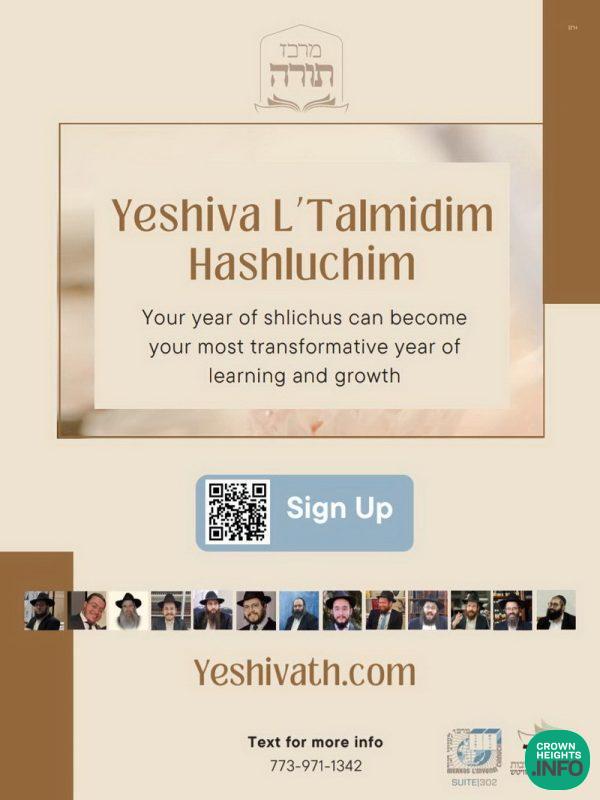
This Elul, Yeshiva L’Talmidim Hashluchim opens to give that principle a real structure. A new program from Merkos 302’s Merkos Torah, offers talmidim hashluchim a framework of serious learning, mentorship, and accountability across Gemara, Halacha, and Chassidus, so the year they give to others becomes a year of their own growth.
“The Rebbe sent talmidim hashluchim to be a role model, and a bochur learns the most from an older bochur who is himself invested in his own sedarim,” said Rabbi Mendy Kotlarsky, Executive Director of Merkos 302. “The yeshiva ensures that while these shluchim are giving everything to the bochurim around them, their own learning gets the same attention.”
The program grew out of conversations with yeshiva hanhalos, mashpiim, and talmidim hashluchim themselves, who kept naming the same gap: the shlichus year offers enormous opportunity, but few have a structured, measurable way to keep their own learning on track.
“We’ve put together a top-tier hanhala and built out a full curriculum across Gemara, Halacha, and Chassidus, with mentors who follow each talmid through the year,” said Rabbi Mendel Chaiton, director of Merkos Torah. “Everything is in place for these young men to have a serious, successful year of their own growth.”
Rather than imposing one model, Yeshiva L’Talmidim Hashluchim works in partnership with each yeshiva’s hanhalah, shaping the tracks and benchmarks together so the program fits the institution’s chinuch. Every participant starts with a personal intake interview that sets his goals and places him in the right track, then receives weekly follow-up, monthly progress reviews, and ongoing mentorship through the year.
The learning runs on three tracks. Gemara L’Iyun preserves serious iyun at a foundational or advanced level, with Rabbi Dov Popack and Rabbi Moshe Wolberg leading the shiurim and a weekly lomdus shiur from Rabbi Mendel Krasnjanski. The Halacha track takes participants through Hilchos Shabbos b’iyun, tracing each halacha from Gemara through Tur, Beis Yosef, and Shulchan Aruch to practical application, as the first stage of a longer semicha curriculum. Chassidus b’iyun anchors the week with structured study of foundational Chassidishe sugyos, shiurim, and farbrengens.
The program draws on a roster of well-respected mashpiim and rabbonim: Rabbi Yosef Klyne, Rabbi Osher Farkash, and Rabbi Yitzchok Kaufman in Chassidus; Rabbi Chaim Hillel Raskin, Rabbi Tuvia Kasimov, Rabbi Ehud Kvin, and Rabbi Berel Polityko in Halacha; with Rabbi Mendel Prescott on halacha from the sugya, alongside guest mashpiim and maggidei shiur.
For the rabbonim building it, the need is clear from both sides. Rabbi Shmuel Wagner, recently appointed Rosh Mesivta of the new Tomchei Temimim mesivta at Lubavitcher Yeshiva Ocean Parkway, helped develop the program and sits on its hanhala.
“As a mechanech, I see what a talmid hashliach gives our bochurim, and I see how much he can gain himself if someone helps him use the time right,” said Rabbi Wagner. “Building this means the talmidim hashluchim finish the year stronger in their own learning, not just busier.”
Through the year, each participant’s progress is shared with his yeshiva. A report also goes to the Rebbe, summing up the talmid’s learning and growth, framing the year’s work as something brought back to the one who first sent talmidim hashluchim out.
Registration is open now and closes Rosh Chodesh Elul. Talmidim and yeshivos can sign up or learn more at Yeshivath.com, or text 773-971-1342.
Download the Yeshiva brochure HERE
—-
Hanhala & Faculty:
Program Leadership:
- Rabbi Mendy Kotlarsky, Executive Director, Merkos 302
- Rabbi Mendel Chaiton, Menahel, Merkos Torah
- Rabbi Betzalel Bassman, Menahel, Yeshiva L’Talmidim Hashluchim
- Rabbi Shmuel Wagner, Program Development
- Rabbi Dov Popack, Curriculum Development
- Rabbi Levi Paltiel, Director, Kollel L’Lomdei Dach
Gemara L’Iyun:
- Rabbi Dov Popack, Foundational Track
- Rabbi Moshe Wolberg, Advanced Iyun Track
- Rabbi Mendel Krasnjanski, Lomdus Shiur
- Rabbi Mendel Prescott, Halacha from the Sugya
Halacha:
- Rabbi Chaim Hillel Raskin
- Rabbi Tuvia Kasimov
- Rabbi Ehud Kvin
- Rabbi Berel Polityko
Chassidus B’Iyun:
- Rabbi Yosef Klyne
- Rabbi Osher Farkash
- Rabbi Yitzchok Kaufman, also Dedicated Mentor and Shoel U’Meishiv
- Rabbi Levi Paltiel
Yeshiva L’Talmidim Hashluchim is a program of Merkos Torah from Merkos 302, in partnership with Igud Hamesivtos V’Yeshivos Lubavitch.