

When Science Catches Up to Torah: A Groundbreaking Conference on Spirituality and Mental Health
For decades, mental health treatment and religious life have run on parallel tracks; respectful of each other, perhaps, but rarely in conversation. A therapist might gently encourage davening; a rav might recommend a good therapist. But the idea that Torah, mitzvos, mussar, chassidus, and a relationship with Hashem could themselves be clinical tools? That was largely left out of the conversation.
That’s about to change.
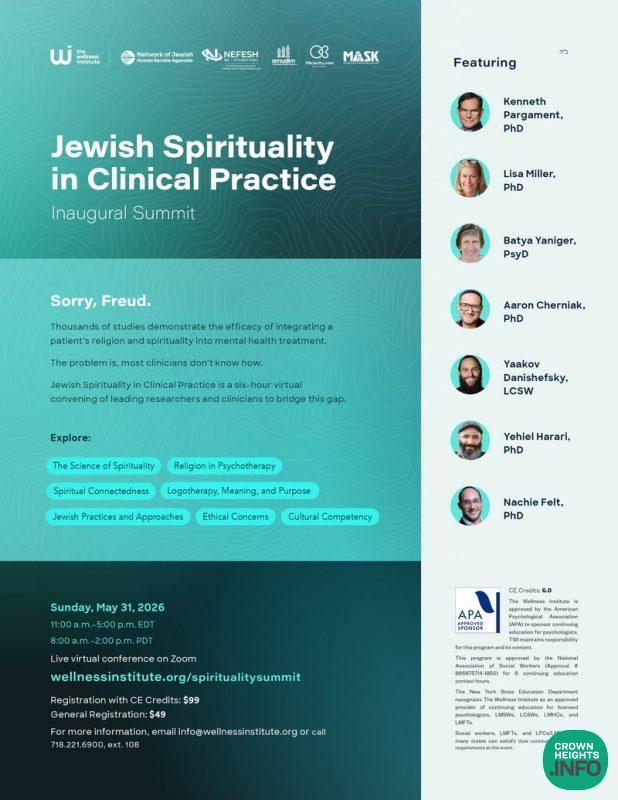
On Sunday, May 31, 2026, the Wellness Institute, a division of The Rohr Jewish Learning Institute (JLI), will host Jewish Spirituality in Clinical Practice, a six-hour virtual conference putting the science, the Torah, and the practical clinical wisdom in one Zoom room.
“Jewish clinicians intuitively sense that there is a connection between their yiddishkeit and their evidence-based clinical practice, but they are unsure about how to integrate these worlds professionally,” says Rabbi Zalman Abraham, director of The Wellness Institute. “Our goal with this conference is to, at the very least, demonstrate that it is possible. Ideally, we’re looking to create a movement.”
What the Research Says
The numbers coming out of mainstream academic research are staggering. People at high risk for depression who lead a religious life are 90% less likely to actually become depressed. After trauma, religious individuals are 76% less likely to develop major depression. Weekly shul attendance is linked to an 84% drop in suicide risk and a 50–70% reduction in “deaths of despair” from addiction, overdose, and suicide. Patients with strong internal religious motivation recover from depression up to twice as fast, and brain imaging shows that a spiritual life builds thicker, more depression-resilient cerebral cortices.
In short, science is catching up to what chassidim have always known. And the demand is there. Over 55% of psychotherapy patients wish their treatment included their spiritual lives. However, most clinicians were never trained to address it.
Closing the Gap
The program features two pioneers of the field as keynote speakers: Dr. Kenneth Pargament of Bowling Green University, widely considered the father of the psychology of religion, and Dr. Lisa Miller of Columbia University, the neuroscientist whose work proved that spirituality literally changes the brain.
“We can’t understand people fully or help them through the darkest times if we ignore the spiritual dimension of these crises,” Pargament has said.
They’re joined by some of the most respected voices in Jewish psychology today, including Rabbi Yakov Danishefsky, LCSW, author of Attached: Connecting to Our Creator; Dr. Yehiel Harari of Tel Aviv University; Dr. David Rosmarin, whose research has reshaped clinical work with the frum population; and a roster of presenters including Drs. Batya Yaniger, Nachi Felt, Aryeh Cherniak, Aryeh Lazar, and Rotem Regev, alongside therapists Levi Weinstein, Moshe Fordsham, and Joey Rosenfeld.
Sessions move from the science of spirituality into practical, sourced applications of Chassidus, Mussar, and specific mitzvos with documented mental health benefits; closing with a Q&A on bringing these tools into Monday morning’s caseload.
The conference is hosted in partnership with Nefesh International, Network of Jewish Human Service Agencies, OK Clarity, Amudim, MASK, and others. It’s built for both Jewish and non-Jewish clinicians, with six CE credits available.
The Details
Sunday, May 31, 2026 11:00 a.m. – 5:00 p.m. ET, Live on Zoom
Cost: $49 | $99 with CE credits | Scholarships available upon request
Register: wellnessinstitute.org/spiritualitysummit