
INBOX: When The Son Carries The Father With Him
Sometimes a child carries their father with them in ways nobody else can see.
In our parsha, Yosef is standing alone — alone in the kind of way that erases your upbringing. No safety net. No familiar structure. What once felt straight and clear is now foreign, distant, almost irrelevant. He’s about to slip when a vision of his father appears. Not a remembered halacha. Not a line from a sefer. Not even a memory of their studying Torah together. A presence. A relationship that didn’t get left behind even when he was thrown into a different world.
I keep thinking about that as we start Tanya again. The Alter Rebbe opens — right in perek bais — with a simple, disarming truth: we are children, and Hashem is our Father. Not metaphorical in a poetic sense, but as the actual architecture of the soul. Which means: the way we relate to Him is shaped by the way we learned to relate to “fatherhood,” and to our own parents, in the first place.
And suddenly it becomes personal.
How I interact with my children — the kind of father I manage to be — directly colors how they will understand their Father in Heaven.
And that thought moves me right into the Chanukah story.
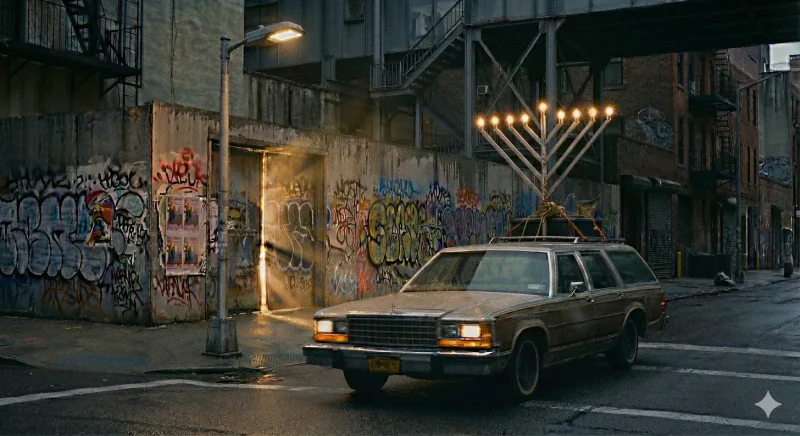
A desecrated Temple. Stones overturned. Innocence vandalized. A world where purity feels almost imaginary. But the Jews didn’t accept that. They searched — through cracks, beneath rubble, in places no rational adult would expect anything unbroken or undefiled to remain. And somehow, against all odds, they found a drop of undisturbed oil.
Maybe the miracle wasn’t the eight days.
Maybe the miracle was that they believed such purity could still exist.
Maybe the miracle was that they kept searching.
Yosef in Egypt. Tanya’s opening metaphor. A tiny flask buried in ruins. Somehow they all braid into the same quiet truth:
A child’s sense of God often begins with their sense of us.
If a father is harsh, brittle, impossible to please…
then G-d becomes someone who waits in the shadows with a measuring stick.
If a mother is anxious, unpredictable, quick to anger…
then Heaven becomes a place where love has conditions.
Children build their understanding of Him on the emotional bond we hand them.
We teach them — long before words — what “Father” means.
And that’s why Chanukah’s relentless search for purity hits so deeply.
As parents, we are asked to search under rubble too — the rubble of moods, misbehavior, slammed doors, confusion, fear. To believe there is something unbroken beneath it all. To keep looking for the pure, innocent drop inside a child even when the outer world feels like ruins. Even when the outer world has already written them into the dustbin of irrelevance.
Because Hashem looks at us that way.
That’s the model.
That’s the Father the Alter Rebbe describes in Tanya.
And if we can parent with that same unreasonable faith — that quiet insistence that something inside them is still intact — then maybe, someday, when our children try to understand who Hashem is, in the depths of their own struggles and vulnerability… they’ll let us in too.
They’ll make room for our bond shine.
A father whose presence shows up when it matters.
A mother who refuses to stop searching.
A paren
t who believes in them even when they’re standing in their own ruins.
And if we give them that miracle, their light — hesitant at first, then steady — will brighten their lives, ours, and whatever worlds they go on to build.