

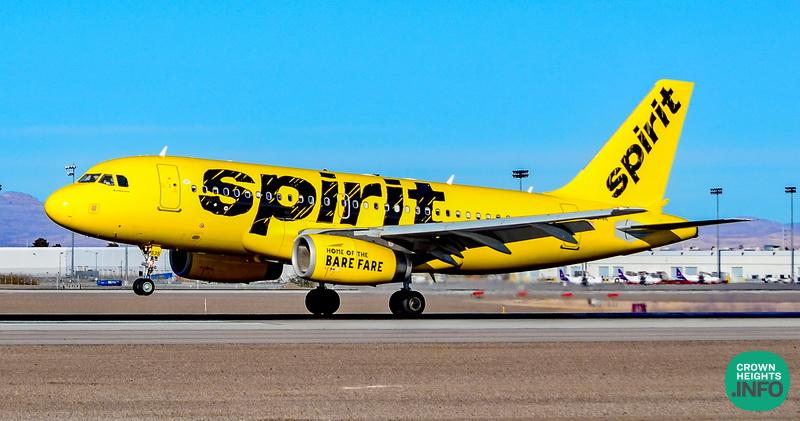
Spirit Airlines Shuts Down, Ending an Era of Bare-Bones Flying
by CrownHeights.info
By any measure, the fall of Spirit Airlines was abrupt. Just after midnight on Saturday, the airline’s final flight touched down, and within hours, a carrier that had helped redefine low-cost travel in America for more than three decades ceased operations entirely—stranding passengers, idling thousands of workers and reshaping the economics of budget air travel overnight.
The shutdown followed months of mounting financial distress, culminating in the collapse of a last-ditch $500 million federal bailout effort. Without new capital, executives said, the airline had no viable path forward.
For travelers, the effects were immediate and chaotic. Hundreds of flights were canceled, leaving passengers scrambling for alternatives at airports across the country. Many found themselves navigating rebooking lines and last-minute fares that surged as demand spiked.
Federal officials moved quickly to contain the fallout. Transportation Secretary Sean Duffy announced emergency measures, including coordination with rival airlines to cap fares and accommodate stranded passengers. Carriers such as American, Delta, United and Southwest began offering discounted “rescue fares,” while some extended assistance to displaced employees as well.
Still, the collapse leaves a deeper void in the aviation landscape.
Founded in the early 1990s, Spirit built its identity around a stark proposition: ultra-low base fares paired with à la carte fees for nearly every additional service. The model attracted millions of cost-conscious travelers and forced larger airlines to introduce competing “basic economy” options.
But the same model proved vulnerable in a changing market.
In recent years, rising labor costs, intensifying competition and volatile fuel prices eroded Spirit’s thin margins. The airline filed for bankruptcy twice between 2024 and 2026, and its efforts to stabilize—including a pivot toward more premium offerings—failed to reverse its fortunes.
External pressures compounded those challenges. A sharp increase in jet fuel prices tied to geopolitical tensions, including conflict involving Iran, dealt a final blow to an already fragile balance sheet.
Equally consequential was a failed merger with JetBlue, blocked by federal regulators on antitrust grounds in 2024. Critics now argue that decision deprived Spirit of a lifeline; others contend the airline’s problems ran far deeper than any single deal.
The human toll is substantial. Roughly 17,000 employees—from pilots and flight attendants to ground crews—now face uncertain futures.
Some competing airlines have signaled willingness to hire displaced workers, but labor groups warn that transitions will not be seamless. In the meantime, Spirit’s workforce joins a growing list of aviation employees affected by post-pandemic industry restructuring.
Passengers, too, face lingering uncertainty. While the airline has promised refunds—particularly for tickets purchased by credit card—those who paid through other means may have to seek compensation through bankruptcy proceedings.
Beyond the immediate disruption, Spirit’s disappearance is expected to reverberate across the airline industry.
For years, the carrier exerted downward pressure on fares, particularly on leisure-heavy routes to Florida, Las Vegas and the Caribbean. Analysts now warn that, with one of the nation’s largest ultra-low-cost competitors gone, ticket prices could rise as competition diminishes.
The shutdown also marks a symbolic turning point. Spirit was among the most visible proponents of no-frills flying—a model that democratized air travel even as it drew criticism for its fees and spartan service.
Its bright yellow planes, once ubiquitous at major airports, have now vanished from the skies.
In their absence, the question facing the industry is not just who will fill the routes Spirit once flew, but whether the era it helped define—of rock-bottom fares and unbundled travel—can endure without one of its most aggressive champions.












Baruch hashem
Some good news in the world. All crappy companies deserve to be permanently shut down and all good companies deserve to thrive and be successful