


Son of a Nazi Returns Desecrated Torah to Its Community
by Motti Wilhelm – chabad.org
As a Chabad representative in Munich, Germany, Rabbi Yochanan Gordon is accustomed to receiving all sorts of questions and inquiries, some more unusual than others. But when his father-in-law, Rabbi Yisroel Diskin, director of Chabad of Munich, forwarded him an email, it piqued his curiosity.
The email came from a German doctor who had contacted the Chabad House through its website. He wrote about a painting he had inherited after his parents’ passing with some mysterious writing he had discovered on the back.
“These texts are on the back of a portrait of my mother,” the doctor wrote. “I only recently discovered that the writing was Hebrew when the portrait came into my possession. My father brought the portrait home from Babruysk, where he worked as a clerk at Field Command 581 from August 1941 until August 1943. As I remember, he told the family that a Russian prisoner had painted the portrait.”
Intrigued, Rabbi Gordon contacted the doctor and arranged to meet him the following morning to examine the painting in person. When he saw the writing on the back, he was stunned.
The text was unmistakably from a Torah scroll, handwritten in the traditional script on parchment. The parchment had been cut from the scroll and desecrated, serving as the canvas on which the portrait was painted.
According to the doctor, his father had served in the Nazi army during World War II and had been stationed in Babruysk, in today’s Belarus, in the former Soviet Union. He was quick to clarify that his father had not participated in the murder of Jews, but had served only as a clerk.

Alongside their systematic murder of millions of Jews, the Nazis sought to destroy Jewish religious and cultural life. They burned and desecrated synagogues, holy books and ritual objects, often deliberately defiling Torah scrolls, Judaism’s most sacred religious objects.
One way the Nazis desecrated Torah scrolls was by cutting up the parchment and repurposing it for everyday use. Torah parchment was used to make shoes, wallets and other objects. Some of these items were recovered after the war and are now displayed in Holocaust museums; others were buried in accordance with halachah, Jewish law. Countless other fragments remain scattered throughout Europe, often in places where no one would think to look.
While stationed in Babruysk, the German soldier encountered a Russian prisoner who was a professional painter and commissioned him to paint a portrait of his wife back home. The exact circumstances remain unknown, including whether the parchment was deliberately cut from a Torah scroll for this purpose or was one of the fragments already lying around. Either way, a piece of a Sefer Torah became the canvas for the portrait.
When the German doctor inherited the portrait, he noticed what appeared to be some sort of calligraphy on the back, but had no idea what it was. Only recently, after taking a photograph and conducting an online search, did he discover that it was Hebrew and learn what he had in his possession.
The doctor decided that he wanted to right the wrong as best he could by returning the Torah fragment to the Jewish community in Babruysk. He was advised to contact his local Chabad center, which led him to Chabad of Munich.
When the doctor met with Rabbi Gordon and recounted the story, he broke down in tears, expressing his sorrow over what had happened. The rabbi immediately reassured him that he would help ensure the Torah fragment was returned to its rightful place.
Gordon was familiar with Babruysk; his own great-grandfather, Rabbi Eliyahu Simpson, was a native of the city. Although he did not personally know the current Chabad rabbi there, he was sure he’d be able to make a connection.
Gordon searched Chabad.org’s ‘Chabad Locator’ directory for the Chabad representative in Babruysk and made contact with Rabbi Shaul Hababo, who has served the community since 2010.
As it happened, both rabbis were planning to travel to New York that week for the International Conference of Chabad-Lubavitch Emissaries, the Kinus HaShluchim, which took place this past weekend.
“Chabad emissaries around the world are on a mission to uncover hidden sparks of holiness,” Gordon told Chabad.org. “More often, those sparks are found in Jewish souls. This time, it was a spark of holiness in the words of the Torah, hidden ignominiously behind a painting for more than 80 years, until finally finding its way back home.”
While in New York, Gordon also consulted a rabbinic authority about the proper treatment of the fragment.

A Stark Contrast
According to Jewish law, a Torah scroll possesses a high degree of sanctity and must be treated with the utmost respect. Even when it is no longer fit for use, it cannot simply be discarded but must be buried in an earthenware container in a Jewish cemetery. Even a fragment such as this, which had been desecrated and repurposed, retains its sanctity.
The rabbinic authority directed Gordon to a responsum by Rabbi Moshe Feinstein, one of the foremost halachic authorities of the past generation, who had addressed a remarkably similar question.
He had been consulted about fragments of Torah scrolls desecrated by the Nazis and whether they could be displayed in Holocaust museums rather than buried. He ruled that when the purpose of displaying such objects is to demonstrate the horrors perpetrated by the Nazis, and to show the stark contrast between their treatment of Torah scrolls and the reverence with which Jews regard them, the display itself can be considered an expression of respect for the Torah and may therefore be permitted.

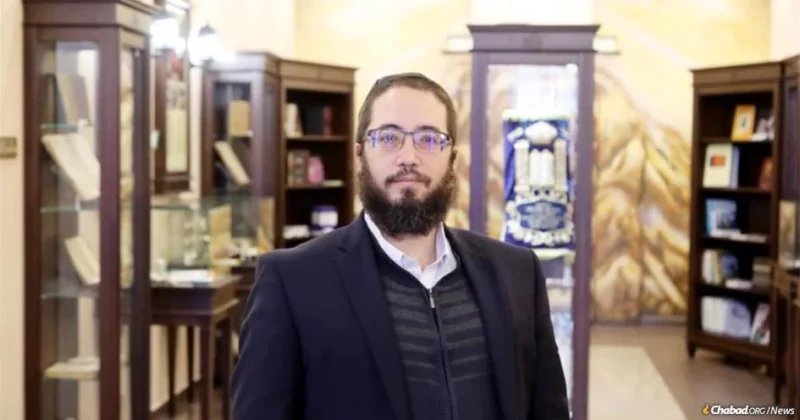
With this halachic ruling in hand, it was decided that the fragment would be displayed at the Jewish Spiritual Center of Belarus, a museum housed in the historic Babruysk Synagogue and directed by Hababo. It would be placed alongside a complete Torah scroll that had been rescued from the Nazis and was already on display.
There, thousands of museum visitors would be able to see the two side by side—a stark contrast between the Nazis’ desecration of the Torah and the reverence with which the Jewish people regard it.
With the arrangements in place, Gordon and Hababo met on the sidelines of the Kinus, where Rabbi Gordon handed over the sacred parchment for its return to Babruysk, the very city from which it had been taken more than 80 years earlier.
“It seems that Heaven had decided the time had come for this holy object to return home,” said Hababo. “G‑d willing, in its new home at the museum, it will inspire visitors and awaken Jewish hearts, once again fulfilling its sacred purpose.”









Gil
It should be noted that the ksav in this sefer is Arizal. It is therefore likely that this sefer was used in a chasidishe shul.
May this be a blessing and an elevation for their souls and may we be reunited with them with coming of moshiach and tchiyas hameisim Amen.