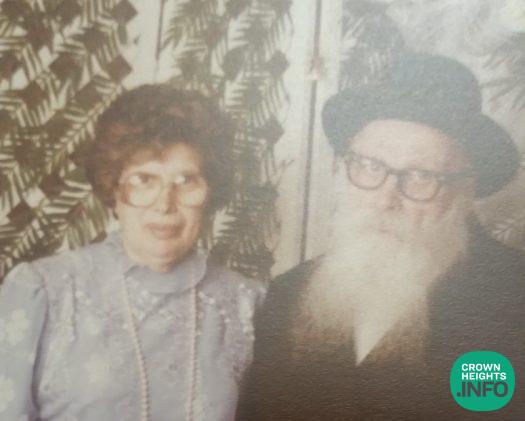
Weekly Story: 8 A Tribute to my Father – Harav Meir Avtzon
by Rabbi Sholom DovBer Avtzon
As this Monday, erev Rosh Chodesh Kislev is my father’s 25th yahrzeit, I will begin with a tribute to him.
As always, your feedback and comments are greatly appreciated and most welcome.
At the beginning of this week, a former student met me and said, “By the Shabbos table I mentioned that when I was in 7th grade, the yeshiva was going through very difficult times, financially and they weren’t paying the teachers.
After a few months, the teachers decided to publicize their situation and decided to go on strike. So all the classes were closed and the students remained home.
However, my teacher, and I said your name told us, that while the building would not be opened, however, he will be teaching all of us that will come to the shul where he davens (Empire Shtiebel).
He explained, that when his father lived in Russia, he put his life in danger, in order to keep Tomchei Tmimim, the Rebbe’s yeshiva open, although they had to be in secret.
Hundreds of chassidim were arrested and many of them were exiled or killed.
So if my father put his life in danger to keep the Rebbe’s yeshiva open, how can I close the yeshiva? Therefore, I am asking you boys to daven Shacharis and eat breakfast at home, and we will begin classes at 10.”
He then said to me, my ten year old son, was very inspired by you taking such a stance, because of what your father did in Russia, around fifty years earlier. It made an impression on him that even nowadays, we can face situations that demand of us to stand firm.
My take away from this is, if that ten year old boy was inspired by the actions of someone else, how much more woukd it be meaningful and inspiring if children would hear about the selfless dedication of their own family members and ancestors!
Being that this week is the international Kinus Hashluchim, I would like to connect this tribute to the concept of Shlichus.
My parents came to America at the end of 1953. As they came via the auspices of HIAS, HIAS told them that they have a position of employment for my father either in Philadelphia or Detroit, and that is their decision.
My father wrote to the Rebbe saying, if he was able to outsmart the dreaded K.G.B. who were actively searching for him, he is sure that the American government won’t care if the family would settle in Brooklyn.
The Rebbe responded that Hashem guides the footsteps of a person and he should go where Hashgacha Elyona guides him. Therefore, the Rebbe continued, presently the chinuch and environment in Detroit is better than it is in Philadelphia, therefore, I would advise you to accept the position in Detroit.
Now my parents were not the only Anash that were assisted by HIAS to resettle in America. Yet they were of the very few that the Rebbe never allowed to move to New York.
Then almost immediately after they settled in Detroit the Rebbe began instructing them to do certain peulos.
On one hand, my parents didn’t have the title of Shliach, rather the Rebbe wrote on some letters to my father the title of Shadar. Additionally, the letters [telegrams] that the Rebbe sent to various communities as well as the shmura matza were sent to him.
Furthermore, the Rebbe once said to the shluchos of Detroit that their letter is to be given to him by the head shlucha, and that is Mrs./Rebbetzin Avtzon/Gasthalter.
So on one hand the Rebbe didn’t actually send them to that city, it just worked out that they ended up there, yet on the other hand, being that they created a Jewish atmosphere they are the shluchim.
[I wonder if this is how it was with others as well, those who settled in various cities, countries on their own, but did whatever the Rebbe wanted, how did the Rebbe refer to them?]
But the point is whatever we are, we all have the responsibility to involve ourselves in the shlichus and mission of the Rebbe, of reaching out to another Jew, perhaps or maybe especially to even your neighbor or former classmates or students and bring them closer to Torah and Mitzvos.
Taste of Chassidus
יפה שעה אחת Torah Ohr (Bereishis P. 16A
Our sages tell us, that one moment of Teshuva and good deeds in this world is worth more (is more beneficial) than the entire world to come. The question is, one of the outcomes of doing a mitzvah is that they create garments which enable us to receive the reward that Hashem will bestow upon us in Gan Eden and the world to come.
So how could Teshuva and good deeds be more worthy or more important than the reward that we will receive once they are done? To explain this clearer, if someone invests time and energy to accomplish something, will one say to that individual, the time you spend on this project was worth much more than what you received in return?! No one invests ten thousand to end up with nine thousand.
On the words of the possuk ואברהם זקן בא בימים, and אברהם was old and he came in his days. The Zohar says he came with the garments that the mitzvahs which he did every day created. The Zohar continues, that it is a pity on the person who is missing their garments in the world to come [in Gan Eden] and subsequently won’t be able to receive their reward.
So we have to understand, how do the garments work, that through them we could receive the reward we earned and without them we cannot receive the reward?
We say the world is full of Hashem’s glory, and we also say I fill the heavens and earth. Hashem’s essence is so powerful, and therefore it is too difficult to for a human or any Creation to contain it. Just as for example it is impossible for any person to stare directly into the sun itself. However, if one is wearing sunglasses, than they can look at the rays without difficulty.
This is the function of all of the garments. They enable us to receive the reward which in Gan Eden, is basking in Hashem’s glory, and in the world to come to see Hashem’s essence itself.
In the human body, we see that our limbs can do various functions, so we see the power and ability of the soul (neshoma), but not its essence. But in the world to come, Hashem’s essence would be revealed.
So the question becomes, how can a human body and even the Neshomah that enclothed itself in a limited body be able to receive Hashem’s essence?
But that is accomplished through the garments that we create through the fulfilling of a mitzva. Being that every Mitzvah is Hashem’s will (essence), so when we fulfill His will, we become connected to it. So while we are not receptacles to contain or even receive His essence, but the mitzvos that emanate from Him, are proper receptacles to receive them,
So while the reward of basking in Hahem’s glory in Gan Eden is tremendous, but then the person is only basking in Hahem’s glory. However, when one fulfills a mitzvah or does Teshuvah, they are becoming connected to Hashem’s essence which is higher than His glory. Subsequently we can say that Teshuva and good deeds have a tremendous quality over the happiness one receives from basking in Hashem’s glory, as now you are being connected to His essence
The problem is that a person in this world is not perfect, and they may have acted improperly; so such a person says, in my state, how can I become connected not only to Hashem’d glory but to His essence?!
On this the Alter Rebbe directs us to pay attention to davening and especially to Shema. Throughout davening we state how the world is truly nullified to Hashem. Then at the end of Shema, we note that Hashem took us out of Mitzrayim.
The word Mitzrayim has the same Hebrew letters as Meitzurim which means limitations. And the possuk states that it is Hashem who takes us out of the confinement of our limitations. Then our Neshoma can shine without being held back by the body and we will love Hashem completely and fulfill His mitzvos, learn His Torah, and through them be connected To Hashem’s essence.
Rabbi Avtzon is a veteran mechanech and the author of numerous books on the Rebbeim and their chassidim. He is available to farbreng in your community and can be contacted at avtzonbooks@gmail.com.