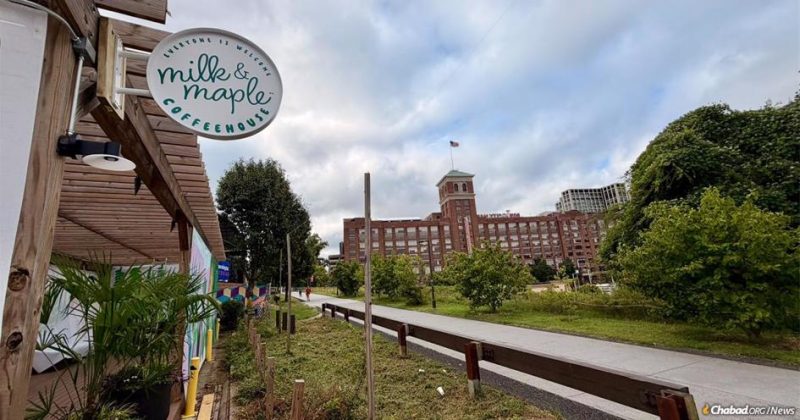
On Atlanta’s BeltLine, a Kosher Coffeehouse Is Brewing Jewish Connection
by Yisrael Eliashiv – chabad.org
On a busy weekend afternoon, thousands of people pour through the Eastside Trail of Atlanta’s BeltLine, a decommissioned railway line that now serves as a wide pedestrian corridor for three miles through the city. They go past the former rail line, murals, breweries and rooftop bars, on their way between Piedmont Park and the crowds at Ponce City Market.
Just across from the market, they also pass a Chabad-Lubavitch center with an outdoor ordering window and a deck four feet from the path. From the trail, says Rabbi Eliyahu Schusterman, director of Chabad Intown, it’s 20 steps to the door of the new Milk & Maple Coffeehouse.
The cafe on the center’s ground floor looks like any other stop along the trail. Everything on the menu, however, is kosher, down to the chalav Yisrael dairy and pat Yisrael baked goods.
Operating under the supervision of the Atlanta Kashruth Commission, Milk & Maple soft-opened in mid-October, ahead of a grand opening set for Sunday, Nov. 1.
Jewish visitors have wandered in looking for coffee or a place to work, Schusterman says, with no idea the space was kosher. Some left with more than they came for.
“We’ve already had people who’ve signed up for our programs because they’ve seen them advertised on the walls or the doors of the café,” he says.
The Eastside Trail was the first completed stretch of what will eventually be a 22-mile loop around the city, linking 45 neighborhoods. It drew more than 2 million visitors in 2023 alone. Schusterman, who founded Chabad Intown with his wife, Dena, in 1997, saw its potential early, and in 2018 the center moved into a 21,000-square-foot building directly on the trail.
“People scooter and bike, run and they walk, so there’s all kinds of energy that goes on on the BeltLine,” he says. “There’s always people coming in and out.”

Eight Years in the Making
In the summer of 1975, the Rebbe, Rabbi Menachem M. Schneerson, of righteous memory, launched a campaign encouraging Jews to keep kosher homes and eat kosher food. Citing the teaching in Tanya that what a person eats affects them physically and spiritually, the Rebbe explained that nonkosher food can cloud the natural purity a person is born with.
Milk & Maple pairs kosher food of the highest standard with a relaxed setting built to appeal to anyone walking by.
“The primary objective was to engage people,” Schusterman says. “We simply wanted to get people through the door.”
Chabad Intown went under contract on its BeltLine property in 2017, and plans for a food business took shape soon afterward. Early proposals involved Israeli-style restaurants run by outside operators, but the pandemic struck and plans went on hold for two years.
A later prospective operator wanted to open a coffeehouse but backed out, unwilling to close on Shabbat and lose a large share of weekend business.
“So at that point, we said, ‘You know, let’s just do it ourselves.’”

The Schustermans’ daughter, Mira Levy, drew up the initial menu, sales projections and design. The Schustermans and their son-in-law, Berri Dworcan, carried the project forward.
Coffee was a deliberate choice. Restaurant customers tend to eat and leave, Schusterman explains, while coffee drinkers linger. Creating products meeting the café’s chalav Yisrael and pat Yisrael standards were harder to arrange.
“The biggest obstacle was getting kosher food here in Atlanta,” says Dworcan, Milk & Maple’s launch manager. “There’s not a big kosher scene here, so we had to source a lot from outside Georgia.”
Even so, Dworcan didn’t want customers to feel they were sacrificing quality or paying more to eat kosher.
“I wanted a cup of coffee that could compete with any other coffee shop in the area,” he says, “and pricing that’s the same as non-kosher places.”

Tefillin, Candles and Classes
For Dworcan, a Montreal native, the café began as a business challenge. A conversation this summer changed that.
While visiting family in Montreal, he stopped at a newly launched kosher coffeehouse connected to Chabad of Westmount and spoke with the emissary behind it. The rabbi told him he had many initial expectations for the establishment. Over time, he came to see that serving kosher food was an accomplishment in its own right, even when it didn’t necessarily lead to more Jewish practice right away.
Dworcan began to see Milk & Maple the same way.
“Even if people don’t come in and put on tefillin or sign up for classes, there’s still something happening every day: people are choosing to eat kosher, people are choosing to make blessings. It’s amazing,” he says.
Not to say the cafe’s tefillin stand isn’t seeing activity. Dworcan says a few customers have already spotted it, mentioned they hadn’t put on tefillin yet that day, and done so without anyone asking.
Schusterman is planning ways to encourage Jewish women and girls to light Shabbat candles, and to share the Seven Noahide Laws with non-Jewish visitors. Flyers for courses and other Chabad programs line the space.
Some customers will put on tefillin, begin lighting Shabbat candles or sign up for a class. Others will order their coffee and leave. Either way, the mitzvah has already happened.