
Here’s My Story: My Mother’s Whisper
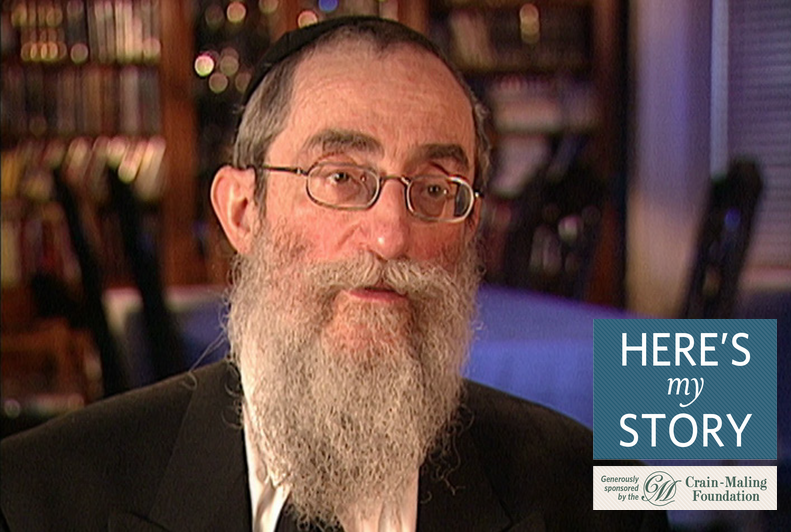
Rabbi Shmuel Lew
Click here for a PDF version of this edition of Here’s My Story, or visit the My Encounter Blog.
It was during a private audience with the Rebbe in 1963, when I was a young yeshivah student, that he asked me about my mother. I was there for my birthday — the practice at that time was that one was able to have an annual audience with the Rebbe for that occasion — but my mother had also been to the Rebbe just five weeks before for another reason: My grandmother was moving to Israel at the time, and shortly before making the trip, she, my mother, and my sister all came to see the Rebbe.
“Why does your mother look unwell?” the Rebbe asked me. “She looks oisgedart” — gaunt, thin. “What’s the reason?”
I had no idea. “I don’t know; maybe she’s on a diet?” I speculated.
“Tell her in my name that she has to look after her health better.”
By the time I came back home to Williamsburg that evening, it must have been around midnight, but my parents were still awake. They wanted to hear what had happened with the Rebbe.
When I delivered the Rebbe’s message, my father was surprised. He hadn’t noticed anything wrong with my mother.
But then my mother whispered, almost to herself, but loud enough for us to hear: “I see he knows what nobody knows.”
It turned out that my mother had recently learned that she had developed diabetes, but had kept the diagnosis to herself. She was already feeling its effects, and unfortunately her condition would have a serious impact on her overall health. A year later, at the age of 58, she had a heart attack and passed away suddenly.
I find it remarkable that the Rebbe paid such close attention to the people who came to see him. My mother hadn’t said anything about her condition, and she was there in the room as part of a small group, and only for five or ten minutes. Yet somehow, the Rebbe had noticed what her own family did not. And he remembered to bring it up a few weeks later.
He would display the same level of deep concern a few years later — this time towards me.
It was the summer of 1976, and I was living with my wife and children in London, where we served as emissaries of the Rebbe, when I contracted meningitis. I ended up spending a few weeks in the hospital, throughout which the Rebbe took a close interest in my condition. His secretary, Rabbi Binyomin Klein, asked my wife to call him with a report every day: “Whenever I go to the Rebbe,” Rabbi Klein said, “he asks me, ‘What do you hear from London?’ I have to know what to answer the Rebbe!”
Making an international call was quite expensive in those days, so Rabbi Nachman Sudak, the head of Lubavitch Foundation — the umbrella body for Chabad institutions in Britain — gave her one of the organization’s phone cards for that purpose.
During this period I also received a letter from the Rebbe, along with his instruction, which his secretary relayed to my wife, that I open the letter personally. I was still quite sick at that point, and I think that having me open the letter myself was a way of giving me the feeling that I was useful, of keeping me involved.
The body of the correspondence was a kind of form letter that the Rebbe had sent to many individuals, with a message about the upcoming month of Elul, as well as a lesson from the opening words of that week’s Torah reading, Shoftim: Just as the Torah commands us to “place judges at your gates,” so too a person must remain on guard in their personal “city,” with regard to what they take in and how they react to the world around them.
In addition to the typewritten form letter, at the beginning and end of the page, the Rebbe had added a beautiful blessing for me. In his own handwriting, the Rebbe acknowledged the updates he had received regarding my health, and expressed his wish that the medical care I was receiving would be “extraordinarily successful,” and that I would soon be able to report that I had fully recovered.
Thank G-d, that is exactly what happened, and by the time I came for my next visit to New York at the end of that year, I was already completely back in the swing of things. When I walked into the Rebbe’s room, my past illness was hardly even on my mind.
Now normally, audiences with the Rebbe were very formal and serious. But this time, as I walked in, and before I even made it over to his desk, the Rebbe greeted me in an atypical way: “Good evening, Reb Shmuel! How is your health?”
I realized that I hadn’t given the Rebbe any health updates for some time, so I quickly blurted, “Thank G-d, I feel fine.” I was anxious to reassure the Rebbe that there was nothing to worry about anymore.
“Of course we thank G-d,” the Rebbe replied, and then he quoted the verse in Psalms: “‘Baruch Hashem, yom yom — bless G-d every day.’ That’s what you have to say — but what does the doctor have to say?”
The Rebbe then asked me whether I had been experiencing any lingering effects from the disease, and as a matter of fact I was. The meningitis had affected my hearing, and that had not fully recovered.
“What percentage of your hearing didn’t come back?” he inquired.
My doctor in London, a local general practitioner, had actually intended to perform a test on my hearing, but his instrument hadn’t been working at the time. When I told this to the Rebbe, he slightly raised his shoulders to indicate his surprise, and he told me to get a general check-up to make sure that everything was in order. So, when I got back to London, I got a referral for the hospital and had all of the proper exams a few weeks later.
Clearly, the Rebbe didn’t just want people to relate to him with formulaic or superficial answers; his relationship with his chasid was profound, and it was real. He really cared, and he wanted to know what was really going on — both when the news was not-so-good, and when the news was good.
Rabbi Shmuel Lew has been serving as an educator and Chabad emissary in London since 1965. He was interviewed five times, in the years 2007, 2009, 2020, and 2021.