

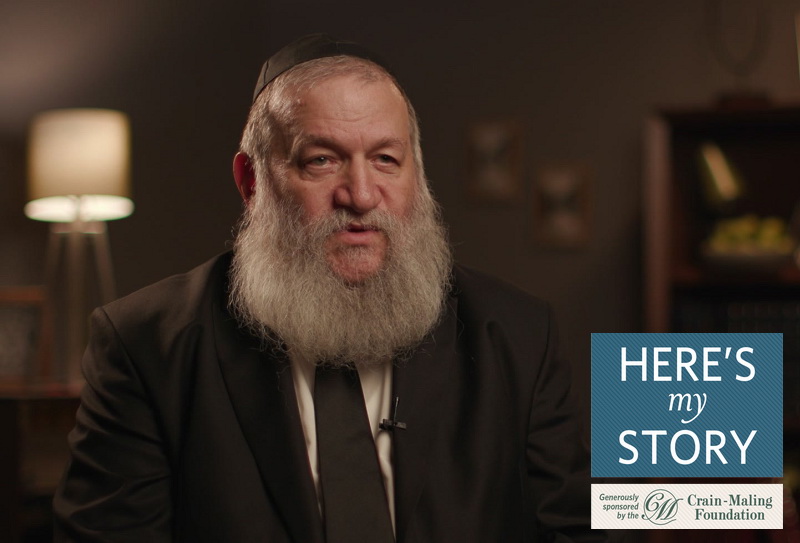
Here’s My Story: A Home on Firm Foundations
Rabbi Zushe Winner
Click here for a PDF version of this edition of Here’s My Story, or visit the My Encounter Blog.
Before my wife Esther and I got married, in 1976, we wrote to the Rebbe to ask for his blessing. The custom was that, before getting engaged, the bride and groom each wrote their own letter, and the Rebbe’s secretary would deliver both of them to him together.
After receiving our two letters, the Rebbe gave one response to the two of us, as well as an additional one that was just for me. To me, the Rebbe gave the instruction he generally gave to someone marrying the daughter of a kohen: The Talmud states that someone who marries a kohenet ought to be a Torah scholar, and in a Halachic responsa, the Tzemach Tzedek — the third Rebbe of Chabad — rules that the groom can be considered such by studying a minimum of one tractate of the Talmud well. And so the Rebbe told me to “become proficient in one tractate.”
As it happened, I wasn’t even aware that I was marrying the daughter of a kohen! I had just written my wife’s name, along with her father’s, “Esther the daughter of Reb Chaim Yisroel Sperlin,” without even realizing that he was a kohen.
The other message from the Rebbe, for both of us, was that he was giving us his blessing for the marriage since we “certainly decided together to establish their home on the foundations of Torah and mitzvot.”
Later on, this became a fairly standard blessing that the Rebbe would give to couples seeking to get engaged, but at that time, in the mid-1970s, he would often only say that it was “a good match” or an “appropriate match” and then add his blessing that the wedding take place at an auspicious time.
And so receiving this particular response, at a time when it was not common, made me think very seriously about what it meant, especially in the weeks before our wedding. The Rebbe was saying, it seemed to me, that the blessing for our marriage was dependent on our commitment to establish our home upon the precepts of the Torah.
Before the wedding, we had a private audience with the Rebbe. At first, the bride and I entered the Rebbe’s office together with our parents and grandparents. My wife’s grandmother, who comes from a Belzer chasidic family, had made a braided havdalah candle for the Rebbe, which she presented to him.
“May your mazel shine,” the Rebbe told her; a blessing for good fortune, with a nod to the candle.
Then the in-laws left the room, and my wife and I handed a note to the Rebbe that we had written earlier. In the note, in addition to requesting his blessings for our marriage, we told the Rebbe that we were prepared to go wherever the Rebbe would send us to serve as his emissaries.
Before the audience, I had asked my wife if she could also leave the room after the Rebbe finished giving us his blessings, because I had a question that I wanted to ask privately. It was about his message at the time of our engagement: How could I be sure that I made the decision to “establish our home on the foundations of Torah and mitzvot” in full sincerity?
The Rebbe answered me by referring to the Halachic ruling of Maimonides in his Mishneh Torah: Deep down, every Jew sincerely wishes to follow the Torah, Maimonides writes, even though at times “a person can be compelled by their own inclination” to do the wrong thing. So when a person resolves to follow the Torah, even if it may seem that it is not wholehearted or with all of the right motivations, ultimately this decision is considered — by Jewish law — to be sincere. Reflecting on this idea, the Rebbe added, would help me make this resolution and follow through on it in my own life.
Back then, the custom was for a groom to receive a bottle of vodka for the wedding from the Rebbe during a farbrengen. So on the Shabbat before our wedding, when it was my turn to come up to his table, the Rebbe opened the bottle, and poured into my cup: “L’chaim!”
The Rebbe told me to give out some of the spirits to people at the farbrengen, and to distribute the rest at the wedding. Then, as he handed me the bottle, he looked into my eyes and repeated the same words: “Establish your home on the foundations of Torah and mitzvot.”
Later, with the Rebbe’s advice and blessing, my wife and I went to Caracas, Venezuela, where I was appointed to lead the newly established yeshivah. Once there, I began to have some concerns about the kosher meat in Venezuela, so I decided that I wanted to learn how to perform shechita (kosher slaughter) myself.
That summer I started studying the laws of shechita. The Alter Rebbe, the founder of Chabad, dedicates several chapters in his Code of Jewish Law to this topic, so I studied them in depth while writing notes on the Alter Rebbe’s insights.
During my years as a student at the Tomchei Temimim yeshivah on Ocean Parkway, I recalled that the Rebbe had always urged people to study the Halachic and Talmudic teachings of the Rebbes of Chabad. Students were encouraged to present a Talmudic lecture called a pilpul, and beforehand, the subject of their talk, along with the sources they would be citing, would be posted on a bulletin board. On more than one occasion that I delivered a pilpul, Rabbi Tenenbaum, the director of the yeshivah, instructed me to include a source from one of the Rebbes of Chabad: If I didn’t, he cautioned me, the Rebbe would comment that there was a relevant teaching from the Tzemach Tzedek or the Alter Rebbe when he saw the bulletin.
Now, as I delved deeper into the laws of shechita, I found the field of study to be so rich, with ramifications for all sorts of general Talmudic principles, but I felt the yeshivah world wasn’t doing justice to it.
When I mentioned my studies in a letter to the Rebbe, I also sent along some of my writings: Twenty or so pages of my notes on the first chapter of the Alter Rebbe’s laws of shechita.
In reply, the Rebbe suggested that I ask a few Chabad Halachic authorities to weigh in on whether I should publish my notes. If those other rabbis I asked were evenly split on the question, the Rebbe added, he was in favor of doing it. Before the Rebbe offered this “suggestion” I had no plans of publishing my notes, so it took me by surprise.
By the time I finished the manuscript, we had moved back to New York, and while they were being prepared for print, I sent the galleys of the first chapter to the Rebbe, who acknowledged them and expressed his appreciation and anticipation for the complete book to be released.
Just knowing that the Rebbe had spent time looking at my work was very special to me, and of course when the book was ready, I sent a copy to the Rebbe. I’ve since heard that the index I made for the notes has helped other scholars develop a deeper understanding of the Alter Rebbe’s view on numerous Talmudic topics. And the copy I sent to the Rebbe can still be seen in his office today; it is on one of the shelves behind his desk.
Rabbi Zushe Winner is a Chabad emissary in Brighton Beach, Brooklyn, as well as the rosh yeshivah at Yeshivas Tomchei Tmimim – Chovevei Torah. He was interviewed in May 2021 and August 2023.