


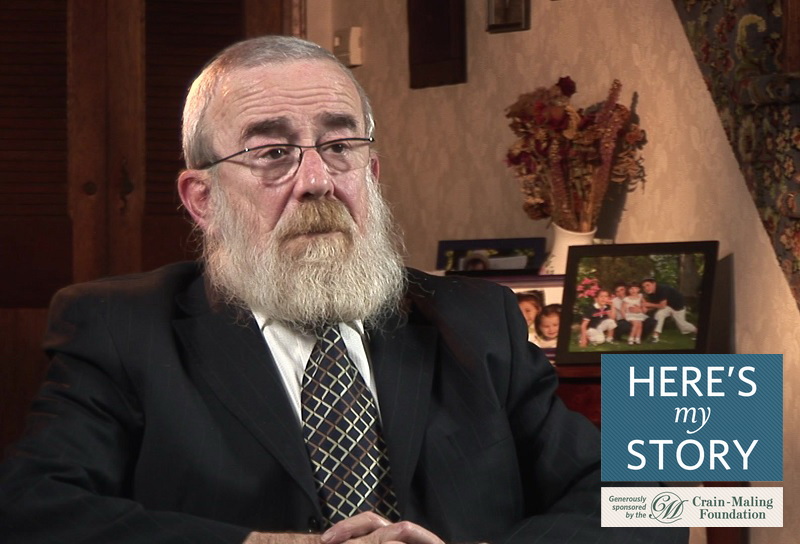
Here’s My Story: We Received Your Invitation With Displeasure
Rabbi Yisroel Shemtov
Click here for a PDF version of this edition of Here’s My Story, or visit the My Encounter Blog.
My Bar Mitzvah was in 1953, just two years after the Rebbe accepted the leadership of the Lubavitch movement. On the invitation they sent out for the occasion, my parents requested that the invitees come to the celebration and “bless the Bar Mitzvah boy to grow up in accordance with the wish and the desire of the Rebbe.”
At that time, our family lived in London, where my father knew a brilliant Torah scholar in his twenties named Rabbi Moshe Sternbuch. Rabbi Sternbuch was born in London, but since he had come up in the Lithuanian yeshivah world, people knew him as the “Lithuanian prodigy.” Later, he would become the head of the Eida HaChareidis rabbinic body in Israel, and one of the preeminent Torah figures in the country.
But one day in 1953, as we were all walking home together from the synagogue, this prodigy was criticizing my father. “How dare you write such a thing?” he demanded to know. It would make sense for parents to ask for people to bless their child to grow in accordance with the desire of the Almighty, or the laws of the Torah, but “how can you wish for your child’s future, their whole life, to follow the desire of the Rebbe — a human being?”
“I would ask the Rebbe what he has to say about this,” continued Rabbi Sternbuch, “but I lost the invitation.”
“No problem, I’ll give you another invitation,” my father reassured him. Rabbi Sternbuch promptly sent it on to the Rebbe, with his question attached.
The Rebbe responded to him in a letter with a few points. First, he explained, “The more specifically a person articulates his requests that he makes in prayer” the better. This is why the “Amidah contains twelve intermediate blessings,” where we pray specifically for all our needs, “rather than one all-encompassing request.”
“It follows,” continued the Rebbe, “that if someone… believes that he has a friend who sincerely wishes him well and understands his needs more deeply and accurately than he himself does, he may formulate his prayer by asking that they be fulfilled in accordance with that person’s intention and desire.”
Then the Rebbe added a second point, which is that when a person wishes — in line with the traditional chasidic blessing for a Bar Mitzvah boy — that his son grow to have “awe of Heaven, and not only that, but also that he become a chasid … and not only that, but also that he become a Torah scholar,” the “evil inclination” can come along and interfere with the purity of this prayer by mixing in an ulterior motive. That is, besides being driven by the spiritual elements in these blessings, a parent might also seek the sense of personal gratification that comes from having a child with all of these qualities.
“The only solution,” proposed the Rebbe, “is to entrust one’s prayer to someone who has no personal stake in the matter and sincerely seeks one’s [true] good.” Then, when the words of the prayer and its inner intention are properly aligned, they will be accepted on High.
Lastly, he addressed Rabbi Sternbuch’s suggestion that the “prayer should simply be that one should fulfill G-d’s will,” without specifying the particulars of which path the child will follow. “With all due respect, this is not so,” insisted the Rebbe. “As noted above, the very text of the prayers instituted by the Men of the Great Assembly demonstrates that requests should be specified in as much detail as possible. The only reason they did not formulate them in even greater detail is so that there would be a single liturgy for all Jews. Nevertheless, even the standardized text is highly detailed.”
Throughout, the Rebbe made references to various Halachic concepts, in order to provide precedents in Jewish law for the arguments he was making to Rabbi Sternbuch. Then, in closing, he remarked that, “To be honest, I wasn’t sure whether I should respond to these questions,” because some people only want to have questions — which they can then use as a justification for rejecting a chasidic way of life. And since there are always more questions they can ask, there is little point in offering answers to such people. “However, since I do not know you,” the Rebbe continued, “I will presume that “your intentions are certainly for the best.”
Decades later, once I was married and raising my family in Crown Heights, I developed a relationship with a certain young man. He had come from abroad to study Torah, but it took a few months until he was accepted into a yeshivah, so I took him into our house and helped him get set up. Years later, after he got married, I noticed that this young couple had not been blessed with children. So the next time I sent a letter to the Rebbe, I decided to write a P.S., asking that he give them a blessing for children.
About an hour and a half after I delivered this letter, the Rebbe’s secretary, Rabbi Binyomin Klein, called me on the phone. “The Rebbe is asking for the names of the mothers of this husband and wife.” When praying for someone, one traditionally uses their Hebrew name and that of their mother. I quickly called this young man to ask him, and then I called Rabbi Klein back with the names.
Another hour or so went by, and Rabbi Klein called back: In response to the request for a blessing, the Rebbe was advising the couple to be more careful in observing the laws of Family Purity. These laws, which guide the marital conduct between a husband and wife, contain many details that, as Rabbi Klein explained, someone might easily forget.
With that, I called the young man back to pass the message on. “I’m just the mailman, and this is what I have for you,” I told him.
“I’m not sure what the Rebbe could be referring to,” he replied, “but I’m going to review all the laws of Family Purity and see what I might be missing.”
Nine months later, I served as the sandek at their son’s circumcision ceremony — and the couple had ten more children after that.
Afterwards, this young man confided in me that he had written to the Rebbe for his blessing for children twenty times, without getting a response — and he hadn’t left out his mother’s name either. So it was interesting that when I scribbled my little P.S., the blessing had come almost immediately, and everything went smoothly after that.
There are a few morals to this story, if I may say so, and I think that one of them is based on that answer the Rebbe gave about my Bar Mitzvah invitation: When a person asks for a blessing for themselves, for children or for anything else, there can be a personal interest alongside the spiritual dimension of the blessing, and so it doesn’t always have the desired effect.
But when you ask for someone else, when you pray for another person, for a brother or for a sister, it has that much more power.
Rabbi Yisroel Shemtov is a longtime Crown Heights community activist, who for many years ran a bespoke frock-coat (kapota) business. He was interviewed in December 2010.










Singh
Rabbi Shemtov served the community well. My grandfather patronized his kapote store