Weekly Story: Do It, Even Though There is No Continuation
by Rabbi Sholom DovBer Avtzon
This week’s post is in memory of my mother, Cheyena bas Aidella, whose 40th Yahrzeit is this coming Thursday evening and Friday, the 27th of Sivan.
While the 28th of Sivan is commonly commemorated as the day the Rebbe and Rebbetzin arrived in America 85 years ago, and I was thinking of writing about that momentous occasion, however, I decided to write about something else that occurred on the 28th of Sivan, and that is the day the Rebbe arrived with or brought his mother to America twenty-six years later 5707 (1947).
Additionally, the message of this article, the importance of doing a positive act even if you may not be able to maintain and continue taking care of it, is something my parents instill into us.
Rebbetzin Chana escaped from Russia in the summer of 5706, together with other Lubavitchers, using Polish passports.
For a while she was in the DP camp of Pocking, Germany. And then in Adar of the following year, she was allowed to enter France to await a visa from another country.
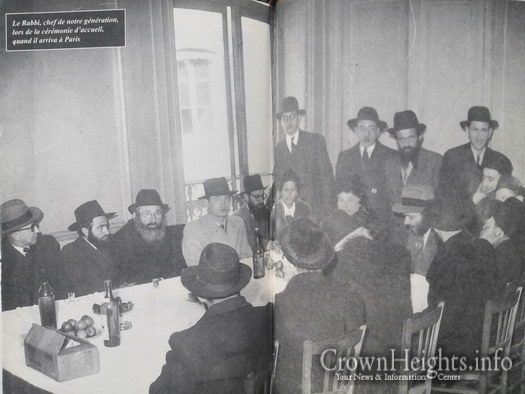
Shortly after she arrived there, the Rebbe flew to Paris to help her obtain the necessary documents to join him in New York, and then three months later escorted her to America. The boat docked in New York harbor on the 28th of Sivan 5707 (1947).
The Rebbe knew that he was going to be in Paris for a short time. Yet during that time he undertook certain responsibilities or activities, knowing that once he leaves to return to New York, there is a strong possibility that no one will assume that responsibilities or continue that activity.
I will mention one of them; it is known that during those three months he often visited a Jewish orphanage home, of children who were separated from or lost their parents in the atrocities of the war.
Very often when a person finds themselves in a similar situation, they conclude that being there wouldn’t be continuity to this activity, there is no purpose in even considering or attempting to do it. After all, who says I can do it, and if I do succeed, is there any meaning to it? After all, in many instances there is a strong possibility that whoever I meet here and speak to, it would be a once-in-a-lifetime situation.
For example, in the summer many people go on vacations and during the year they travel for business and meet other people there. Often, and sometimes sub-consciously a person thinks what are the chances that the two of us from different countries and backgrounds are going to book a future vacation for the same destination on the same dates?
Therefore, one may say, why should I try to speak to them about the importance and necessity of fulfilling a mitzvah and learning Torah? After all, in all probability there won’t be a continuity to it.
But we can and should learn from the Rebbe’s conduct, that we should try to do something positive while we are there, and this can be explained in various ways or for various reasons.
One of the principal teachings of Chassidus is, that everything is b’hasgacho protis- by Divine Individual Providence. Therefore. we are taught (based on the possuk מה’ מצעדי גבר), that wherever a person decides to go, there is a divine reason for them to be there. So yes, you decided to go on this vacation, but Hashem planted that thought so that you can fulfill a mission of His.
As the well-known story that the Rebbe Rashab pointed out to his son two chassidim who were reviewing a maamar in a certain place in the field, that that place was waiting since Creation for someone to review words of the Torah there and elevate that spot.
So perhaps the reason our business or vacation took us there is to meet this Jew and inspire him or her!
Another way to explain why we should utilize that moment even if we indeed will never meet again.
Rabbi Havlin was visiting America to fundraise for Toras Emes in Eretz Yisroel. He wrote to the Frierdiker Rebbe that in his travels he is meeting many Jews from Russia, who either were chassidim themselves or are the children of chassidim. However, sadly they are not conducting themselves in the spirit of chassidim.
The Frierdiker Rebbe replied, you shall utilize the time you are interacting with them to encourage and inspire them to return to the conduct of their youth or the ways of their parents.
He continues, you might say, what is one discussion going to accomplish, as even if that person is inspired and wishes to continue the conversation, I will be somewhere else as I am traveling from place to place and city to city.
However, you should realize that when a person faints and is revived, that normally takes a few moments, and almost always it doesn’t have to be repeated. But it endures for the remainder of the beneficiaries life. So too, when we do a positive act, and making sure that we conduct ourselves in a way that makes a positive impression on others, in other words our conduct made a kiddush Hashem, that one action last for an eternity.
So let us learn from the Rebbe, and unapologetically be proud chassidim and have our tefillin or pamphlets with you when you are on a vacation, and inspire another Jew to do a mitzvah.
Or as mentioned earlier, make sure to daven properly (not rushed), and thereby elevating that hotel or Air B&B, park, field with the holiness of words of Torah and Tefilla.
A Taste of Chasidus בהעלותך את הנרות – When you will elevate the lights (1)
Likkutei Torah (Bamidbar 29C)
This week’s maamr begins with Hashem instructing Aharon to light the seven lights in the menorah.
The Navi Zecharia (4:2) says I saw a golden Menorah… and I asked What are they (symbolizing) and the answer was this is the word of Hashem to Zerubavel.
While the simple explanation is that Hashem was sending a message to Zerubavel, who was a prinIn word not PDFce and was leading the Jewish people out of the Babyloneon exile, the Alter Rebbe explains that Zerubavel is a reference to the Jewish people themself, and the reason they are called זרובבל is because they were planted in Babyloneon.
Based on this explanation, the possuk is telling us in reply to the Navi’s question about what the vision of the Menorah meant, that Hashem is saying that the Menorah is a representation of the Jewish people.
Just as, or better said, because the mode of the Jewish people service of Hashem, is divided in seven parts, therefore the menorah had seven lights.
The seven modes of service are based on each individual person’s character.
There are those that their natural disposition is of kindness, and therefore their way of serving Hashem is with or through feelings of love. Then there are those whose disposition is of strictness and being judgemental, so their way of serving Hashem is through fear. That is followed by the next five characteristic traits of beauty (Tiferes), victory (Nrtzach), splendor (Hod), foundation (Yesod) and sovereignty (Malchus).
Now while we translate the opening words of this parsha to mean, when you will light the candles, the literal translation of the word b’haaloischo is when you will elevate the candles. That means that there are the way the candles are shining (burning) before Aharon’s involvement, and then there is the higher way it is, after Aharon’s involvement. So we have understand what does this mean in practical terms. At what level were we holding on our own, and to which level is Aharon, who is one of the Seven Shepherds of the Jewish people, is being instructed to elevate us to?
Chassidus explains that the nature of a flame is to go upwards, as the flame wishes to connect itself to its source. That symbolizes love (as Lavan said to Yaakov, you ran away from me, because you had a powerful desire to be in your father’s house).
Every Jew has a natural love to Hashem, (although sometimes it may be concealed). In Chassidic terminology, this is called Ahavas Hativies – the natural love we have for Hashem. This love we received as an inheritance from Avrohom Avinu, (as Avrohom embodied the trait of expressing his love to Hashem), as the possuk states that Avrohom continued his (travel) pursuit to the South and in Kabbalistic terminology south is a reference to love (since when we face east the south is on our right and right symbolizes the characteristic of kindness – love).
So that possuk is informing us that Avrohom was constantly strengthening and attaining a higher level of love for Hashem.
The way for a Jew to arouse or awaken this love is by thinking in the greatness of Hashem, on how He created and constantly recreates the world.
This level of love is called Ahavas Olam, a love to Hashem that is developed by the person contemplating on the greatness of Hashem from or through the lense of the world.
We see that Hashem is giving us life, and therefore we desire to be connected and united with Him. While this is a level we all would love to attain, and are given the ability to accomplish, yet there is a drawback or better said a shortcoming in this mode of service.
That is that the person’s love to Hashem is based on his understanding of what Hashem is, and that is not the true essence of Hashem. Furthermore, essentially one a very refined level this love is not pure.
Being that it is based on the fact that Hashem is constantly giving me life, it is in my best interest to love and be close and connected to Him.
This is the level of the Ahava we have ( or can attain) before Aharon lights [inspires] us to reach a higher level. However, the Hebrew letters that spell Aharon – אהרן also spell the Hebrew word of נראה, which means revealed. This level of love indicates that the person’s desire is not that I should merit to be close to Hashem, but rather their only desire is that Hashem’s (glory and) essence should be revealed in the world.
The way to accomplish this is by contemplating on how far removed we are and the entire created universe from Hashem.
In order for Hashem to create the universe, He had to conceal Himself to such an extent, that He created the universe through the power of His speech, which is an external power. As speech is only necessary when there is another entity. But when you are by yourself, there is no need for speech.
The person then cries out in anguish and pain, why is Hashem concealing Himself from me?
This cry arouses Hashem’s compassion and He then reveals His essence, when the glory of Hashem will be revealed and the human flesh will see not only what can be seen now, but also what Hashem conceals from us, will be seen in the open.
And that is what Aharon was instructed to do, nurture the Jewish people, that their desire will be that Hashem’s essence be revealed in this world.
Rabbi Avtzon is a veteran mechanech and the author of numerous books on the Rebbeiim and their chassidim. He is available to farbrent in your community and can be contacted at avtzonbooks@gmail.com.