
A Taste of the Rebbe’s Farbrengens – Parshas Behaalosecha
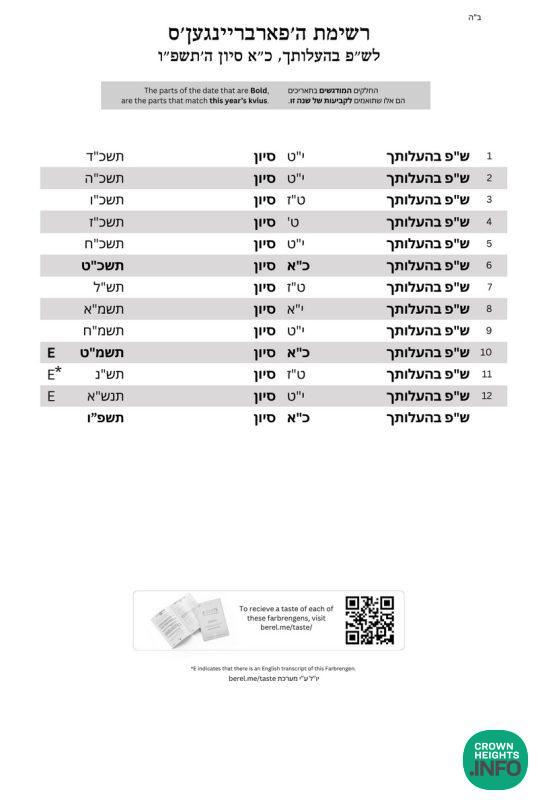
The Rebbe held 12 farbrengens on Shabbos Parshas Behaalosecha (see image below for a full list). The sichos from these farbrengens span just under 300 pages in the Yiddish Hanochos (transcripts) in Sichos Kodesh, and around 25 pages in the 3 English Hanochos published by Sichos in English.
Each farbrengen is a priceless treasure. It was the highlight of the week for those fortunate to be present when the Rebbe farbrenged. Nowadays, these farbrengens are preserved in thousands of pages, waiting to be relived by every chossid.
To get a taste of these farbrengens (Some selected highlights appear below), visit berel.me/taste/behaalosecha to explore this week’s “Taste”. You can download and print it for Shabbos, with curated suggestions for which farbrengens to learn, along with a qr code to access each one.
To receive the “Taste” each week, subscribe for free at berel.me/taste/subscribe
May we merit to once again experience a farbrengen with the Rebbe—now!
—
Selected excerpts from this edition of the “Taste”
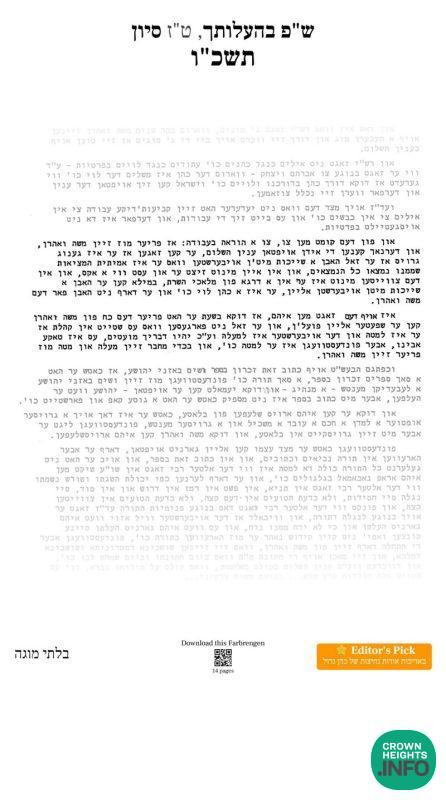
Shabbos Parshas Behaalosecha 5750
On the surface, since, as explained above, the concept of the flame “rising up on its own” is connected with a Jew’s potential for free choice, how is it possible for the Torah to promise that ultimately, each Jew will reach this level? Giving such a promise appears to nullify the possibility for choice.
This difficulty can be resolved as follows: If there would be an influence from above which would bring a Jew to this level, then, the above promise would contradict the concept that a Jew has to choose to raise up his flame of love for G-d by himself. Since, however, the expression of this love is a reflection of a Jew’s essential desire, for, as the Rambam writes, each Jew truly wants to fulfill G-d’s will, and, if he does not, it is only because his evil inclination forces him to act against his will. Therefore, the fact that ultimately, a Jew will realize his true nature and express his love for G-d is not a contradiction to the concept of free choice. Since a Jew’s will to serve G-d is an inner (and often subconscious) desire and, life within the context of material reality offers the possibility for two serving G-d or i”n the opposite a person has a real choice. alternatives
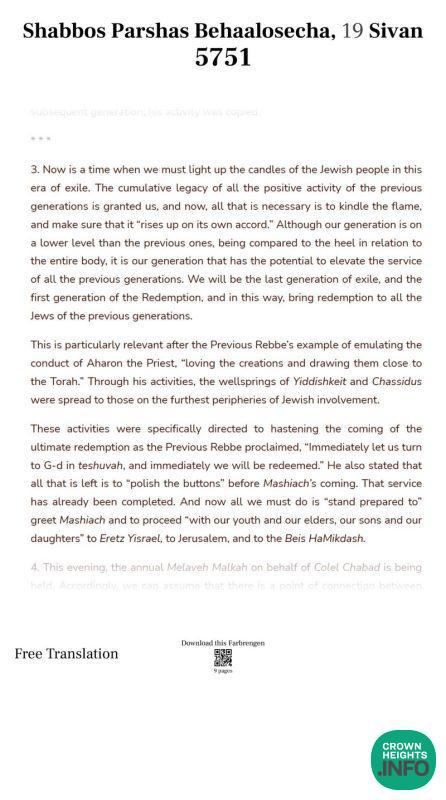
Shabbos Parshas Behaalosecha 5751
Now is a time when we must light up the candles of the Jewish people in this era of exile. The cumulative legacy of all the positive activity of the previous generations is granted us, and now, all that is necessary is to kindle the flame, and make sure that it “rises up on its own accord.” Although our generation is on a lower level than the previous ones, being compared to the heel in relation to the entire body, it is our generation that has the potential to elevate the service of all the previous generations. We will be the last generation of exile, and the first generation of the Redemption, and in this way, bring redemption to all the Jews of the previous generations.
This is particularly relevant after the Previous Rebbe’s example of emulating the conduct of Aharon the Priest, “loving the creations and drawing them close to the Torah.” Through his activities, the wellsprings of Yiddishkeit and Chassidus were spread to those on the furthest peripheries of Jewish involvement.
These activities were specifically directed to hastening the coming of the ultimate redemption as the Previous Rebbe proclaimed, “Immediately let us turn to G-d in teshuvah, and immediately we will be redeemed.” He also stated that all that is left is to “polish the buttons” before Mashiach’s coming. That service has already been completed. And now all we must do is “stand prepared to” greet Mashiach and to proceed “with our youth and our elders, our sons and our daughters” to Eretz Yisrael, to Jerusalem, and to the Beis HaMikdash.