


A Story of L’Chaim
by Leibel Kahan – Lubavitch.com
Judaism has always known what a drink is for. Wine sanctifies the Sabbath, seals a marriage, marks the Passover. It is not incidental to the ritual — it is the ritual, poured and blessed and passed around the table. But more than that, Jewish life has long treated physical pleasure not as something to avoid, but as something to elevate — to be experienced with meaning.
So when Chabad rabbis turn up at bourbon tastings and craft breweries and wine tours, they are not importing something foreign into Jewish life. If anything, they are extending an older instinct outward, and meeting people where they already are. Take California’s Sonoma Valley, for instance, where wine is not an industry so much as an atmosphere. “When we arrived, we found ourselves surrounded by wine culture,” said Rabbi Mendel Wenger of Sonoma Valley Chabad. “We would constantly get calls asking about kosher wine or wine tours, and the reality was that options were extremely limited. There was no true local, boutique Sonoma winery producing kosher wine.”

At the Passover Seder — where wine is a centerpiece — Rabbi Wenger joked about creating a kosher winery. Adam Goldsmith—a guest at the Seder, took it seriously. “I noticed the wines they had served by the Seder were from larger, more commercial brands,” he said. “It struck me that there was nothing single-vineyard, Sonoma-based that was kosher.”
He soon connected Rabbi Wenger with well-known local winemaker Mark Gamache. “Mark had one condition,” Rabbi Wenger said. “The kosher wine could not compromise on quality — it had to be something that could compete with the best wines in the country.”
Named R. Degen Wines after Goldsmith’s grandfather, a Holocaust survivor, the kosher-certified winery has now produced two wines: a Pinot Noir and a Chardonnay, both set to be released in 2027, with more on the way.
“People hear about kosher wine and they immediately start asking questions,” said Rabbi Wenger. Wine is how the conversation starts, he explained.
Goldsmith appreciates the way Chabad “taps into our local DNA and create something for us and the broader Jewish community is very special.”

In California the language may be wine, but move inland, and the drink changes. In the Midwest and the South, whiskey does the talking — more specifically, bourbon. In Indianapolis, Rabbi Dovid Grossbaum joined members of Mensch Club, a Chabad gathering point for men of all ages, to walk through a series of bourbon barrels, tasting and comparing until the group arrived at a single selection that would eventually be bottled under a private label of their own making.
“The important part isn’t the whiskey,” said community member Adam Sharp. “It’s what it represents. Activities like this bring people together and help them connect over shared interests.”
Their bottled bourbon bears the label “Knefler’s Fifth,” an homage to Brigadier General Frederick Knefler, the highest-ranking Jewish officer in the Union Army, who called Indianapolis home and was known as a vocal opponent of Prohibition.
“Historically, we know Knefler was a bourbon drinker,” shared Jason Zielonka, another participant in the project. Zielonka is charged with providing Chabad with wine and liquor for the weekly Shabbat Kiddush, and he’s seen it as an opportunity to introduce people to various bourbons and whiskeys over the years. “We can’t say for certain, but I’d like to imagine this may have been the kind of l’chaim shared in the synagogue in Indianapolis 150 years ago.”
“If Knefler walked into our Chabad House today,” added Rabbi Grossbaum, “I think he’d be delighted that Jewish life thrives in Indianapolis with such vibrancy so many years later. In his time, that kind of continuity would have been hard to imagine.”
Farther south, in Kentucky — the heart of American bourbon production — the relationship between whiskey and Jewish life goes deeper than social ritual. There, Chabad Rabbi Chaim Litvin has spent years working inside the industry itself, earning him the nickname “Bourbon Rabbi” — which is also the name of his line of quality kosher bourbons.

“I was born in Louisville — my parents are Chabad representatives there,” he said. Growing up, he watched an economy shaped almost entirely by distilleries. “Ninety-five percent of bourbon is made in Kentucky. It’s not just an industry here — it’s the culture.”
His early involvement was not in production but in certification. Soon enough, he was traveling across the country — “doing tastings, lectures, talking about Jews in the bourbon industry and what goes into making bourbon kosher.”
But amid dozens of events across the country, a recurring question emerged: “Which bourbon is yours?” During COVID, Rabbi Litvin shifted from facilitator to producer — and eventually, launched his own line of bourbon.
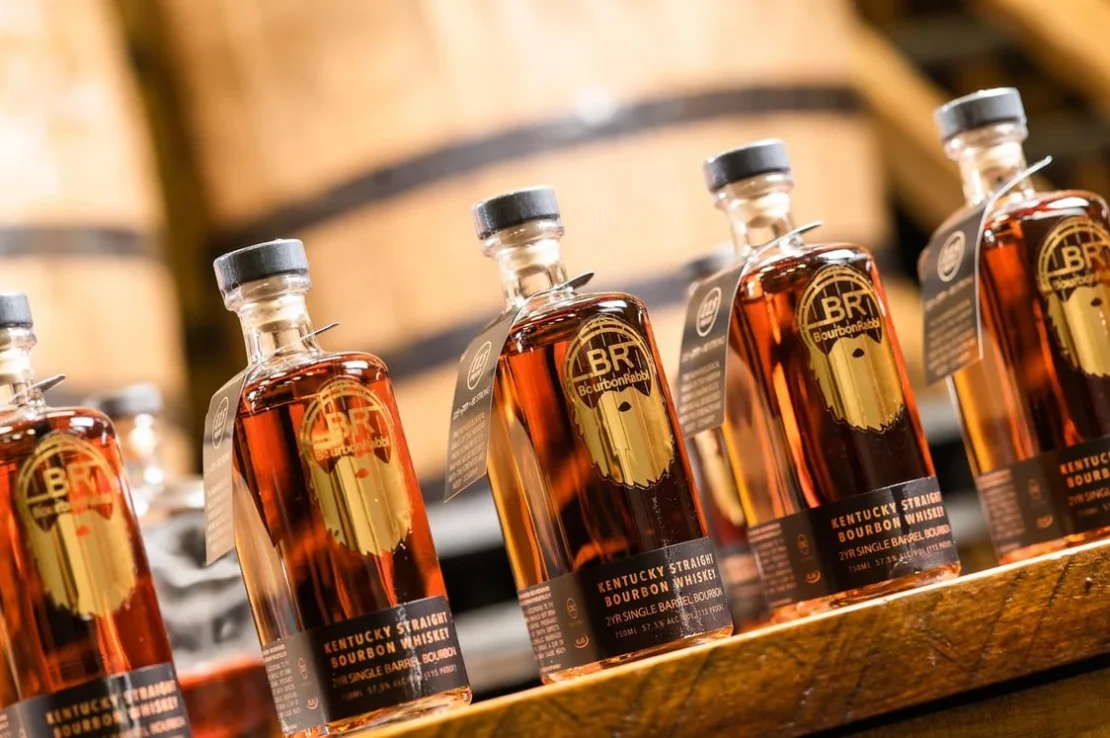
One of the bourbon tasting attendees, he recalled, first arrived after seeing a random advertisement. He later became a regular at his local Chabad. “People come for an evening out,” he said. “They learn a little, they relax, and suddenly they’re part of something.”
An evening out exactly like this took place at Chabad of Beverly-Salem, Massachusetts, where brewing enthusiast Jason Chalfour joined the community for a night of beer making and a discussion on the history of Jews in brewing.
The final product’s labeling carried Chabad branding and a note describing it as “the first beer brewed in a Chabad House,” alongside a dedication to the Lubavitcher Rebbe.
Still, Rabbi Mendel Barber was careful not to overstate the role of alcohol itself. “It’s not that the drink is central,” he said. “People come and this becomes another way to connect. Some people come for Torah study, some come for Shabbat, and some come because it’s familiar and fun. But it all opens the same door.”
That door, once opened, often widens in unexpected ways.

Chalfour described it less as an event than an extension of a longstanding hobby — one that happened to intersect with Jewish community life at the right moment. “Homebrewing is communal by nature,” he said. “You don’t really do it alone. You share it. You talk through it. That part fits naturally with what Chabad is already doing.”
A glass of wine, a barrel of bourbon, a pale ale. Each begins as a familiar object, something already embedded in American life. But in the hands of these Chabad rabbis and their communities, what emerges is not a theory of outreach so much as a practice of attention: noticing where people already gather, and revealing, within those moments, the depth Jewish life has assigned to them.