Rabbi Avraham Golovacheov, 43, Quiet Engine Behind Berlin’s Jewish Life
by Yisrael Eliashiv – chabad.org
The tallit-draped coffin rested in the Chabad-Lubavitch synagogue on Münstersche Straße in Berlin, candles burning close by as tradition dictates. Rabbis and community members sat in quiet rows, their voices rising and falling as they recited Psalms. Outside, the streets of Berlin moved on. For the Jewish community, time stood still.
On Monday, April 6 (19 Nissan), during the intermediate days of the holiday of Passover, Rabbi Avraham Golovacheov passed away following a battle with illness. He was 43 years old. The next morning, his funeral procession made its way to the Jewish cemetery on Heerstraße, and a community that had leaned on him for nearly two decades was left to reckon with the full weight of his loss.
Only after his tragic passing is the full extent of Golovacheov’s contributions coming into view—work that had been obscured, for years, by the man’s humble and understated approach to life.

The One Who Made It All Work
Golovacheov arrived in Berlin close to 18 years ago, shortly after his marriage to his wife, Chana. Born in Kherson, Ukraine, in 1983, he received his rabbinical training in Israel, New York and Moscow before being asked by Rabbi Yehuda Tiechtel, director of Chabad of Berlin, to join his team of emissaries in the German capital. He came to a city still carrying the weight of its history, with a mission to help strengthen Jewish life there.
He served as Rabbi Tiechtel’s right hand in rabbinical matters. While others were more public facing and addressed the crowds, Golovacheov made sure operations ran smoothly and halachic standards were upheld. He made it his mission that Berlin’s rabbinical framework stayed consistent and reliable.

“We have, thank G‑d, 13 full-time rabbis here in Berlin, each one active in various parts of the city,” Rabbi Tiechtel told Chabad.org. “But Rabbi Golovacheov quietly ensured that the entire rabbinate functioned smoothly every day.”
When the community established its beit din (rabbinical court) around 15 years ago, Golovacheov became its backbone. Berlin’s Jewish community includes a large proportion of families from Eastern European backgrounds, for whom questions of Jewish status, and historical records of marriage and divorce—a technical but profoundly important prerequisite to Jewish marriage—are not abstract concerns. Europe’s history of wars and displacement over the last century only complicated the vital and often difficult Halachic questions of Jewish status.
Golovacheov had spent time at a rabbinical court in Israel and developed an expertise in confirming a family’s Jewish standing.
“Document verification, tracing family lineage, ensuring everything meets halachic standards are essential for Jewish families and Jewish community,” Rabbi Tiechtel said. “And he approached this with exceptional professionalism, sensitivity and precision.”

Golovacheov channeled equal energy into another transformative project. When the community founded the “Jüdisches” publishing house, Rabbi Tiechtel turned to him to oversee it. He handled all elements of publication, the translation, graphic design, management, and distribution, with the same exactness that marked everything he did.
“He was a person who got things done,” Rabbi Tiechtel said. “He ensured that projects moved forward, that details were handled properly, and that the final product was of quality.”
The books that came out of that work opened the doors of Torah to German-speaking Jews who had no other way in. He worked on a translation of the Kehot Publication Society’s Tehilat Hashem Annotated Siddur, making prayer accessible to German speakers, as well as translations of the book of Psalms, the Machzor for the High Holidays and the Haggadah for Passover, among other works.

As native Russian speaker with a knack for making everyone feel comfortable and welcome, Golovacheov also directed Russian-language programming in Berlin, taught at the Jewish day school and ran Chabad’s yeshivah for beginners.
“For the Russian-speaking Jewish community here in Berlin, Rabbi Avraham was a beacon of stability,” Rabbi Tiechtel said. “He guided many with patience and clarity.”
The stories of his quiet generosity have only begun to surface since his passing. A preschool principal once came to him with a complicated problem; Golovacheov resolved it without fanfare. An immigrant couple with limited means, preparing for their wedding, found themselves with a ceremony far beyond what they had imagined—arranged by the quietly efficient rabbi without any fuss.
“That was who he was,” Rabbi Tiechtel said. “A person of action, of care, of quiet generosity.”

‘There Was No Complaint’
Last September, the community learned of his illness. He responded the way he
responded to everything, with faith and determination. Golovacheov kept working, often remotely from his laptop, even from his hospital bed.
“There was no complaint,” Rabbi Tiechtel said. “There was simply a deep sense of responsibility and belief in G‑d’s plan.”
The community dedicated a Torah scroll in his merit, and people prayed and pledged to perform additional mitzvahs in the hope of his recovery. His perseverance left an impression even on his doctors. His final weeks were, in Rabbi Tiechtel’s words, “truly inspirational.”
But the time had come for Golovacheov’s soul to ascend Heavenward, leaving behind a grieving family, community and a legacy of deep, quiet and lasting impact that will not soon be forgotten.
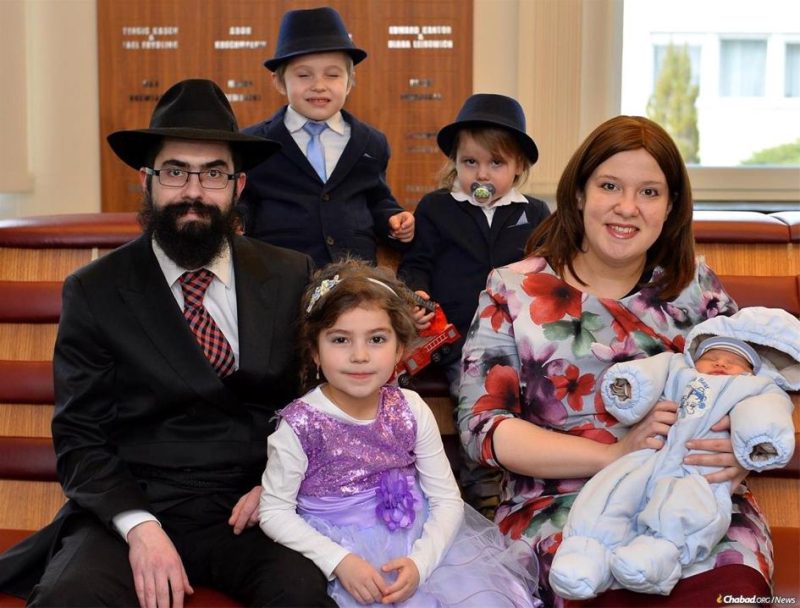
In addition to his wife, Rabbi Golovacheov is survived by their six children: Sterna Sarah, Shalom Dovber, Shmuel, Mendel, Shneur and Yossi, who was born only weeks before his father’s passing.
To support the Golovacheov family as they navigate the tragic loss of their husband and father, click here.