
Sleek Chabad Russian Center Rises on Miami Waterfront
by Shloimy Galperin – chabad.org
When Evelyn Raynshteyn and her family moved from Brooklyn, N.Y., to South Florida in 2004, she began looking for a community for Jews of Eastern European heritage. She found it at the Chabad Russian Center of Sunny Isles Beach.
It wasn’t large. Raynshteyn can still recall its founder, Rabbi Alex Kaller, standing outside the apartment building that housed the nascent center searching for a minyan. Sometimes the rabbi even went floor to floor, knocking on doors, hoping to find a 10th man for the required quorum.
“We were maybe 15 or 20 people,” she recalls of the Chabad Russian Center’s core group. “But we clicked right away. We were like family.”
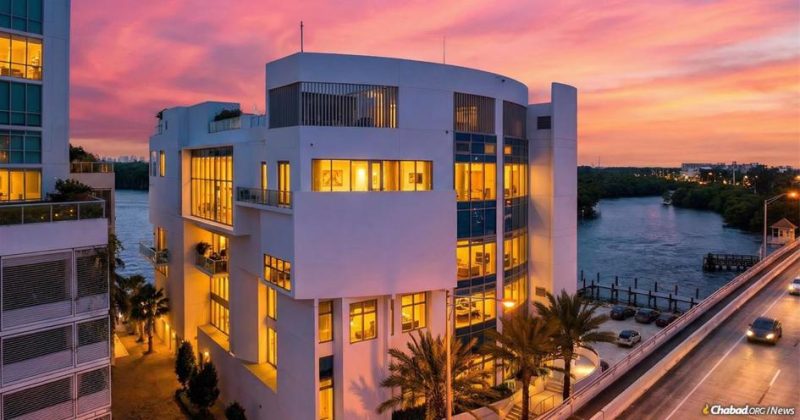
That family has grown considerably in the two decades since. Growing from the Kaller’s living room to a small storefront in a strip mall, the community now fills hundreds of seats every Shabbat at the recently opened new home of the Chabad Russian Center in the Leizer Verbukh Jewish Community Center, a six-story, 39,000-square-foot white modernist structure overlooking the water of Biscayne Bay.
The building was dedicated in January and serves as the base of Jewish life for Russian-speaking Jews in the area, regardless of which part of the former Soviet bloc they come from. Aside from the airy sanctuary and Slivnyak Family Simcha Hall events space, the new center is home to Chabad’s Gan Frida Preschool and Finker-Frenkel Tamim Academy, educating hundreds of students on campus. Chabad Young Professionals, CTeen, CTeen Jr., and Bar and Bat Mitzvah Clubs, along with programs for families and seniors all keep the center humming 24/7.

‘I Saw the Potential in this Community’
Alex Kaller grew up in Moscow with minimal Jewish education. His parents were proudly Jewish but not particularly observant, yet, as the Iron Curtain lifted, he began seeing signs of Jewish culture emerging from the shadows, and became more interested.
After Kaller was bullied in an antisemitic attack at school at the age of 14, he connected with a Jewish organization and began learning about his heritage. He began learning the basics, and had a brit milah. He became a regular at the historic Marina Roscha synagogue, and began attending the first Jewish school that opened after the fall of the Soviet Union. Within two years, the determined young man headed to the Chabad-Lubavitch yeshivah in London. Entering a full-day yeshivah wasn’t an easy transition.
“While the class was grappling with deep ideas and concepts in the Talmud, I was grappling with the words,” he recalls. Yet he persisted, and soon enough found himself comfortable swimming in the sea of Torah.
While still a yeshivah student, Kaller spent time doing Jewish outreach in Russia. He saw the thirst of his fellow Russian Jews, so long deprived of their heritage by Soviet Communism, to connect with their faith. Inspired then by the call of the Rebbe, Rabbi Menachem M. Schneerson, of righteous memory, to ensure every Jew has access to their faith, he knew then that he wanted to be a part of the solution.
In the United States, where he received his rabbinical ordination, he saw much of the same: Russian-Jews who had been denied knowledge of their Judaism. He knew these Jews, he understood them—and he spoke their language. Learning of the thousands of Russian-speaking Jews in South Florida, Kaller approached the late Rabbi Avraham Korf, regional director of Chabad-Lubavitch in the state.
“I told Rabbi Korf, quite confidently, three words: ‘You need me.’”
Rabbi Korf asked why.
“Because I speak the language and understand the mentality and culture, and Russian Jews are assimilating every day.”
The rabbi suggested he call back in a year, once he had more experience and perhaps a wife, but Kaller was not dissuaded. He kept calling every month. In 2002, just before Purim, he bought a one-way ticket to Miami. “I walked into Rabbi Korf’s office with my suitcase and said, ‘I’m here.’”

Kaller was given room and board at the local yeshivah and spent his days going from business to business. One of his first stops was a nearby taxi company, Central Cab, which was owned by a group of immigrants from the USSR. “I offered to wrap tefillin, and they rolled up their sleeves. Those were my first contacts.” When people offered him money, he declined. “I said, ‘Do me a favor. Don’t give me money. Just give me another Jewish contact.’”
Someone pointed him to Sunny Isles Beach, a newly incorporated city where the aging motels were being replaced by the new modern ocean front condominiums that were filling up with Russian-speaking Jewish residents. He went from storefront to storefront, looking for Jewish souls.
One early contact was Vladimir Edelstein, owner of a local Russian restaurant and club. Edelstein wore a large star of David and was proud of his heritage, though disconnected from observance. Kaller befriended him and proposed a Passover seder at the restaurant. One evening happened to be open that season—by Divine Providence, the first night of Passover. Edelstein handed him the keys.
“Ninety-five people signed up for that seder. That’s when I realized the potential in this community,” Kaller says.
To build a network of contacts to launch his fledgling community, he placed an advertisement in a Russian-language newspaper offering a free Jewish calendar. Readers sent their addresses, and he often included a mezuzah, encouraging another mitzvah.
“That summer I became engaged,” Kaller shares. “My wife, Chani, and I decided to get married in Miami because Rabbi Korf had already made me an emissary here, and 300 people attended. It was a beautiful and educational experience for the community to participate in a proud and traditional Chassidic wedding.”

‘The Feeling Is Still the Same’
The early infrastructure for the Chabad Russian Center was a far cry from its sleek and spacious home today.
High Holiday services were held in an empty restaurant space inside a converted motel. The bimah was Coca-Cola crates covered with a cloth, on which a borrowed Torah scroll was read. Despite the improvisational set-up, hundreds of people showed up that first High Holiday season. Weekly Shabbat services soon followed in the Kallers’ apartment.
Raynshteyn’s father heard about the community from someone he met at a mechanic shop. The rabbi came to their house and put up a mezuzah.
“At the time, the community was very small,” she remembers. “But it was so warm.”
The programs expanded—first a Sunday Hebrew school, then a preschool—and by 2005, the community moved into its first dedicated space, an 800 square feet storefront.
Their preschool eventually grew into a full elementary school: Tamim Academy and the Gan Frida Preschool now educates about 180 children, with enrollment expected to reach 220 next year across two locations. Hundreds join services every Shabbat. Just two years ago, Kaller says, some questioned whether a 39,000-square-foot building was necessary.
“Now,” he says with a laugh, “we don’t even have an empty corner.”
Valentin, an active community member, and his wife, Ruth, first connected about 11 years ago. They enrolled in an adult education course and drove more than an hour each way. “The drive home often wasn’t long enough to finish discussing the class,” he says.
It was the atmosphere and learning that kept them coming back.
“Being part of Chabad is like being part of a big family. Everyone shares the same values, and no one judges you,” says Valentin. Despite the growth, he says, the community has not lost its boutique touch. “The feeling is still the same. Rabbi and Mrs. Kaller care for each community member on a first-name basis.”