
Weekly Story: The Rebbe’s (Shabbos) Farbrengens
by Rabbi Sholom DovBer Avtzon
As noted last week, I am continuing writing up aspects of the Rebbe’s farbrengens, that may not be known to all. I thank Rabbi Seligson for forwarding me a copy of the Kfar Chabad magazine, where it is noted that Rabbi Avrohom Rotenberg, A Ger Chossid, whose mother lived across of 770, had a boy on the 7th of Kislev, 5718 (1958), and on the following Shabbos the 14th of Kislev was the bris.
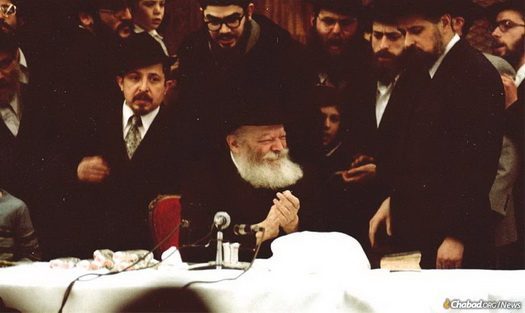
Some chassidim entered the Rebbe’s room after davening and requested that in honor of the day {the Rebb and Rebbetzin’s anniversary], perhaps the Rebbe will farbreng. The Rebbe replied, “Now everyone is going to participate in the bris.” Because of the bris the farbrengen began at 1;30and that is how it remained.
There it is noted that Reb Avrohom notes that in the previous Shabbosim the farbrengens began at One in the afternoon. Author’s note: I don’t know if previous farbrengens means a handful of farbrengens or if it means it was like that for a much longer period of time.
It was also brought to my attention that I mistakenly wrote that there were around 400 Shabbos Mevorchim farbrengens before the Rebbe became Rebbe, while there were only a drop over 100.
As always, your feedback and comments are greatly appreciated and welcomed.
Time of Farbrengen
Although we noted that the Shabbos Farbrengens began after Shacharis and then the Rebbe established that it will begin at 1:30, that was only for Shabbos afternoons. During the weekdays, the farbrengens began at 9:30 in the evening, besides when the Rebbe began saying a Sicha after Maariv, so it was whenever Maariv concluded.
Then on Yomim Tovim, Rosh Hashanah, Simchas Torah, Acharon shel Pesach and Shavuos, the Rebbe would begin the farbrengen shortly before Shkia (sunset), and through the farbrengen would extend the Yom Tov into the weekday. At the conclusion of the farbrengen, everyone davened Maariv, the Rebbe would then say Havdalah out loud, and then he would distribute Kos Shel Brocha for hours.
On Shemini Atzeres the farbrengen would begin an hour after maariv, and would end around midnight,[1] followed by hakofos a half hour later.
Being that the farbrengens took place on Shabbos afternoons, the maamar was said then also. However, there were a few times that the Rebbe said the maamar Friday night, in middle of Kabbalas Shabbos. That was when Yud Shevat came out on a Friday, and the Rebbe never farbrenged on the evening before Yud Shevat,[2] so some times he said a maamar on the night after Yud Shevat, eve of Yud-Aleph Shevat.
Niggunim
Reb Shmuel Zalmonov was one of the outstanding baalei Menagnim in Lubavitch and he was the one who chose which niggun would be sung at the Rebbe’s farbrengens.[3] In the early chofs (60’s), when he went to Eretz Yisroel, the honor was split; Reb Yoel would begin the first niggun at the beginning of the farbrengen, while Reb Heshky Gansbourg would be the one who would begin singing the other niggunim between the Sichos. The exception to this was the niggun that would be sung before the Rebbe would say a maamar, when the Rebbe would motion to Reb Yoel, hinting that he is preparing to say a maamar and he should sing a niggun. As well as at the end of a farbrengen, when the Rebbe wanted specific niggunim sung, and would sometimes tell him which niggun he is to sing.
Interesting to note, the niggun that Reb Shmuel Zalmanov sang before the Rebbe said a maamar was not always the Rostover Niggun. He sometimes sang that, but the majority of times, he chose to sing other niggunim. However, Reb Yoel always sang the Rostover Niggun.
Reb Yoel once mentioned that he noticed a certain expression on The Rebbe’s face, when Reb Shmuel Zalmonov would sing the Rostover niggun before the maamar, which he understood from that, that the Rebbe preferred that the Rostover Niggun be sung before a maamar, as it was the most appropriate for the frame of mind for a maamar, and that is why he constantly sang it. That is when it also became known as the Niggun Hachanah.[4]
The niggun that Reb Yoel used to sing at the beginning of the Farbrengen, was a niggun without words. What is that niggun called. However, by the Shavuos farbrengen of 5730, someone sang a niggun with the words of the final two pesukim of the Rebbe’s kapital (69), beginning with the words key elokim Yoshia Tzion, and the Rebbe accepted that as his niggun. From then on, it was the norm to begin the farbrengen with the new niggun of the Rebbe’s kapital.
The Maamar
Being that we are discussing the niggun before the maamar, it is appropriate to note changes concerning when the Rebbe said the maamar.
Until 5717-18, the Rebbe began a farbrengen with a Maamar. After the maamar the Rebbe would say two sichos. However, on blank 1718, the Rebbe discussed the reason why the maamar should be first, and then he mentioned the reason why the maamar should be preceded by sichos. From then on the new order began that the Rebbe began a farbrengen by saying two sichos, then a maamar followed by additional sichos.
From parshas Noach 5725 and onwards, the Rebbe used the last two sichos to explain a Rashi, or his father’s notes on the Zohar, Igeres Hakodesh, Pirkei Avos, and the Rambam.
However, there were a few exceptions, when the Rebbe just said a maamar and nothing else. One of the most notable ones was on the Shabbos before Yud Shevat, when the Rebbe said a maamar before davening. However, that stopped in 57—.
Being that we are discussing the maamorim, it is interesting to note that there are two types of maamorim. The regular maamar, which was preceded by the Niggun Hachanah (Rostov) and everyone would stand up, before the Rebbe began saying it, and would sit down after the Rebbe concluded it. Then there were the maamorim which the Rebbe said in the style of a sicha. The Rebbe would normally begin discussing something and then would begin a maamar. Sometimes he continued saying it in the tune that he was saying the sicha, and other times he would change the tune to the same tune of a maamar.
However, they are treated with the same regard as a regular maamar. This is clearly seen with the maamorim that were part of the sichos that the Rebbe said on Motzei Shabbosim in the winter of 5738, during the initial months of the Rebbe’s recovery. Some of those maamorim were Moogah (reviewed and edited) by the Rebbe.
Additionally, when the Rebbe would say a maamar, during the niggun preceding it, he would wrap up certain fingers with a handkerchief under the table,[5] and while saying the maamar his eyes would be closed.[6] When he said the maamorim in the style of a sicha, he would also close his eyes and wrap up some fingers.
In total the Rebbe said 1568 maamorim, roughly divided in half between the maamorim that the Rebbe instructed a niggun to be sung beforehand and those that he began saying as part of a sicha. From those, the Rebbe was magiuh around two hundred.[7]
Evidently, it is much more than I originally anticipated, so bezras Hashem, I will write an additional installment next week.
A Taste of Chasidus V’eleh Shemos Bnei Yisroel ואלה שמות בני ישראל Torah Ohr 49A
In this maamar the Alter Rebbe is going to explain the reason why Hashem sends His children into golus (exile). He begins the maamar by asking why does the possuk at the beginning o this Parsha basically repeat what it taught us in Parshas Vayigash, that Yaakov and his children went to Mitzrayim? Furthermore, why are there a few differences between the way it is described in the two parshios?
He explains, being that there are differences in the way the Torah describes them in both parshios, that demonstrates that they are not describing the same exile, rather they are referring to two different exiles.[8] The one in parshas Vayigash is referring to the Exile of Egypt, while the beginning pesukim of Parshas Shemos are referring to the exile that we are currently enduring.
However, in order to understand why they are mentioned separately and differently we first have to understand what the is purpose of going into exile, or why did Hashem send us into exile. In other words what is the benefit that will be derived from us being in Golus for a period (or extended period) of time?
[There is a question of why did the children of Yaakov have to endure the excruciating Egyptian exile? Concerning the 70 years of the Babylonian exile, Rashi explains that it is as a punishment to the Jewish people for not observing 70 years of shmita and Yoivel. Since they worked on the land for the 70 years that the land was supposed to be rested, therefore they were exiled from the land for 70 years, so it can rest for 70 years. In other words, it is to rectify their incorrect conduct.
However, the Egyptian exile was before the Jewish people accepted the Torah, so they really did not do anything wrong. So why or for what were they being punished?]
Here the Alter Rebbe spells out the way Chassidus views golus (exile).
The Midrash teaches us that Hashem gave Avrohom Avinu a choice; do you prefer that your descendants go to gehinom (purgatory), or they go into exile? Your choice. And Avrohom chose exile.[9]
This clearly shows us that gehinom and golus are equal, meaning they accomplish the same thing. So we have to see/understand what does Gehinom accomplish.
The great Tanna and sage Rabbi Meir had a teacher, whom the sages refer to as Acher, but not by his real name of Elisha Ben Avoohu. The reason for this is that towards the end of his life, he became a non-believer. After his passing the heavenly court decided that he wouldn’t be judged [and subsequently be sent to Gehinom, because if the Torah he had learned. Yet, he wouldn’t be allowed into Gan Eden because of his misdeeds.
Years passed and his student Rav Meir said before his own passing, that I will plead on his behalf that my teacher should be judged and receive his severe punishment in Gehinom. He explained that through the punishments of Gehinom his teacher would ultimately be able to enter Gan Eden and bask in the glory of Hashem.[10]
So we see that in truth the suffering one endures in Gehinom is not to punish the person for their sins etc., but in truth it is a cleansing process which removes the bad that attached itself to the Neshoma of a Jew. Once that bad is removed, then the person can become connected with Hashem and bask in Hashem’s glory in Gan Eden. [11]
In other words, he is comparing Gehinom to a fiery furnace where precious metals, such as silver and gold are thrown in, to remove or separate the residue and dirt that attach itself to the precious metal and then we will have 100% pure precious metal without any thing attached to it.
This is the same reason as to why Hashem sent us into exile. The talmud teaches us that the Sage Rav Zeira was moving from Babylonian to Eretz Yisroel. His primary concern was that the style of learning was completely different one from the other. In the Babylonian talmud there are numerous questions rebuttals and arguments, until we reach to a conclusion. While in the Yerushalayim talmud, all this discussion is omitted. They ask a question and immediately give an answer.
He realized that as long as he’s still attached to his previous way of learning he will not be able to appreciate and connect to this new way of learning. He had to get the former way of learning completely out of his system. He concluded that the only way he could successfully accomplish this is by fasting 40 days.[12] So you see that he afflicted himself in order to attain this higher level.
The same thing is with every exile, and now we will discuss the Egyptian exile. We see as the exile extended it got more and more difficult, until it reached the point that the Jews cried out to Hashem and even after Hashem sent Moshe, Moshe pleaded to Hashem and asked, “Why are You making it so hard on Your nation? Ever since I spoke to Pharaoh it has become worse and there was no benefit from it!
Hashan replied, I revealed myself to your forefathers Avrohom, Yitzchok and Yaakov. However, they did not receive the revelation of my holy name. One may ask, how did this reply answer the question? But Hashem was alluding that because they did not endure the suffering of Mitzrayim, they were not able to merit the revelation of Hashem’s holy name, they had to suffice with a lower level of G-dly revelation. But being that the Jewish nation is suffering therefore they will merit to attain this higher level, which occurred at the splitting of the sea and especially at Mattan Torah.
This is what also what Hashem said to Moshe, “When you will take the Jews out of Mitzrayim, then they will receive the Torah. This is teaching us, that in order to receive the Torah, the Jews had to refine a certain aspect in themselves. They had to completely get rid of the concept of I, me and myself, to be able to receive the Torah. Simply stating they needed to attain complete humility in front of Hashem. Comparable to the humility of Moshe who declared, “And what are we,” in essence we are nothing.
The reason for this is, being that the Torah is Hashem’s wisdom, and we are His creations, as long as we consider ourselves as an entity, how can a limited creation as great as they may be, comprehend the wisdom of Hashem, their Creator?!
So after we were taken out of Mitzrayim, we received the Torah, and a second giving of the Torah won’t happen. So therefore, one may wonder, why do we need to go through yet another exile and this one is a long, bitter and exhausted exile of more than two thousand years, with all of its horrific atrocities against us?!
However, when Moshiach redeems us from this final exile we will then be taught the inner dimension of the Torah, which comes from a higher level in Hashem’s wisdom, which is truly unlimited. Therefore, it is going to require a deeper or completely thorough and exhausted refining of our attachment to anything that may be foreign to G-dliness and Holiness. Therefore, this exile is much longer and painful than the Egyptian exile.
Or to explain it somewhat differently, the exile of Mitzrayim merely removed the bad that attached itself to our Neshomos, enabling us to receive the Torah. But then how was the Neshoma as it is enmeshed in a human body, which gives the Neshoma certain limitations, going to have the ability of connected itself to Hashem who is unlimited.
And the answer is being that Hashem placed His essence in Torah and Mitzvos, so by toiling in learning His Torah and fulfilling the mitzvos, we are connected ourselves to His essence which Hashem enclothed in the Torah and Mitzvos.
Rabbi Avtzon is a veteran Mechanech and the author of numerous books on the Rebbeim and their chassidim. He is available to farbreng in your community and can be contacted at avtzonbooks@gmail.com
[1] The Rebbe would make sure that everyone had returned from Tahalucha (walking and bringing the happiness of the Yom Tov to Jews in other communities.
[2] The only time he said a maamar on Friday afternoon was Yud Shevat 5730, the twentieth yahrzeit of the Frierdiker Rebbe, and the day he concluded the writing of Moshiach’s Sefer Torah, so he said a maamar Friday afternoon, beginning with the words – To understand the concept of writing a Sefer Torah.
[3] He published the two volume set of Sefer Haniggunim of Lubavitch, with the first volume punlished in 5708 (1948). It is possible that he also began the niggunim by the Frierdiker Rebbe, in the years that he farbrenged.
[4] There is another niggun which is called Nggun Hachana, and that one is sung before one sings the Alter Rebbe’s niggun.
[5] Chassidim explain, that when a Rebbe says a maamar, it is Shechina Midaberes mi’toich giroinoi – that Hashem’s Shechina is talking through his throat, just as it was by Moshe Raibeinu. And therefore, the Rebbeim would tie their handkerchief around some fingers, in order to remain grounded and connected to the physical world.
[6] However, the Rebbe Rashab for example used to say it with his eyes closed, until his son began participating in the farbrengen and would stand opposite his father. Then when the Rebbe Rashab would say the Maamar, they would lock their eyes onto each other.
[7] Originally, they were published in six volumes, in the order that they were published. But then they were published in four thicker volumes in order of the months of the year.
Interesting to note, the first volume (of the six-volume set) which has a total of – maamorim contain the twenty maamorim that the Rebbe was magiah from the beginning of his nesius in 5711 through the year 5737, a period of twenty-six years. Then they are another thirty maamaorim that the Rebbe was magiuh in the next nine year. All of these were maamaorim that he chose to review shortly after he said them.
The other five volumes which contain a total of == maamorim, and they were mugah in a period of the next fifteen years. The difference was that these maamorim were chosen by chassidim who were responsible to publicize the Rebbe’s teachings. So when Beis Rivkah completed a Sefer Torah, the Vaad presented the Rebbe with the Maamar he said seventeen years earlier about the completion of writing a Sefer Torah. Once the Rebbe reviewed that maamar so in the next five and a half years, in honor of various occasions, they presented him with close to 150 maamorim and he reviewed and edited them.
[8][8] This is the meaning of what Yehudah said to Yosef (Bereishis: 43:20) “Yurad Yuradnoo”, a double expression of descending into exile, as well as the double expression that Hashem promised Yaakov, “Anoici A’alcho gam Uluh – And I will bring you up.” As they are referring to two separate descents as well as their individual ascends.
[9] Bereishis Raba ch. 45.
[10] Chagigah 15b.
[11]Chassidus explains this is also the reason why the flood was for forty days. Just as a Mikva must contain at least 40 Seahs, for it to have the ability to purify the person or item immersed in it, so too, the flood’s mission was to purify the world, and not merely to punish the world by destroying it.
[12] Bava Metzia 85a. Author’s note: While he saw a quality in the learning style of Talmud Yetushalmi, generally speaking Talmud Bavli is considered a more thorough learning. This is seen by the fact that when there is a disagreement between them, the halacha follows the decision of Talmud Bavli.
The Alter Rebbe also discusses this at length in this maamar, that only through the intense toil in the study of Torah,we merit that the Shechina rests upon us.