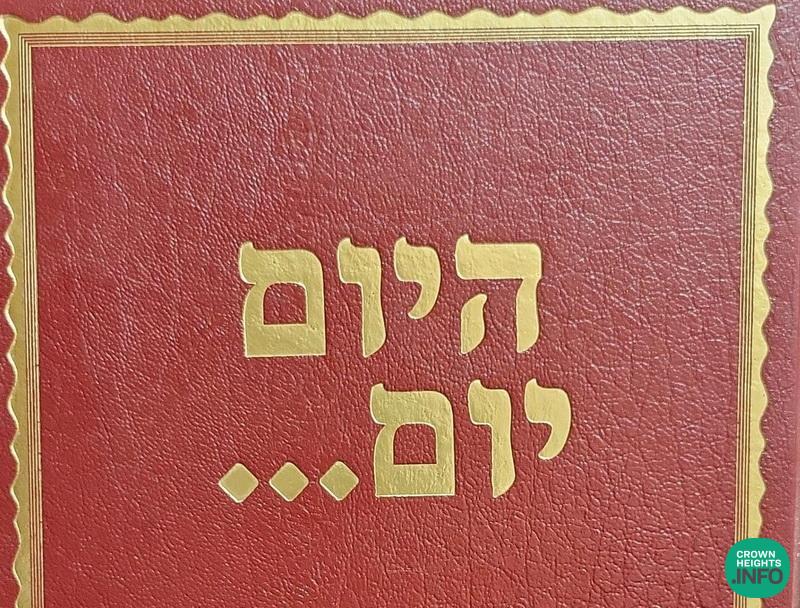
Hayom Yom — A Palace of Pearls and Diamonds
The Extraordinary Story of the Chabad Calendar for Every Day, for All Time
As we approach Yud Tes Kislev, the Rosh Hashanah of Chassidus, we are also preparing to begin another cycle of a remarkable calendar—Hayom Yom.
Unlike an ordinary calendar, which begins on Rosh Hashanah or January 1, Hayom Yom begins on Yud Tes (19) Kislev and concludes on Chai (18) Kislev of the following year.
It is a uniquely Chabad calendar, studied by Chassidim every single day throughout the year.
But how did Hayom Yom come about? What was its original purpose? And why, more than eighty years after its publication, does it continue to occupy such an important place in the daily life of a Chabad Chossid?
The story begins in 1940.
The Frierdiker Rebbe had recently arrived in America. During a Pesach Farbrengen that year, he expressed his desire to gather together the customs of Chabad, handed down through the generations of the Rebbeim, and compile them into a Sefer HaMinhagim.
He explained “that it is very important that we should gather together all Chabad customs from all the Rebbeim, and to establish a Sefer HaMinhagim, a book that compiled all these customs.
“And they should be adjusted for daily life. It should be a rulebook for Chassidei Chabad with their customs, with short essays and short stories. Such a booklet, the Rebbe says, can be organized only by someone who is a deep Pnimi, a very inward, wholesome, organized person with a broad and a deep mind.
“I am looking forward, based on the successes that I’ve had with G-d’s help, that I will succeed in this. Ultimately, this will happen for the benefit of Anash.”
The Frierdiker Rebbe envisioned something that would bring together the traditions, customs, and teachings of Chabad and make them part of a Chossid’s everyday life.
Almost three years later, that vision began to take shape.
On Chof (20) Kislev, 5703, the Frierdiker Rebbe wrote a letter to his beloved son-in-law, who would later become our Rebbe.
Referring to the famous letter of his father, the Rebbe Rashab, describing Yud Tes Kislev as the Chag HaChagim, the Festival of Festivals, and the Rosh Hashanah of Chassidus, he requested:
“Based on the letter of my father (the Rebbe Rashab) about the Yom Tov, the Chag HaChagim of Yud Tes Kislev, that it is a Rosh Hashana for Chassidus Chabad, I ask you to please organize a calendar for the year which starts Yud Tes Kislev this year to Yud Tes Kislev next year. And in it, I want three things.
“Number one, it should include the Shiurim of learning, what we must learn on a daily basis. Chumash; the daily portion of Chumash with Rashi, based on a weekly cycle. Tehillim; to say Tehillim after Davening Shachris, as it is divided on a monthly cycle. Tanya; the Shiurim of learning Tanya, as I organized and divided them according to the year, to complete on a yearly cycle. This is part one of what this calendar should consist of.
“Number two, it should include Minhagim of Chassidei Chabad.
“Number three, it should contain a collection of short sayings from Chassidus, and the paths and the ways of Chassidim, the conduct of Chassidim, short maxims that are appropriate for each day of the year.
“The name of this Luach, the name of this calendar should be ‘Hayom Yom… Luach Or Zorua L’Chassidei Chabad’—a calendar of implanted light for Chassidei Chabad.”
Three elements. One extraordinary calendar.
Let’s examine them.
Chumash, Tehillim, and Tanya — Chitas
The first element was the establishment of a unified daily cycle of Chumash, Tehillim, and Tanya, known by the acronym חת”ת—Chitas.
The daily study of Chumash with Rashi was already practiced by the Alter Rebbe and his Chassidim. Each day they studied the corresponding portion of the weekly Parsha, completing the entire Parsha every week.
The daily recitation of Tehillim according to its monthly division was introduced by the Frierdiker Rebbe before his arrest in 5687 (1927). He instructed Chassidim to begin reciting the daily portion after Shachris.
Only later did it become clear that this instruction had served as a spiritual preparation for the arrest and subsequent liberation that followed.
But the third element, the daily study of Tanya, introduced something new.
Chassidim had long maintained various customs of studying Tanya. One widespread practice was to learn a Perek Tanya each week, repeating that same chapter every day.
The first section of Tanya, Likutei Amarim, with the introduction, contains fifty-four chapters, corresponding to the fifty-four Parshiyos of the Torah in the traditional reckoning. By following this practice, Chassidim could complete that section over the course of a year.
Now the Frierdiker Rebbe introduced a new arrangement: a daily division that would enable every Chossid to complete the entire Tanya, all five sections, every year, beginning and concluding on Yud Tes Kislev.
Thus, the daily cycle of Chitas became an integral part of Hayom Yom.
The Minhagim — Preserving the Traditions of Chabad
The second element was the collection of Minhagei Chabad.
This is particularly fascinating.
In many discussions between our Rebbe and the Frierdiker Rebbe, as well as in the Sichos of the Frierdiker Rebbe, we discover customs that were previously unknown to many Chassidim.
Sometimes the Frierdiker Rebbe explicitly stated that he was revealing something new.
At other times, he explained that certain customs had previously been observed only by particular individuals or exceptional Chassidim, rather than by everyone.
There were also differences between communities. Chassidim from one town followed certain customs, while Chassidim from another town followed others.
We find references to such customs in Shaar Hakolel, authored by Reb Avrohom Dovid Lavut, our Rebbe’s great-grandfather, and in the writings of Reb Chaim Noeh. These works preserve many details about the practices of Chassidim throughout the generations.
But there had not been one universally accepted, comprehensive collection of Minhagei Chabad.
Hayom Yom was the first systematic effort to bring together Minhagei Chabad in a daily calendar, making these customs accessible to every Chossid and incorporating them into his daily life.
This was precisely what the Frierdiker Rebbe had envisioned almost three years earlier: a collection of Chabad customs and traditions, compiled by someone with the depth, knowledge, and understanding necessary for such a task.
Something to Live With Every Day
The third element was a collection of short teachings from Chassidus, together with guidance concerning the ways and conduct of Chassidim.
Not lengthy discourses.
Not complicated philosophical discussions.
Rather, short, meaningful teachings that would inspire a Chossid and give him something to live with every single day.
And here we discover something remarkable about the calendar itself.
The Frierdiker Rebbe requested a calendar beginning on Yud Tes Kislev—but he sent the request only on Chof Kislev!
In other words, the new calendar year had already begun!
Furthermore, the completed calendar was published only approximately three months later, in time for Yud Alef Nissan.
Yet it remained the calendar for that very year, 5703–5704 (1942–1943).
Why?
Because Hayom Yom was never intended merely as a calendar for keeping appointments.
It was a calendar for living.
Although originally prepared for one particular year, its teachings were never limited to that year.
I have heard from many Chassidim, including those who were not Chabad Chassidim, that they continued studying Hayom Yom daily for many years afterward.
A calendar originally prepared for one particular year became a calendar for all time.
And throughout the years, our Rebbe repeatedly encouraged us to consult Hayom Yom to discover the significance and message of each particular day.
A Palace with 383 Chambers
Perhaps the most beautiful description of Hayom Yom comes from the Frierdiker Rebbe himself.
A few months after commissioning the work, following its publication, he wrote an extraordinary letter to Reb Alexander Cohen.
He expressed his delight with the completed book:
“Most certainly you already got this book: Hayom Yom.
“It’s a small format book, like a Chossid has to be, small to himself. But it is sprinkled, loaded with pearls and diamonds of the highest quality. It is a true Chassidic culture work.
“G-d Almighty, B’lei Ayin Hora, granted my son-in-law to be able to erect such a grand, splendid palace, a Chassidishe palace with 383 chambers, that meaningful speech streams forth every single day. Every day says something. It is the true Hayom Yom. Today is a day.”
Imagine that description!
A small book, like a Chossid who considers himself small and humble.
Yet within that little volume lies a magnificent palace, containing 383 chambers—corresponding to the 383 days of the original calendar, which began in the leap year 5703—filled with the finest pearls and diamonds.
Every chamber has something to say.
Every day carries its own message.
This was the pride and delight the Frierdiker Rebbe took in the work.
And throughout the years, whenever our Rebbe referred to Hayom Yom, he consistently attributed the work to the Frierdiker Rebbe.
Although our Rebbe had compiled and arranged it, he never presented it as his own independent work.
On the contrary, he emphasized that the Frierdiker Rebbe had reviewed the entire book, from cover to cover, and approved every word.
The Secret Hidden in the Opening Words
I once heard a fascinating observation from Rabbi Seligson, who devoted many years to studying Hayom Yom.
With the Rebbe’s approval, he published three volumes of his own commentary on Hayom Yom, offering many original insights.
One of his observations concerns the very first words of the calendar.
The opening entry, for Yud Tes Kislev, begins:
יום התועדות וקבלת החלטות
A day of Farbrengen and the adoption of good resolutions.
Rabbi Seligson pointed out a remarkable parallel to the opening words of the Rambam’s Mishneh Torah:
יסוד היסודות ועמוד החכמות
The first letters of these four words form the letters of Hashem’s Name:
יוד־הא־ואו־הא
And remarkably, the opening words of Hayom Yom also begin with those same four letters:
יוד־הא־ואו־הא
A beautiful connection between the opening of the Rambam’s great work and the opening of Hayom Yom.
Another Hint Hidden in the Name
A friend of mine, a Shliach in Eretz Yisrael, once shared another interesting observation.
Throughout Jewish history, authors have sometimes incorporated subtle hints to their names within the titles or introductions of their works.
Consider the name Hayom Yom.
The words יום יום—Yom Yom—can also be understood as containing a hint to the names of the Frierdiker Rebbe and our Rebbe.
The first יום:
יוד־ואו־מם — יוסף ומנחם
The second יום:
יוד־ואו־מם — יצחק ומענדל
The two Yuds stand for Yosef and Yitzchok, the two Mems for Menachem and Mendel, with the Vav connecting them.
A hint to Yosef Yitzchok, the Frierdiker Rebbe, whose teachings form the substance of the book, and Menachem Mendel, our Rebbe, who compiled and arranged it.
Whether we look at the opening words or the title itself, we discover another layer of meaning in this remarkable little volume.
Today Is a Day!
I am reminded of something Rabbi Chadokov would often relate.
He once entered the Frierdiker Rebbe’s room, and the Frierdiker Rebbe expressed himself with the words Hayom Yom.
Rabbi Chadokov, who was a Yekke, would repeat the expression in his characteristic German-Jewish pronunciation:
“HAYOM YOM! Today is a day!”
And that is really the entire message.
A day is not simply another square on the calendar.
Every day is precious. Every day has a purpose. Every day contains its own Chassidic teaching, its own pearl, its own diamond, waiting to be discovered.
As we approach Yud Tes Kislev and begin another cycle of Hayom Yom, let us dedicate ourselves to gathering those precious pearls and diamonds, the finest treasures of Chassidus.
And above all, let us live with them.
Not merely to read Hayom Yom.
Not merely to study Hayom Yom.
But to make every day truly Hayom Yom—Today is a day!
And if you’d like to make Hayom Yom part of your daily routine, you can listen to my daily podcast, in which I explore the teachings of each day’s Hayom Yom in depth. It is available in English on Chabad.org, in the Hayom Yom section of Daily Torah Study, as well as on all major podcast platforms. The Yiddish version is also available on https://www.youtube.com/@chassidus.
“HAYOM YOM! Today is a day!”
A Gut Yomtov, Chassidim!
לשנה טובה בלימוד החסידות ודרכי החסידות תכתבו ותחתמו
Rabbi Yosef Katzman