

Weekly Dvar Torah: Looking for the Inside
This week we enter the month of Elul, and with it begins one of the most personal conversations a Jew has with Hashem.
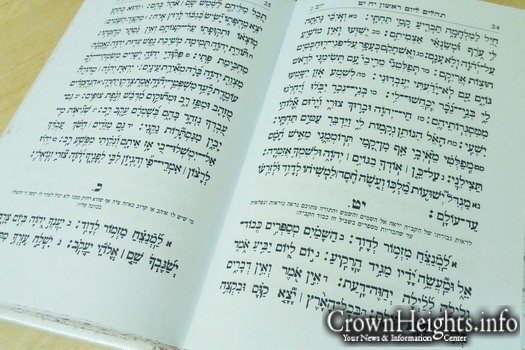
Every day throughout Elul we recite Chapter 27 of Tehillim, L’Dovid Hashem Ori V’Yishi. In it we say:
“Lecha Amar Libi, Bakshu Panai; Es Panecha Hashem Avakeish.”
“Of You, my heart says: ‘Seek My face.’ Your face, Hashem, I will seek.”
The Frierdiker Rebbe asks: Why does Dovid HaMelech say that it is his heart speaking? Our relationship with Hashem is supposed to involve understanding—“Da Es Elokei Avicha,” “Know the G-d of your father.”
And what exactly does it mean to “seek Hashem’s face”?
Panim means a face, but it also means the inside, the inner dimension of something. During Elul something begins stirring inside a Jew, coming from somewhere deeper than intellect—from the Pintele Yid, the spark of G-dliness within the Neshama that never stopped yearning for its Source.
Lecha Amar Libi. My heart begins talking.
And what does it say?
Bakshu Panai.
Stop looking only at the outside. Start looking for the inside.
This is the real Cheshbon Hanefesh of Elul.
Every successful businessman knows that from time to time he must stop and take stock. What is working? What isn’t? What needs strengthening, and what needs correcting?
A Jew does the same thing in Elul. But our accounting goes deeper than just counting Mitzvos and Aveiros. We begin asking a more fundamental question:
What am I doing here?
Human beings are the choicest of creation. We dominate the world and utilize everything around us. Yet animals don’t commute to work, fly across the world for business meetings, or spend their lives worrying about putting bread on the table. Much of creation finds its sustenance waiting for it wherever they are.
And we, the crown of creation, must work, sweat, travel and struggle.
Why?
Elul says: Bakshu Panai.
Look inside.
You thought you traveled somewhere because there was a business deal waiting. Perhaps Hashem had another reason. Perhaps there was a Jew there who needed a word of Torah or some Ahavas Yisroel. Perhaps you had to Daven Mincha there, give some of your profits to Tzedakah, or make a Bracha in a corner of the world waiting to be elevated.
The business was real. The money was real. But that may have been only the outside.
Elul asks us to discover the Panim.
And then comes another remarkable Elul tradition.
From the second day of Rosh Chodesh Elul until Yom Kippur, Chabad Chassidim say an additional three chapters of Tehillim every day. The Frierdiker Rebbe relates an extraordinary history behind this custom.
When he was nine years old, his father, the Rebbe Rashab, spoke to him about Tehillim in Elul. The Rebbe Rashab had received the tradition from his father, the Rebbe Maharash, when he was nine. The Rebbe Maharash had received it from the Tzemach Tzedek at the same age, and the Tzemach Tzedek, at nine, received it from the Alter Rebbe, tracing the tradition back through the Maggid and Baal Shem Tov to the prophet, Achiyah HaShiloni.
Generation after generation. Rebbe after Rebbe. Three chapters of Tehillim.
The Tzemach Tzedek later revealed the extraordinary power of those words of Tehillim. When he perceived a grave accusation Above against the Jewish people, he was instructed by his grandfather, the Alter Rebbe, to establish a Minyan to recite Tehillim early every morning. The decree was annulled.
He later said that if we only knew the power of Tehillim and what it accomplishes Above, we would recite it at every opportunity. Tehillim shatters barriers, rises to the greatest heights and brings down Divine kindness and mercy.
Maybe that too is Bakshu Panai.
There are moments when all our understanding and calculations can take us only so far. Then a Jew opens a Tehillim and speaks from somewhere deeper.
Lecha Amar Libi.
The heart speaks.
But there is one more place where Elul challenges us to look beyond the outside.
At another Jew.
The Alter Rebbe’s Chassidim once complained about the suffering they endured from the coarse Jews among the Misnagdim who persecuted them.
The Alter Rebbe responded with a teaching he had heard from the Maggid in the name of the Baal Shem Tov:
“To love a fellow Jew is to love G-d. You are children of Hashem your G-d. One who loves the Father loves His children.”
Not only the children who agree with you.
Not only the children who treat you properly.
His children.
I knew an elderly Chossid who had spent seven years in a Soviet Gulag because another Jew informed on him. Years later, in Israel, he encountered the very man who had betrayed him.
He brought him home—and hosted him for three weeks.
How could he do that?
The Chossid explained that he could not judge a Jew who had lived under Soviet-Stalinist persecution. Who knew what pressure and terror that man had endured?
The outside said: Informer. Seven years of my life.
The inside said: A Yid.
That is Bakshu Panai.
And perhaps that is the deepest Cheshbon Hanefesh we can make as we enter Elul.
Not only: How many things did I do right this year, and how many did I do wrong?
But: What have I been looking at?
Have I been looking at the outside of my life—or searching for its Panim?
Have I looked at the aggravation, work and struggles—or asked why Hashem placed me exactly where He did?
Have I looked at another Jew’s behavior—or searched for the Jew underneath it?
And when we begin looking that way at ourselves and at one another, we can ask Hashem to look at us the same way.
Don’t look only at our outside.
Look beyond our failures, distractions and mistakes.
Look at the Pintele Yid inside. Look at the Neshama that never stopped being Yours, the Jew who underneath everything still wants to be close to You.
Lecha Amar Libi, Bakshu Panai.
Our heart is calling.
Es Panecha Hashem Avakeish.
We are looking for Your inside.
Hashem, please look at ours.
And may that meeting of Panim El Panim bring us a year of Divine kindness and mercy, a sweet and happy New Year materially and spiritually, and the ultimate Panim El Panim—the coming of Moshiach, when the inner G-dly purpose of this entire long journey will finally be revealed.
Have a Shabbos of looking inside,
Gut Chodesh, Gut Shabbos
Rabbi Yosef Katzman