


Weekly Dvar Torah: One Heart – Prerequisite for Receiving the Torah
As the days of Sefiras HaOmer draw to a close, we find ourselves standing at the edge of one of the most powerful moments in the Jewish calendar. For seven weeks, beginning with the Exodus from Egypt, the Jewish people journeyed step by step toward Har Sinai. Forty-nine days of refinement. Forty-nine stages of emotional and spiritual elevation. The slaves of Egypt transformed themselves into a people capable of receiving the Torah of Hashem.
Yet these same days are overshadowed by mourning.
During this very period, 24,000 students of Rabbi Akiva passed away in a devastating plague because, as our sages tell us, they did not show sufficient respect for one another.
They were giants of Torah. They were disciples of the great Rabbi Akiva, the sage who taught that “Ve’ahavta L’reiacha Kamocha” — loving your fellow Jew like yourself — is a fundamental principle of the Torah. And yet, somehow, the refinement of interpersonal sensitivity did not fully manifest itself among them.
Torah alone is not enough if it does not penetrate the heart.
One can be brilliant in scholarship and still fail in sensitivity. One can master holy texts and yet miss the holiness of another human being. Therefore, these very days became days dedicated not only to preparing intellectually for Matan Torah, but also to emotionally refining ourselves in Ahavas Yisrael, respect, unity, kindness, and sensitivity toward one another.
Perhaps this is one of the reasons the Rebbe placed the Possuk “Ve’ahavta L’reiacha Kamocha” among the famous Twelve Pesukim introduced during the Sefira days, fifty years ago. The Rebbe was not merely giving children verses to memorize. He was giving the Jewish people a blueprint for life.
Torah begins with how a Jew looks at another Jew.
Torah begins with love. Torah begins with respect.
And all of this reaches its climax as we approach Rosh Chodesh Sivan.
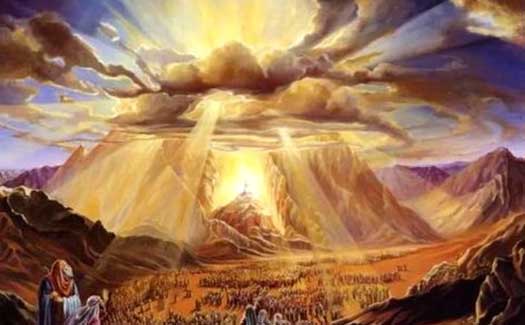
The Torah describes the Jewish people arriving at Sinai with unusual language: “Vayichan Sham Yisrael Neged Hahar” — “And Israel encamped there opposite the mountain.” The commentators immediately notice that the verse shifts into singular form. Not “they encamped,” but “he encamped.” Rashi explains: “K’ish Echad B’lev Echad” — like one person with one heart.
That was the moment.
That was when Heaven declared the Jewish people ready to receive the Torah.
Not after miracles.
Not after splitting seas.
Not after revelation.
Only after unity.
This is why the Rebbe encouraged that the Shabbos before Shavuos become a Shabbos of unity, where Jews gather together in friendship, Farbrengens, and Ahavas Yisrael as preparation for receiving the Torah anew. And indeed, throughout the world, Yeshivas and Chassidic communities have embraced this Shabbos as a special time of togetherness and unity.
And this year, something astonishing happened.
The President of the United States declared this very week “Shabbat 250,” calling upon Americans to honor and observe Shabbos in recognition of 250 years of American independence and in appreciation of the contribution of the Jewish people and Jewish values.
What remarkable Hashgacha Pratis – Divine Providence.
Out of all weeks of the year, this recognition arrives specifically during the week of the Shabbos of unity before Matan Torah.
Suddenly, the message of Shabbos — rest, holiness, family, faith, and unity — is being acknowledged publicly on the national stage.
But perhaps the deepest lesson of these days emerges from two Hayom Yom entries connected to the end of Iyar.
The Hayom Yom of the 25th of Iyar discusses the teaching of the Alter Rebbe: “The reward of a Mitzvah is the Mitzvah.” The Frierdiker Rebbe then relates the story of a poor Chossid who spent money he could barely afford in order to send good news by express runner – and not just regular mail – to the Alter Rebbe, informing him that several Chassidim had been freed from imprisonment. Others argued that he should not spend such precious money, because of his personal financial status, and his family’s difficult health situation, which drained him of all funds. But he insisted that bringing joy and relief to the Rebbe sooner rather than later was worth everything to him.
The Alter Rebbe later blessed him that he should always be able to deliver good news.
And indeed, his life was transformed. Blessing entered his home. Healing entered his family. Joy entered his life.
The Mitzvah itself became the reward.
Not only in the World to Come, but in this world.
Then comes the Hayom Yom of the 26th of Iyar. The Frierdiker Rebbe emphasizes how careful one must be never to speak negatively about another Jew. Even subtle wording matters. A writer once referred to Canadian Jews as “Jews living in cold Canada,” and the Rebbe sharply objected.
How can one call Jews cold?
Jews are warm. Jews are alive. Jews are precious.
What a remarkable sensitivity.
Not merely avoiding slander.
Avoiding even labels.
Avoiding cold descriptions.
Avoiding words that diminish another Jew.
And perhaps here lies the entire preparation for Matan Torah.
Not merely learning Torah.
Not merely counting days.
But refining speech.
Refining attitude.
Refining the heart.
The students of Rabbi Akiva failed in this area, and Torah itself could not protect them.
But when Jews unite, when Jews speak warmly about one another, when Jews bring each other joy, encouragement, blessing, and good news — then they become vessels capable of receiving the Torah anew.
Perhaps this is the real meaning of preparing for Sinai.
To become the kind of people in whose presence another Jew feels respected, uplifted, and loved.
And perhaps that itself hastens the moment when once again the entire world will stand united around the mountain of Hashem, with the coming of Moshiach, speedily in our days.
Have a united and uplifting Shabbos,
Gut Shabbos, Gut Chodesh
Rabbi Yosef Katzman