


Mamdani Unveils Proposal for Redesign of Brooklyn’s Grand Army Plaza
by CrownHeights.info
New York City Mayor Zohran Mamdani this week unveiled a sweeping proposal to redesign Grand Army Plaza, promising a safer, more accessible gateway to Prospect Park and surrounding cultural institutions. But while City Hall is presenting the plan as a bold new vision, much of the groundwork for the transformation predates Mamdani’s administration by years.
The proposal calls for a “transformational redesign” of the historic Brooklyn traffic circle, long criticized as confusing and dangerous for pedestrians and cyclists. Advocates and planners have for years pointed to the plaza’s heavy traffic flow and fragmented pedestrian islands as major safety concerns, with some describing it as “a highway disguised as a roundabout.”
According to City officials, the new plan aims to rebalance the space—prioritizing pedestrian access, improving cycling connections, and restoring the plaza’s function as a true public gathering place. The redesign would better connect key destinations including Prospect Park, the Brooklyn Public Library, and the Brooklyn Botanic Garden.
However, the push to overhaul Grand Army Plaza did not begin with Mayor Mamdani.
Urban planners, advocacy groups, and even prior administrations have spent years studying and proposing changes to the site. As early as 2008, a design competition explored major alterations to traffic patterns and pedestrian access, though only limited improvements were ultimately implemented. In 2011, the city’s Department of Transportation carried out safety upgrades aimed at improving accessibility and reducing hazards, part of an ongoing effort to “close the gap on safety” at the plaza.
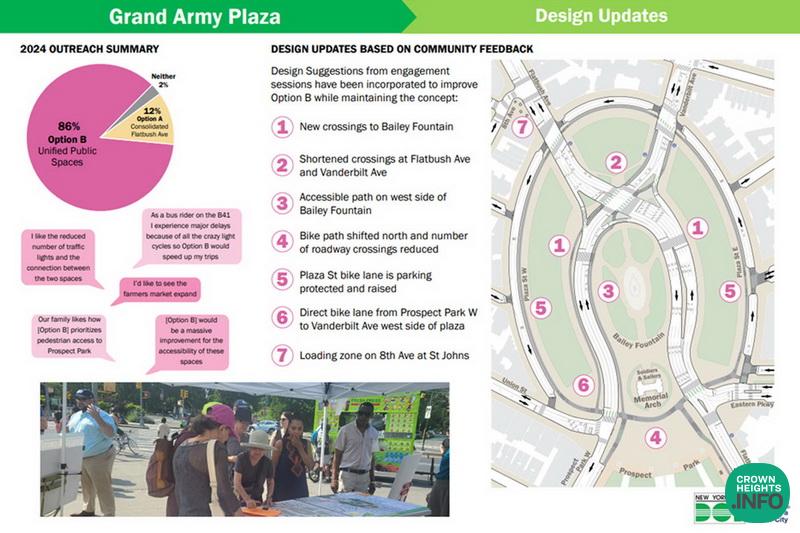
More recently, calls for a comprehensive redesign intensified. Community advocates and transportation groups have repeatedly urged the city to move forward with long-discussed plans, with renewed pressure emerging in the years leading up to Mamdani’s tenure.
At the same time, significant restoration work has already been underway at the site. In 2025, the iconic Soldiers’ and Sailors’ Memorial Arch—first dedicated in 1892—completed a major $8.9 million restoration project backed by city funding. The plaza itself, originally designed in 1867 by Frederick Law Olmsted and Calvert Vaux as the grand entrance to Prospect Park, has undergone multiple redesigns and upgrades over more than a century.
This long history underscores a key reality: the newly announced plan is less a starting point and more the latest chapter in an ongoing effort to modernize one of Brooklyn’s most prominent public spaces.
While Mayor Mamdani’s proposal may accelerate momentum, the vision for a safer, more pedestrian-friendly Grand Army Plaza has been years—if not decades—in the making.
City officials say the next steps will include community input, design refinement, and eventual implementation timelines. As the process moves forward, the success of the plan may ultimately depend on whether it can finally deliver on ideas that have been circulating long before the current administration took office.