Albania, a Holocaust Haven, Welcomes Its First Permanent Chabad Emissaries
by Tzali Reicher – chabad.org
Tirana refuses to be gray. After communism fell, the Albanian capital repainted its apartment blocks and government buildings in bold colors as a deliberate break with the past.
But when Rabbi Yossi Fridman walked those streets for the first time in August, it was the language, not the sights, that caught his ear.
“I couldn’t go two minutes without hearing Hebrew on the street,” he says. “It was a very pleasant surprise.”
For most of the 20th century, Albania was one of Europe’s most isolated countries, as it cut itself off from the liberal West and communist East. Today, a direct flight from Israel takes a little more than two hours, with thousands of Israelis arriving each summer.
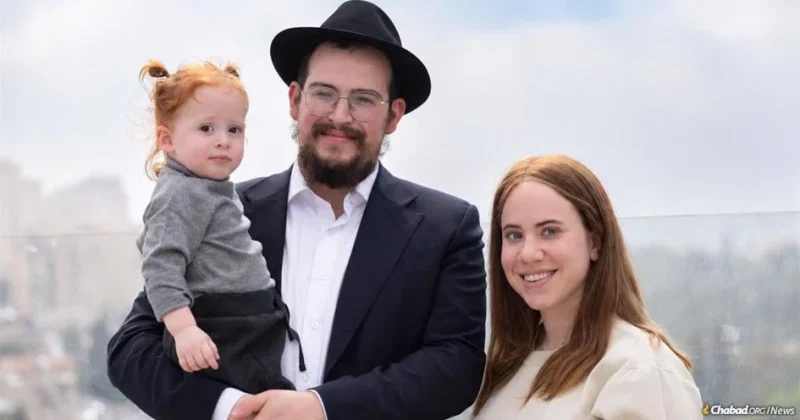
Fridman, his wife, Etka, and their baby son, Meir, will lead Albania’s first permanent Chabad-Lubavitch center. The appointment was announced on Sunday at the banquet of the International Conference of Chabad-Lubavitch Emissaries, making Albania the latest country with a full time Chabad presence. At the same banquet, Rabbi Yossi and Rochele Krinsky were named to lead the first permanent Chabad center in Slovenia.
During his summer visit, everyone Fridman met was glad to hear that Chabad was coming and that commercial kosher food would soon follow. Jews and non-Jews alike stopped him to talk. He returned before Rosh Hashanah, carrying a shofar and tefillin.
“I didn’t have to ask people if they wanted to perform a mitzvah,” he says. “People were so excited to put on tefillin, to connect and to talk, and to have someone provide for their Jewish needs. Even people that aren’t so connected with their Judaism in Israel or wherever else they come from were happy to welcome us.”
There isn’t an exact count of how many Jewish people live in Albania. Fridman believes there are several hundred.
“Our main work is to find the community, serve it and look after the thousands of travelers,” says Fridman.

The Fridmans will stay through the crowded summers and the quiet winters, and they know it won’t be easy. “It’s a small community, and plenty of people weren’t sure if they were ready for the establishment of a permanent Jewish community,” he says. “But we’re up for it.”
Fridman grew up in Moscow, where his parents, Rabbi Yakov and Sashi Fridman, served as Chabad emissaries to the city’s Israeli expat community. Their Shabbat table was filled every week with Hebrew-speaking tourists and businesspeople.
“I grew up like this, and I always wanted to join the ranks of the Rebbe’s emissaries,” he says. “I knew it was something I, together with my family, would do.”
Etka Fridman grew up helping newcomers learn about their Jewish heritage through the work of her parents, Rabbi Kasriel and Yafa Shemtov, at the Mayanot Institute of Jewish Studies in Jerusalem.
The couple considered communities across Europe and the United States, but Albania kept coming up. More and more Israeli visitors were arriving every summer, and the Muslim-majority country had grown unusually close to Israel. They also found a proud Jewish history.

More Jews at the End of the War
Theories suggest that a community presence in Albania goes back 2,000 years, when the first Jews may have arrived around 70 C.E. as captives on Roman ships wrecked off the southern coast.
The firmest evidence is found in Saranda, the ancient port of Onchesmos, across the water from the Greek island of Corfu. In 2003 and 2004, Albanian and Hebrew University archaeologists excavated the site, and found a synagogue built over earlier mosaic floors and enlarged in the fifth or sixth century. At the center of one mosaic stands a menorah, flanked by a shofar and an etrog.
More Jews were recorded living there in the 12th and 13th centuries, and after the Spanish expulsion of 1492, Iberian Jews settled in Albania’s seaports. The 1930 census counted 204 Jews in Albania, and the state formally recognized the community in 1937.
During the Holocaust, Albania distinguished itself and cemented a place in Jewish memory.
As Nazi Germany rose, German and Austrian Jews fled to Albania. In 1938, its embassy in Berlin was still issuing them visas when other European countries had shut their doors. At the Wannsee Conference in January 1942, the Nazis listed 200 Jews in Albania for murder. Albanian Muslims and Christians hid them, along with hundreds of refugees, and kept protecting them after German forces occupied the country in 1943. In Berat alone, 60 families sheltered Jews in their homes and basements.
By the war’s end, about 2,000 Jews lived in Albania. It was the only country in Nazi-occupied Europe to finish the war with more Jews than it had at the start.
The rescuers acted out of besa, the Albanian code of honor that binds a host to protect a guest. Fridman sees it today.
“The culture is to be unbelievably welcoming,” he says. “They do everything they can to welcome and protect their guests. Guests are of primary importance. It’s a point of pride and honor.”

The Jewish community struggled under the tyranny of Communism. Enver Hoxha’s dictatorship banned all religion, Judaism included, from 1967 until 1990 and cut the community off from the Jewish world. After the regime fell in 1991, nearly all of Albania’s Jews emigrated to Israel. Only a dozen or so stayed, but in recent years, Albania has flourished as it promotes tolerance, inclusion and warm ties with Israel.
Chabad has served the Jewish community from across the border. In 2010, Rabbi Yoel Kaplan, director of Chabad-Lubavitch of Thessaloniki in Greece, was installed as Albania’s first chief rabbi and served Jews across the Balkans. At the time, he said he hoped a full-time emissary would soon settle there. This August, Rabbi Mendy Kotlarsky, executive director of Merkos 302, visited Albania. The community celebrated the visit and called it an opportunity for Albania’s Jews to connect with the global Chabad movement.
Fridman sees that enthusiasm and says more locals contact them every day.
“We know it may start small,” he says. “But we’ve already seen tremendous interest. The local community is a real family, and we’re looking forward to joining it, and offering more and more.
“Even if one Jew needs help,” says Fridman, “we will be there.”