


Weekly Story: Simchas Beis Hashoeiva
by Rabbi Sholom DovBer Avtzon
The thoughts which I am posting this week, are thoughts that I said during at a public farbrengen as part of this year’s Simchas Beis Hasho’eiva farbrengens. Bezras Hashem, I will add next week a few points I heard from others.
As always, your feedback and comments are greatly appreciated and most welcome.
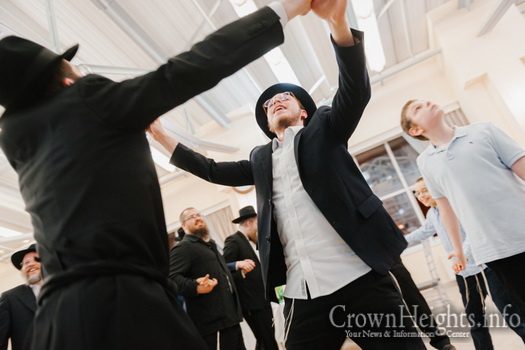
Simchas Beis Hashoeiva occurred on Sukkos in connection to the pouring of the water libation on the Mizbeiach, at the same time the wine was poured down the other tube, when the morning sacrifice that was brought on Sukkos.
The question is what is the reason for this tremendous celebration? a celebration that was so splendid that our sages state, “Whoever has not witnessed this celebration did not see a true celebration in their life!”, describing these festivities as the most joyous celebration one can experience.
The Talmud gives a few reasons why we began celebrating it, in the first place. And one of the reasons is that there was an argument concerning this mitzvah. The Torah explicitly commands us to bring wine libations together with every sacrifice. On Sukkos, when the Torah describes the sacrifices that are brought every day of Sukkos, the Torah alludes to the fact that we should also bring a water libation.
However, during the time of the second Beis Hamikdash, there arose a powerful group of Jews, who only followed what was written explicitly in the Torah and did not accept the teachings and guidance of our Sages, or even the laws that were transmitted over the generations as commandments and guidance that Moshe gave over orally when he descended from Mount Sinai.
So, in order to enhance our respect and commitment to follow the guidance of our Sages, the people began rejoicing not only while this mitzvah was being fulfilled in the morning, but they began celebrating the night before, as the preparations of sending a Kohen to draw the water that will be used. It indeed became a tremendous celebration, or should we say the celebration of a lifetime.
We also see this concept of rejoicing in fulfilling the words of our sages in hilchos Shabbos.
The Torah teaches us השבת ביום תבערו אש לא – Do not make a fire on Shabbos. However, the Tzidukim translate it to mean, A fire should not be used on Shabbos, even when the fire was burning before Shabbos.
However, our sages taught, that under certain conditions, it is permissible to place a pot on the bleich before Shabbos which is covering the fire and let it keep food warm or even conclude its cooking on Shabbos.
To demonstrate that we follow the words of our sages, and not Chas v’sholom the tziddukim, the custom is to eat on Shabbos day something hot or at least warm.
Perhaps this can explain the following story.
When the Frierdiker Rebbe traveled out of Lubavitch, in many cities he found families that he can trust their kashrus. In one such city, when it came Shabbos, the hostess figured I will give the Rebbe a large portion and he will eat whatever he desires and leave over whatever he doesn’t want to eat That is much better than to give him a smaller portion and he might be hungry.
So on Shabbos afternoon she served the first portion of fish and whatever side dish, and as she expected, the Rebbe ate only a part of what he was served. Then to her surprise, although she gave the Rebbe a large portion of cholent, he ate everything that was on the plate. But when she served the next course of chicken or meat and its side dishes, the Rebbe once again ate only a small part of it, leaving a large amount untouchrf.
The hostess concluded that evidently the Rebbe only enjoys her cholent, so the following Shabbos, while she served a smaller portion of fish, she gave him a larger portion of cholent.
This time the Rebbe also ate whatever cholent was on his plate, but when the plate was being removed he mentioned that next time she should only serve him only a small portion of cholent. He continued, the reason I ate all the cholent this week and last week is because one is not supposed to leave over any cholent that is on their plate.
I heard this story from my father when I was a youngster, and I always wondered what is the reason for this custom, of not leaving over cholent (or whatever hot food you are eating that Shabbos.
But perhaps the reason is as follows, since we eat a warm/hot food on Shabbos to demonstrate and make a statement that we are following the guidance and teachings of our Sages, so if someone sees some leftover cholent (or whatever hot food that was being served) on my plate, they might think that I didn’t eat it because I question the validity of this ruling of our sages. So to prevent this possibility the Frierdiker Rebbe forced himself to eat it up completely.
The Torah is eternal, and therefore we should apply the lesson from this rejoicing during Sukkos (Simchas Beis Hashoeuva) to our lives today. Not only should we be proud and happy that he have that gift of the Rebbe and his teachings and guidance, as it gives us clarity in our mission and purpose of life, but even or perhaps better said, especially nowadays, we are able to apply his teachings to our everyday life and world conduct.
The realization of how tremendous this gift is to us, [and the goan Yaakov (Jewish pride) that every Jew feels about their connection to Hashem, His Torah and Mitzvos,] should result that we celebrate it with tremendous happiness and joy, and with a strong declaration there whatever the Rebbe says, applies to us now just as it applied to us at the time and moment we heard it.
To put it in a few words, we will quote the famous saying of thr tzaddik Reb Meir of Premishlan, “When one is connected to above, they don’t fall down.” As we see from the following story, the benefits of celebrating your connection to the Rebbe, and to Yiddishkeit is immeasurable.
The Alter Rebbe instructed a chossid to move from his village or small town and settle in the capital Petersburg. There he was to become a dealer in precious stones and sell to the nobility at a low markup price. And if he doesn’t cover his expenses, he shouldn’t be worried, as the Rebbe will cover the deficit.
The Rebbe explained that the real profit will be that he will hear the wives of the nobility discuss the various decrees their husbands are considering implementing against the Jewish people. Knowing this information before it is being voted on is crucial, as the Rebbe can then decide which nobleman to approach and how best to have the decree rejected, delayed or at least minimized.
In some situations they might ask their husbands to be kind to the Jews, as they see that Jews are very honest in their business. They could say, show me another diamond dealer that has such fair prices!
The chossid related that being that I was constantly dealing with the noble women, there was a time that I was in a situation that I was being tested if I can stand firm in the way a Jew should and must conduct themselves.
Suddenly I said to myself, You are a chossid of the Rebbe, so how can the Rebbe’s chossid fall so low, and that is what protected me from sinning.
This does not only apply to dancing throughout the night, every night of Sukkos, but it should be noticeable throughout the year,
Applying this concept of Sukkos to our daily life is essentially the entire concept of Sukkos.
Chassidus explains that being that a Sukka has four walls that surround us, by definition that is called a Makif. A Makif is explained as something that surrounds you, but is not internalized. Simply meaning you are learning a concept and you have a general idea, but it is still too complex to wrap your fingers/brain around it. So while you are aware of this concept, you don’t understand it thoroughly.
However, on Succos we are commanded to live / dwell in the Sukka (makif, as the sukka surrounds us from all sides) and internalize it, as the possuk states In a Sukka (makif) you shall dwell, [make it part of you].
Similarly, we are guided that when we shake the Lulav [together with the other three species] in all six directions, we are to bring the Lulav close to our hearts when we shake it. Here too, the directive is clear, internalize all that you are witnessing and learning.
A Taste of Chassidus
In lieu of explaining one concept of the weekly maamar in Likkutei Torah, I am posting a Chassidic thought that I heard recently from Rabbi Nissan Mangel sheyichye, which I personally enjoyed and though that it is quite illuminating.
One of the foundational teachings of Chassidus is the concept of Achdus Hashem, that everything is part of Hashem. In Chassidic terminology this is called either Yichud Ilaah and Yichud Tatuah.
The question is how can these concepts be explained in simple words, so that a regular person can truly understand it.
Years ago this was a difficult question, but nowadays it is easier to explain.
We are now sitting at a farbrengen, there are many individuals each one with their own appearance and personality. There are also various pieces of furniture, food, clothing etc. So you see a myriad amount of aspects.
But science teaches us that the truth is that what we described is only what we see, but in reality everything in this room is just matter. And matter itself can be broken down to molecules which can be broken further into Atoms. Then we are taught that every atom has three aspects (parts), protons, neutrons and electrons. Einstein then says, that everything is really made of of energy.
So you see that science states, that as different as every creation seems, in truth they are really the same, energy.
The only question or point that Einstein did not address, what is the essence of this ENERGY?
That is answered by Chassidus, that all forms of energy, is an extension of G-dliness, so everything in creation is part and parcel of Elokus (G-dliness).
Rabbi Avtzon is a veteran mechanech and the author of numerous books on the Rebbeim and their chassidim. He is available to farbreng in your community and can be contacted at avtzonbooks@gmail.com.









Sholom
I heard from Rabbi Nosson Gourarei , that the Freidike Rebbe N.E. said, that Kugel and Cholent are ” Halocha leMoishe Misinai”. Therefore he wouldn’t allow his children’s leftovers to be thrown out. But would eat it up, saying “Heilger Kugel and Cholent”.
Sholom DovBer Avtzon
I have heard of that saying, however, I have never heard that one is not to leave over kugel o. Their plate.
Therefore, I thought that perhaps the reason. Is as noted above.
Thank you