
‘They Danced With This Torah Before the Nazis. We’re Dancing With It After’
by Yisrael Eliashiv – chabad.org
The dancing at Chabad-Lubavitch at the Shore in Ventnor, N.J., was already underway on Simchat Torah 2023 when the horrific news from Israel, of the Oct. 7 Massacre, began to spread through the room. It came in fragments, each update worse than the last. Congregants turned to Rabbi Avrohom Rapoport, the center’s director, and asked whether they could still dance.
“Now we have to dance for ourselves and for all those who can’t dance anymore,” Rapoport told them.
So they kept going. Rapoport remembers laughing and crying at the same time, the joy of the holiday pressing against what they were hearing from the Holy Land.
“It was as if the Torahs were dancing for us,” Rapoport said. “We were just holding on.”
With the congregation watching him, he pointed to one of the scrolls in the circle. He had no answers, he told them, and did not know what lay ahead. “But one thing I do know. You see this Torah? They danced with this Torah before the Nazis, and we’re dancing with this Torah after the Nazis.”
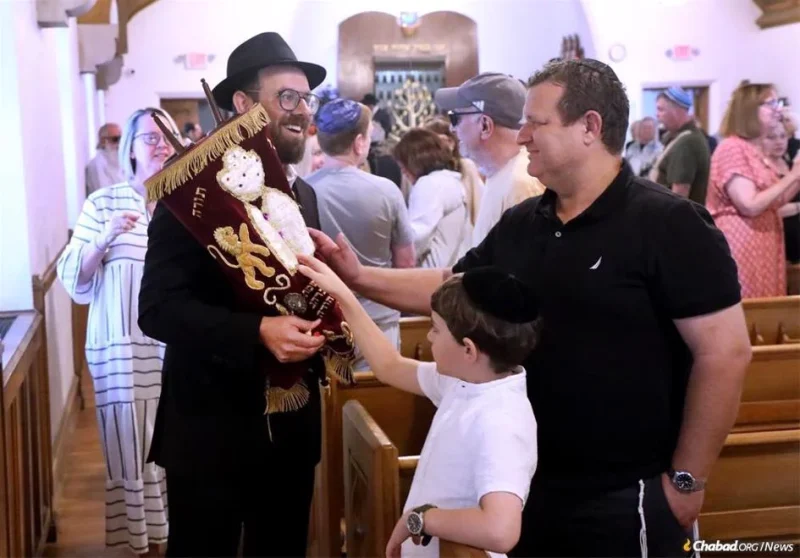
The scroll belonged to the Hammerschlag family, who had carried it out of Germany in 1939. It had long since ceased to be valid for public reading. The community used it to show to children, to teach bar mitzvah boys their portions and, once a year, to dance with on Simchat Torah.
This year, on the holidays of Shemini Atzeret and Simchat Torah, which begins on Oct. 2, the Hammerschlag Torah will join the Hakafot as a restored, kosher scroll, back in regular use. In Bellaire, Texas, another Torah that spent decades out of Jewish hands has made a similar return. Their stories bear out what Simchat Torah has always taught: The Torah accompanies the Jewish people through their darkest hours and their most joyous ones … and the dancing continues.

Through the Front Door
The Hammerschlag Torah’s story begins in Lauenau, Germany, where the family had deep roots. Local research has found evidence of a Hammerschlag-owned Torah there dating to at least the mid-19th century. Lennard Hammerschlag, whose grandfather Adolf Hammerschlag brought it out of Germany, says the family believes the scroll is about 200 years old. Some estimates put it older still.
When the family fled to Bulawayo, in what was then Southern Rhodesia, they were forced to give up nearly everything they owned along the way. Adolf made certain the Torah was not among the losses. It remained in the family for nearly 80 years.

In 2018, Lennard, his brother Marc, and a group from Stockton University brought the scroll back to Lauenau, into the room on the old Hammerschlag property that had once served as the town’s Jewish prayer space and is now part of a Greek restaurant. The Torah had once been spirited away under terrible circumstances. This time it came and went in peace.
“It was significant that I didn’t have to bring it in through the back door,” Hammerschlag said. “I brought it in through the front door.”

In Ventnor, the scroll served for years as the centerpiece of the Chabad center’s Holocaust exhibit. Hammerschlag wanted more for it than a display, and he and Rapoport had spoken about restoring it for years. When a sofer, a ritual scribe trained in writing holy Jewish scrolls including Torahs, mezuzahs and tefillin, finally gave them an estimate for the painstaking job, the figure exceeded the cost of a new Torah.
“Value-wise, you could buy a Torah for less than it costs to fix this one,” Rapoport said. “For us it wasn’t a money thing. This Torah has a story.”
The two were discussing the cost at a small Shabbat dinner hosted by Rapoport when a guest, Craig Beresin, moved from the far end of the table to avoid prolonging an unrelated disagreement. He sat down at random and found himself within earshot.
“I’m meant to hear this,” he recalls thinking, “and I’m not meant just to hear it and do nothing.”
His parents were elderly and in poor health, and he had been looking for meaningful ways to honor them. He pledged toward the restoration and began bringing others into the project.
When the scribe, Gad Sebbag, examined the scroll, he found fine parchment and fine lettering. The text on the entire Torah, however, was red. Jewish law requires the letters of a Torah to be black, and over the decades the ink had faded through shades of brown to a reddish hue, a condition known as chaludah. All 304,805 letters needed attention.
Restoring them meant tracing the hand of the original scribe, whose strokes, spacing and layout remained visible in the faded ink.
“When you trace his writing, you kind of relive his thought,” said the scribe, who more often writes new scrolls.
On August 30, 2026, the community gathered to complete the restoration. They screened the documentary “Saved from the Shoah: The Hammerschlag Family Torah Returns,” Hammerschlag filled in the final letter, and the congregation sang, danced and raised the scroll high in the Jewish tradition of hagbah. Its first formal reading came on Rosh Hashanah, when Hammerschlag was called for the third aliyah.

‘Like a Patient Thought to Be Lost’
In May 2015, Dr. George Leventon and his wife, Marge, traveled to Russia to help recover and restore Torah scrolls that had been kept out of Jewish communal ownership for decades since the early years of Soviet persecution. In their Moscow hotel, Marge unrolled the one that would eventually reach the Jewish community of Bellaire, Texas.
“We realized no one else had opened this Torah for 70-plus years,” she said. A sofer who examined the scroll soon afterward determined that it could be repaired and returned to ritual use.
George, a physician, reached for the language of his profession. “It was like a patient that was thought to be lost,” he said, “and getting the patient out of the ICU and into a recovery mode.”

An initial restoration followed in 2016, with further work in 2024 to prepare it for regular synagogue use. George restored the badly dried wooden rollers himself, Marge designed its mantle, and friends contributed two crowns and a yad, the pointer. For a time, the scroll was housed in an aron kodesh (“ark”) in the couple’s home. An expert who studied the script recognized it as the one preferred by Rabbi Shneur Zalman of Liadi, the founder of Chabad-Lubavitch, known as the Alter Rebbe.
The Leventons eventually placed the Torah on loan with The Shul of Bellaire. “Every time it comes out of the ark and it’s used,” George said, the moment carries the weight of history and of the people who carried the scroll before, whose memory, through it, is “still alive.”

On Sunday, Oct. 27, 2024, as the community marked a year since Oct. 7, the congregation formally dedicated it as the Am Yisrael Chai Torah. Rabbi Yossi Zaklikofsky, co-director of the Chabad center, recalled the prophet Ezekiel’s vision of the dry bones. “This Torah, like the dry bones in Ezekiel’s vision, seemed lifeless for decades,” he said, before being restored “word by word, letter by letter.”
Esty Zaklikofsky, who co-directs the center with her husband, said the name reflected what the community was living through.
“At the time, everybody was very focused on the hostages,” she said. “It really felt like this Torah had itself been held hostage for approximately 80 years. It wasn’t being used as a Torah is meant to be used, and here we were, decades later, with the Torah restored and everybody celebrating.”