


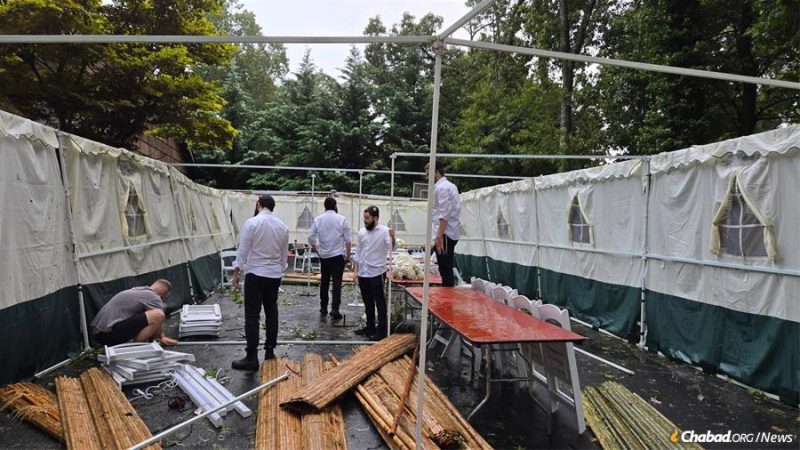
As Nor’easter Storm Lashes Eastern Coast, Sukkahs Fall and Rise Again
by Faygie Levy Holt – chabad.org
On the first night of Sukkot, September 25, the wind and rain had eased just enough for Rabbi Mendy Teldon to welcome 150 people into the sukkah at his home on Long Island, N.Y., where they heard Kiddush, made a blessing, and had a bite to eat, before returning to the warm and dry indoors. By the next day, the storm picked back up, and the sukkah came crashing down. Teldon, who directs Chabad-Lubavitch of Mid-Suffolk with his wife, Brocha, was the only one inside at the time, and walked away unharmed.
The early-season nor’easter storm hit the Northeast United States over the weekend with soaking rain, strong winds and massive waves. Gusts reached as high as 70 miles an hour in some places, and more than 80,000 customers across the region were still without power by Sunday afternoon. Falling trees killed one person and injured four others, including children. Trees, power lines and sukkahs came down across New York, New Jersey, Connecticut and Massachusetts. In some cases, sukkah walls stayed standing while their roofs caved in, leaving them unusable.

Teldon had taken down the sukkah at his Chabad center ahead of the inclement weather before the holiday started.
“On Sunday afternoon, a large crowd joined us at Chabad, expecting to enjoy lunch in the sukkah. Though we didn’t have a sukkah there, we were able to shake the lulav and etrog together, and it was very special,” he said.
Two other Sukkot events planned for this week are still on.
“We had a team coming on Monday to fix the sukkah, and we know G‑d has nachas [gratification] when we show commitment to the mitzvot,” Teldon said. “A little water and wind? We’ll rebuild. On Sukkot, we say that ‘May the Merciful One restore for us the fallen sukkah of David.’ It is not about how many times the sukkah falls down, but how many times we get to rebuild it.”

A Tent Blown Apart, a Sukkah Still Standing
Among the hardest-hit areas was Atlantic County, N.J., home to Atlantic City and the towns of Margate and Ventnor. On Saturday, water levels in Atlantic City rose to their highest point since Superstorm Sandy, prompting evacuations and rescues along the Jersey Shore.
Rabbi Avi Rapaport of Chabad at the Shore said the region had seen storms over Sukkot before, but this one was “the worst.”
Several families he knows had serious flooding in their homes. One house was badly damaged, though thankfully it is not a primary residence. Other families had their sukkahs blown away.
![“We came out the next morning [Shabbat], and the tent was blown apart, but the sukkah was still standing," said Rapaport.](https://w2.chabad.org/media/images/1387/YfAl13877621.jpeg?_i=_n504BC99DD0473598AAE3BCDC5D75568D "“We came out the next morning [Shabbat], and the tent was blown apart, but the sukkah was still standing,\" said Rapaport.")
The synagogue sits on high ground and escaped the flooding. On the first night of Sukkot, a break in the weather, with no rain and little wind, allowed Rapaport to host a meal in the sukkah. The crowd was smaller than expected, since anyone who wasn’t already on the island couldn’t get to the Chabad center.
Food was laid out in a large tent nearby, and guests carried their plates into the sukkah.
“We came out the next morning, and the tent was blown apart, but the sukkah was still standing,” said Rapaport.
“It’s kind of poetic to have a storm on Sukkot,” he added. “While our heart breaks for those who lost property or have damage, the idea of Sukkot is about putting ourselves into G‑d’s hands. You really feel that when you have the winds and the rain and flooding. It reminds you that the ultimate protection comes from G‑d. And we have to be grateful for all the blessings we have.”