
Weekly Story: Yud-Gimmel Tishrei – The Yahrzeit of the Rebbe Maharash
by Rabbi Sholom DovBer Avtzon
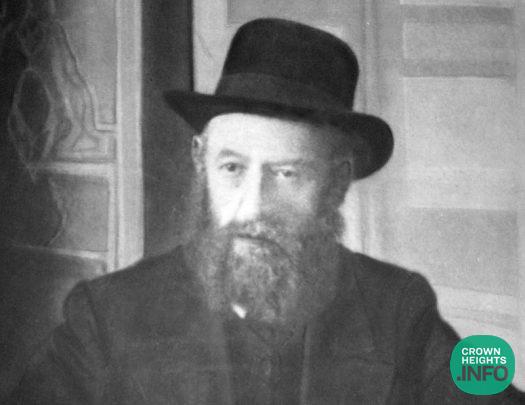
Yesterday (Thursday) was the 13th of Tishrei, the 144th yahrzeit of the Rebbe Maharash. In this week’s post, we will discuss one of his innovations in the way he said Chassidus; specifically, the fact that he was the first Rebbe to say a hemshech. I am writing this to begin a discussion and gain greater clarity on the topic, rather than to offer a definitive answer.
I chose for the A Taste of Chassidus to write something on V’zos Haberacha – the final parsha of the Torah, as in the diaspora it is never read on a Shabbos.
As always, your feedback and comments are greatly appreciated and welcome.
As is known, the Rebbe Maharash is credited with being the first Rebbe to say hemshechim. A hemshech is a series of connected maamorim, with each maamar adding further clarification to the concept until it is fully explained in the final maamar. Sometimes a hemshech consists of just a few maamorim, while the longest hemshech was said by the Rebbe Rashab. He began saying it on Shavuos 5672, beginning with the words of בשעה שהקדימו נעשה לנשמע (When the Jewish people said “we will do” before saying that “we will understand”), and continued through the 144th maamar.
In Cheshvan 5676, over a week after he left Lubavitch, he suddenly stopped saying the hemshech and instead gave out written copies of the remaining maamorim.
I was asked: How can we say that the concept of saying a hemshech began with the Rebbe Maharash when we seemingly find the same thing by the Mitteler Rebbe? For example, his sefer, Ateres Rosh, which discusses aspects of Rosh Hashanah, was originally said as numerous maamorim throughout one Tishrei, yet they are clearly all part and parcel of one concept. It would therefore seem that he, too, said a hemshech, and that was before the Rebbe Maharash was born.
Possibly the answer is as follows.
Take, for example, one of the most famous hemshechim, which the Rebbe Rashab began on Rosh Hashanah 5666 with the words יום טוב של ראש השנה. There are over sixty maamorim in that hemshech, and it was said throughout that year and part of the following year.
In that hemshech, there are quite a few maamorim that stand out individually. Mashpiim have told their students to learn one or more specific maamorim from that hemshech. This demonstrates that it is possible to properly understand the concept conveyed in a particular maamar even without having learned the maamar that preceded it or the one that follows it.
A hemshech, then, is a series of individual maamorim, each of which can stand on its own. Collectively, however, they bring out the full depth of a concept in a way that no individual maamar could accomplish on its own. That is what the Rebbe Maharash innovated when he began saying hemshechim.
Ateres Rosh of the Mitteler Rebbe is different. If someone were to open it to a random page and learn a few chapters from the middle, unless he were very knowledgeable in Chassidus, he would have difficulty properly understanding those pages. It would be like walking into the middle of a speech and leaving before the speaker concludes; naturally, you would not fully understand or appreciate it.
In other words, Ateres Rosh, and similarly other lengthy maamorim that the Mitteler Rebbe said over a period of time, were too long to be said in one sitting and were therefore divided into sections. A hemshech is different: each maamar is a complete concept on its own, while at the same time adding further clarification to the general theme being developed throughout the hemshech.
The Rebbeim accomplished this by beginning each maamar with its own question on the weekly parsha or another concept. The maamar would answer that particular question based on the concept already being developed in the preceding maamorim. Thus, the main body of each individual maamar served two purposes: it answered the particular question posed in that maamar while also adding a new dimension to the general concept or theme of the entire hemshech.
Only in the final maamar would the Rebbe resolve the main question or questions posed in the first maamar at the beginning of the hemshech.
A Taste of Chassidus
תורה צוה לנו משה Likkutei Torah Devorim p. 93D (186)
Parshas V’Zos Haberacha is the only parsha that we do not read on Shabbos, rather, it is read on Simchas Torah. So it should not be a surprise that the Alter Rebbe is going to explain a possuk of V’zos HaBeracha as it is connected with the theme of Simchas Torah.
At the beginning of the parsha, before blessing each individual Shevat (tribe), Moshe spoke about the greatness of the Jewish people in general, that they willingly and eagerly accepted the Torah, while no other nation was willing to do so.
In the second possuk, three aspects are noted:
A. Hashem first offered the Torah to the descendants of Esau [and other nations], and they refused to accept it.
B. When Hashem came [appeared] to the Jewish people, He only brought along part of His entourage of angels.
C. The Torah He gave us, was originally written in fire.
Then two pesukim later, the possuk notes, That the Torah that Moshe commanded us is an inheritance מורשה for the Jewish people.
On that possuk our sages comment, not only does מורשה mean it is our inheritance, but it is also conveying the meaning that the Torah is engaged to the Jewish people. In other words the Torah is the Kallah (bride), while we (the Jewish people) are considered the Chosson (groom). While in other places our sages present it just the opposite, that the Torah is considered to be the Chosson, and the Jewish people are considered to be the Kallah. So what is it?
As will be explained there are different levels (or stages) in the Torah, and each stage represents a different aspect of the Torah.
In Chassidic terminology, the Chosson is considered the Mashpia (provider) and the Kallah is considered the Mekabel (receiver).
As noted previously the possuk notes that Hashem came to the Jewish people after He asked Esau, if they want the Torah.
The Torah has a few names for Esau, here it uses the name שעיר, which shares the same root as שער, which means hair. Chassidus points out, that while hair grows from the head (brain), yet when it comes through the pores in the skull its life power is so diminished that a person doesn’t even feel anything when their hair is being cut.
The Alter Rebbe explains that this is the reason why the possuk uses the word שעיר, when it is describing the Torah. The Torah consists of many parts, תורה שבכתב (the written Torah) and תורה שבעל פה (the oral Torah).
Now the Torah is Hashem’s wisdom (chochmah) and being so the question arises, how is it possible for a human, even the smartest person to properly comprehend the wisdom of Hashem who is the Creator. So therefore Chassidus explains that the sefira of Chochma [as well as the Torah itself] is compared to water. Just as the nature of water is to descend from a higher place and find a place for itself on a lower level, so too, Hashem lowered His infinite wisdom in a manner that ultimately a creation – a human, can comprehend it, even though it still remains G-dly.
To allude to this point, Esau in this possuk which is referring to the Torah is called שעיר. When we remove the Yud the word becomes שער (saar) which means hair, to inform us that this that Hashem has presently granted us is only a very limited percentage of the Torah as it is in His wisdom. But we should know that there is the Yud in the word, to point out, that it didn’t change its essence, as it is from His wisdom, as Chassidus continuously points out that the letter Yud corresponds to Chochmah.
The Torah continues and states that Hashem came with only part of His angels. The Hebrew word for come is בא, yet here the Torah uses the word אתא, which is an Aramaic word, which has much less meaning and holiness than a word of Loshon hakodesh. It is to stress that what we did get is considered chitzoniyous as compared to the Torah is in its source.
The Alter Rebbe points out that is the reason why Hashem has not revealed to us the true meaning of the trup, vowels, the crowns on top if certain letters, as well as the way the letters are to be configured/written.
This also gives a deeper meaning to what Torah Shel Baal Peh means. Normally, it is translated to mean The Oral Torah which clarifies the meaning of what is written in the Torah itself. Yet the Alter Rebbe is pointing out that originally when the Torah was by Hashem Himself, it was compared to thought which is for the thinker alone and at their level. However, when the person is planning to give over that thought to others, then it has to come down a level, or many levels, so that the listener who presently doesn’t know this thought can comprehend it properly.
But it demands one precondition and that is that the person controls or constricts themself to the point that they don’t do what they desire, but put their own interest and desire aside in order to fulfill Hashem’s desire and will.
In the Zohar it is noted that fire causes things to constrict, and that is why this possuk concludes with noting how the Torah is connected to fire. It is informing us, that in order for us to learn and understand Hashem’s Torah, we have to constrict and conquer our own desires.
On this possuk the sages said don’t read is as an inheritance, but it also means engaged. One of the major differences between engagement and marriage is, by the engagement the Chosson gives the Kallah a plain gold ring, and by the marriage they become united as one.
So as noted above, the Torah as we received it is only a minute part of the essence of the Torah as it is by Hashem\. So at this point the Oral Torah we received is receiving from the essence, and therefore at that point it is referred to as a Kallah.
However, after Matan Torah when only through the work of the Jewish people (when they nullify their own desires to fulfill Hashem’s) do they cause that the Torah continues to come down, so the Torah they learn causes that Hashem continues to give us the Torah on a daily basis [as we say in the blessing, He is [presently] giving us the Torah], being that the Torah we learn causes Hashem to give it to us anew, so now the Torah is the catalyst and at that point, the Torah is compared to the chosson (mashpia).
In the musaf prayer of every Yom Tov we say the word והשאינו, which is similar to the word of נשואין (marriage). By marriage the chosson and kallah are equal. So then the Torah Shel Baal Peh would be elevated to receive not just a minute shine of the Torah, but its essence.
But that is only for one who put their own interest aside, however, on Simchas Torah it applies to every Jew no matter who they are, even if they didn’t nullify their desires to serve Hashem.
Rabbi Avtzon is a veteran mechanech and the author of numerous books on the Rebbeim and their chassidim. He is available to farbreng in your community and can be contacted at avtzonbooks@gmail.com.