

After a Visit to the Ohel, 150 Students ‘Rediscover’ Jewish Holidays
by Tzali Reicher – chabad.org
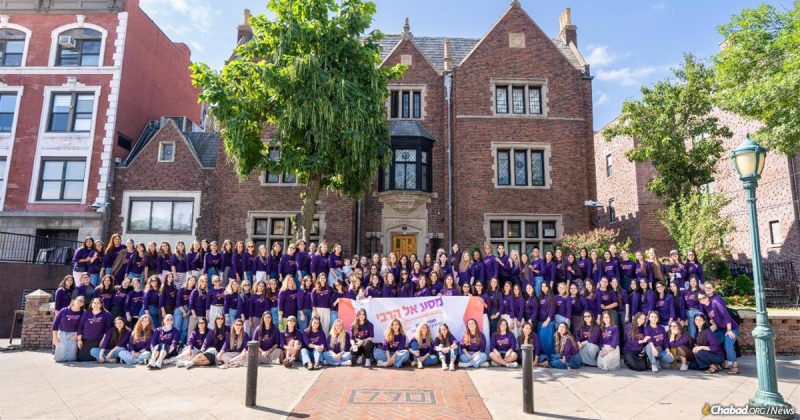
On their last morning in New York in September, 150 young women, all students from universities and colleges across Israel, went to the Ohel, the resting place of the Rebbe, Rabbi Menachem M. Schneerson, of righteous memory, in Queens, N.Y.
Following an inspirational four days of praying, studying Torah and bonding with each other, the visit proved transformative.
The trip was organized by Chabad on Campus Israel, the network of Chabad-Lubavitch centers that serves students at campuses across the country, and the delegation came from about 20 of the network’s campus branches, accompanied by their campus emissaries.
The whirlwind trip started with a trip to Princeton University, where they toured the campus, met with Jewish students, and joined a farbrengen at the university’s Chabad center. The days that followed included a pilgrimage to the Rebbe’s office at 770 Eastern Parkway, a tour of the home of the Rebbe and his wife, Rebbetzin Chaya Mushka Schneerson, of righteous memory, a few blocks away, and a farbrengen in Brooklyn. Friday was set aside for a challah bake before the students joined local families for Shabbat meals.
Of course, it wouldn’t have been a trip to the United States without a required stop at that great American innovation Six Flags, as well as a jaunt through the Jersey Gardens mall.
At a closing banquet at Chabad of Port Washington, N.Y., each student took upon themselves an additional mitzvah to keep as a tangible takeaway from the trip.
Bracha Shilat, who directs Chabad on Campus Israel with her husband, Rabbi Moshe Shilat, told the students that now, having visited the Rebbe’s resting place and synagogue, and spent time immersed in his teachings, each of them was now an emissary.
“They carry the Rebbe with them,” she said, “and have to share the light and inspiration they experienced with others.”

Edan Biton, a student at Beit Berl College in Kfar Saba, was among them.
“During the trip to New York, and especially through visiting the Ohel, I started looking at Judaism in a completely different way,” she said.
Back home, Biton finds that Shabbat feels different.
“I started understanding that keeping Shabbat is a privilege, something I can actually look forward to,” she said. “I enjoy preparing for it, lighting the candles, and having that special feeling that the whole week stops for a moment.”
For her, the change came through most clearly in the Days of Awe.
“When I think about Rosh Hashanah and Yom Kippur now, I don’t only think about fear or judgment,” Biton says. “I also think about connection and gratitude, and the opportunity to start again and come closer to G‑d.”
Her shift in mindset came after studying Chassidut with Rabbi Moshe and Miriam Goldstein, her Chabad emissaries. Growing up in a non-religious home, Biton had experimented with taking on more mitzvot, but it never stuck.
“A lot of the things I did were because I felt I had to do them, and from a place of fear, rather than because I was happy and excited to do them, ” she said. “But now I’ve learned and experienced that serving G‑d doesn’t have to feel like a burden. It can come from love, from happiness, and from feeling grateful that I even have the opportunity to do what G‑d wants.”

Many of the participants on the trip, together with an additional hundred students, reunited over Yom Kippur at a hotel in the Carmel, in Israel’s north, for a program organized by Chabad on Campus. Booking out the entire hotel, they ate the pre-fast meal together, performed Kapparot, went out for Tashlich, and prayed every service of the day together.
“It was a very emotional holiday, watching students, many who had never fasted or prayed on Yom Kippur before, doing it for the first time together,” says Bracha Shilat. “In the closing prayers of the day, as the fast was ending, watching everyone saying the phrases of Shema Yisrael and Hashem Hu HaElokim, affirming G‑d’s Oneness, was so powerful.”
For Sukkot, the Chabad emissaries will distribute hundreds of sets of the Four Kinds and build sukkahs on dozens of campuses.
Biton is already thinking about her own sukkah.
“I find myself genuinely excited to decorate the sukkah and make it beautiful,” she said. “I’m not scared that I’m not doing enough. I just want to do more.”
“That’s what I took with me from New York and from the Ohel,” she said. “Not just memories from a trip, but a different way of looking at Judaism, and the way I want to live my life.”