

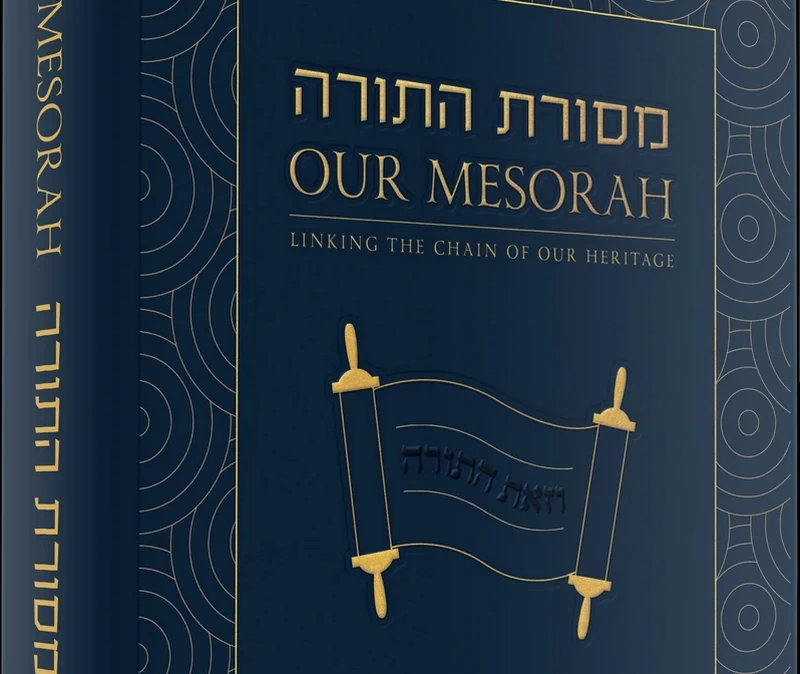
Why Are Rabbonim Praising This New Sefer?
In what is already being hailed as a landmark contribution to Torah scholarship, a newly released 592-page volume titled “Our Mesorah” by Rabbi Sholom Schochet is captivating readers and rabbinic leaders across the globe. The book tackles a question that sits at the very heart of Jewish faith:
Are the words and letters of our Sefer Torah identical to those given by Moshe Rabbeinu?
As it turns out, the answer isn’t quite as straightforward as most assume, and our Sages have grappled with it for generations.
While every Jew affirms belief in the Torah’s eternal immutability, Rabbi Schochet takes readers on a thrilling, behind-the-scenes, intellectual expedition through Jewish history to reveal the dramatic backstory of how the Torah’s text survived thousands of years of exile, persecution, and displacement.
For the first time in a single, cohesive work, Our Mesorah systematically confronts some of the most perplexing and little-known passages in Chazal, the Rishonim, and the Acharonim. The sefer guides readers through moments when the transmission of the Torah was severely tested and tackles some of Judaism’s most challenging questions:
– What ultimately happened to the Sifrei Torah authored by Moshe Rabbeinu and Ezra HaSofer?
– Why did Chazal concede a lack of expertise regarding the Torah’s precise text?
– Why did Rashi’s Sefer Torah contain an extra letter?
– How did three conflicting Sifrei Torah discovered in the Beis HaMikdash ultimately determine the path of our mesorah?
– How do we reconcile instances where pesukim cited in the Gemara vary from the text found in our Sifrei Torah today?
– Why did Ezra HaSofer place mysterious dots over specific words in the Sefer Torah?
– How could Tosafos assert that the Amoraim were not fully versed in specific pesukim of the Torah?
– Why does the Gemara’s count of the Torah’s pesukim differ from ours?
– What is the Ben Asher Codex, and why did the Rambam rely on it to write his Sefer Torah?
– Did the Sefer Torah of Moshe Rabbeinu actually include nekudos and taamim?
– What led the Rama to conclude that our Torah scrolls are “not so precise”?
– Why does the Chasam Sofer say that, according to the Gemara, our Sifrei Torah are invalid?
– How can the Avnei Nezer claim our mesorah today is more reliable than that of the Amoraim?
– Why does Reb Moshe Feinstein write that the kashrus of our Sifrei Torah is uncertain?
– Can two Sifrei Torah with conflicting spellings both be halachically valid?
– What led the Shaagas Aryeh to rule that the mitzvah to write a Sefer Torah is no longer in effect?
Far from undermining emunah, the sefer demonstrates how these historical challenges reflect the intense devotion of our Sages to protect every single letter of the Torah. It also illustrates the real-world halachic impact and relevance of these historical events today, addressing practical rulings regarding writing a Sefer Torah, reciting blessings over a Torah with variant spellings, and handling textual errors discovered during Krias HaTorah.
The revolutionary work has received enthusiastic haskamos and approbations from nearly a dozen leading Rabbonim worldwide, spanning diverse communities and including prominent Poskim and Dayanim:
Rabbi Yosef Braun (Crown Heights) praised the work’s depth and relevance, stating: “With meticulous care, Rabbi Schochet explores the complexities of textual variations, shedding light on the historical preservation of the Torah from Moshe Rabbeinu until today. His insights into the Halachic effects of this topic are both profound and enlightening.”
Rabbi Sholom Ber Chaikin (Cleveland) commended the author’s painstaking research and his alignment with the Rebbe’s vision: “Rabbi Schochet gathered all the content, as one collects each grain of wheat from the threshing floor, leaving no morsel behind… drawing exclusively from the most sacred sources – the Gemara, Midrash, Rambam, Shulchan Aruch, and similar works.” Rabbi Chaikin noted that by publishing this monumental work, the author has brought tremendous nachas ru’ach to the Rebbe, who strongly encouraged the publication of authentic Torah literature.
Rabbi Levi Yitzchok Raskin (London) highlighted the critical need for such a work today: “It is refreshing to see a work that addresses the fundamentals of our Torah-true tradition, based upon authentic sources… Hence the special value to a rational and readable treatise of this topic that is unapologetic for the values of Torah-loyal Jews since time immemorial.”
Rabbi Yehoram Ulman (Sydney) emphasized the book’s power to fortify emunah: “In our time, when many raise doubts and questions about our sacred tradition of the Torah, this book holds immense value. It provides clear and well-grounded answers to all uncertainties, as the Sages said: ‘Know what to respond.'”
By transforming the Torah’s complex textual history into an inspiring narrative of resilience and Divine providence, Our Mesorah offers readers an entirely new appreciation for the Sefer Torah we dance with, read from, live with, and cherish every day.
Ultimately, one question remains:
The Torah can handle the hard questions. Can you?
Our Mesorah is available in Judaica bookstores globally and online. Read more at ourmesorah.com.










Mim
Is this in English?
Yaakov
I checked the preview chapters on the website, and it is in English. All the key sources are also quoted in their original Hebrew – and translated. This book is going to be widely discussed due to its foundational, but sensitive, subject matter. I’m excited to read it.
Levi Y Rapoport
The Handbook of Jewish Thought by Rabbi Aryeh Kaplan Volume 1 addresses this question
Curious
This is the one book that I actually enjoy reading. The ideas flow smoothly and keep me interested. The topics are unique and really hit hard. It taught me so much new information.
Impressed
Very impressed.