


Agudas Chassidei Chabad Calls for Greater Care in Using the Rebbe’s Image and Words in Advertising
by CrownHeights.info
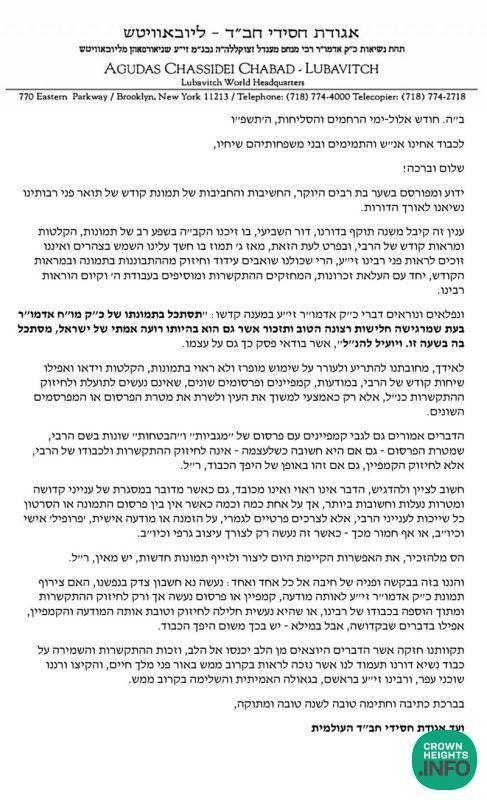
As the month of Elul begins, Agudas Chassidei Chabad has issued a heartfelt call to the Chabad community concerning the use of photographs, recordings, videos and teachings of the Rebbe in advertisements, fundraising campaigns and other promotional materials.
The letter, addressed to “our brothers, Chassidim and Temimim, and their families,” emphasizes the importance that photographs of the Rebbe and the Nesi’im hold for Chassidim, particularly in the years since Gimmel Tammuz.
At the same time, the letter raises a serious concern: the Rebbe’s image and words should not be used merely as advertising material or as a device to attract attention to a campaign, organization, product or individual.
“In our generation, this [the Rebbe’s image] has taken on an even greater significance,” the letter notes, “because Chassidim have access to an abundance of photographs, recordings and other images of the Rebbe. Since Gimmel Tammuz, when “the sun was darkened at noon” and we were no longer able to see the Rebbe’s countenance, these images provide Chassidim with encouragement, inspiration and a tangible connection to the memories of the Rebbe.”
The letter quotes a particularly powerful response from the Rebbe himself. When a woman wrote about experiencing a weakening in her resolve, the Rebbe advised her to look at a photograph of the Frierdiker Rebbe and remember that even the Rebbe Rayatz had experienced such moments of weakness.
The photograph, the Rebbe explained, could provide her with strength.
It is precisely this type of use—one that strengthens hiskashrus and inspires a person in their service of Hashem—that Agudas Chassidei Chabad identifies as the proper purpose of these holy images.
The letter then turns to a growing phenomenon that Agudas Chassidei Chabad says warrants greater awareness and sensitivity: the use of photographs, recordings and Sichos Kodesh of the Rebbe in advertisements and promotional campaigns when their primary purpose is not to strengthen hiskashrus, but to make the advertisement more effective.
The concern, the letter makes clear, is not necessarily with the cause being promoted.
A campaign may be raising money for a Chabad institution. It may be publicizing a Mivtza. It may be encouraging people to undertake an important religious commitment. The underlying initiative may be entirely legitimate.
But that does not automatically make the use of the Rebbe’s image appropriate.
If the photograph or recording is being used primarily because it makes the advertisement more compelling, attracts greater attention, lends prestige to the campaign or helps promote the organizers, Agudas Chassidei Chabad cautions that the use itself may be inconsistent with the honor due to the Rebbe.
The letter similarly addresses advertisements publicizing various Mivtzoim and “promises” in the Rebbe’s name. Even where the content itself is important and true, the question must be asked whether the Rebbe’s image or words are actually being used to strengthen hiskashrus—or whether they have effectively become a marketing tool for the campaign.
One of the strongest points in the letter is its insistence that good intentions do not necessarily make such usage appropriate.
Agudas Chassidei Chabad specifically cautions that this applies even when the objective is a holy one.
The issue becomes even more apparent when there is no meaningful connection between the Rebbe’s photograph or recording and the subject being promoted—for example, when the image is used for a private invitation, personal advertisement, individual profile or simply as a graphic-design element.
In such circumstances, the letter asks Chassidim to consider whether the Rebbe’s image has been reduced, even unintentionally, to a piece of promotional artwork.
The letter also warns against the modern ability to digitally create or “improve” photographs of the Rebbe, noting that creating new images in this manner raises its own serious concerns.
Rather than issuing a list of rigid rules for every possible situation, Agudas Chassidei Chabad calls upon each individual to make an honest personal accounting.
The central question is simple:
Is it truly necessary to use a photograph of the Rebbe for this particular advertisement, campaign or publication?
And beyond necessity:
Is the photograph being used for the honor of the Rebbe and to strengthen hiskashrus, or is it being used because it makes the advertisement or campaign more effective?
The letter warns that if the latter is the case, then despite sincere and positive intentions, the result can ultimately be the opposite of honoring the Rebbe.
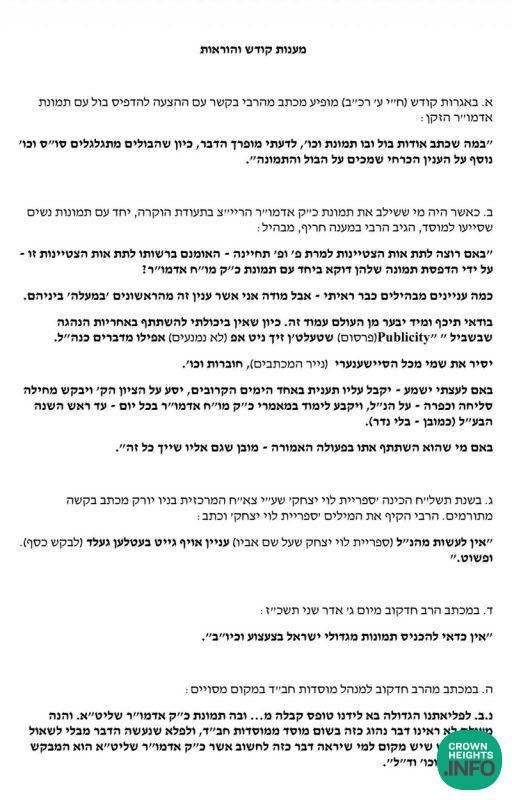
To illustrate their point, the letter includes several striking examples from the Rebbe and from Rabbi Chaim Mordechai Aizik Hodakov demonstrating that this concern is not a new one.
In one instance, the Rebbe was asked about producing a postage stamp bearing a photograph of the Alter Rebbe. The Rebbe responded that the proposal was unacceptable, noting that stamps pass through many hands and raising the inherent concern of placing the photograph on a stamp.
In another case, a photograph of the Frierdiker Rebbe had been incorporated into a certificate of appreciation alongside photographs of women who had assisted an institution.
The Rebbe reacted with extraordinary strength.
While acknowledging that the women could certainly receive certificates of distinction, the Rebbe questioned whether such recognition should be given by printing their photographs together with the photograph of the Frierdiker Rebbe.
The Rebbe called the matter deeply disturbing and instructed that the page be removed immediately.
Significantly, the Rebbe specifically referred to the role of “Publicity” in the matter, objecting to a situation in which, for the sake of publicity, proper sensitivities concerning the Rebbe’s image were disregarded.
The Rebbe went so far as to instruct that his name be removed from stationery, publications and brochures if those involved could not refrain from such conduct.
The examples also extend to fundraising.
In 5738 (1978), when the Levi Yitzchak Library, under the auspices of the Central Chabad Youth Organization in New York, prepared fundraising material, the Rebbe specifically objected to using the name of the “Levi Yitzchak Library” simply as a means of raising money.
Rabbi Hodakov likewise wrote in 5727 that it was not advisable to include photographs of great Torah leaders in fundraising materials and similar publications.
In another case, Rabbi Hodakov expressed astonishment upon seeing a donation receipt from a Chabad institution containing a photograph of the Rebbe.
Among his concerns was that someone receiving the receipt could mistakenly conclude that the Rebbe himself was requesting the donation.
These examples underscore the distinction at the heart of the new letter: the issue is not whether the institution or campaign itself is legitimate, but whether the Rebbe’s image or name is being employed as a promotional instrument.
The message from Agudas Chassidei Chabad is ultimately one of introspection.
As the month of Elul begins—a time traditionally associated with cheshbon hanefesh and preparation for the Yamim Noraim—the letter calls upon Chassidim to examine their own practices.
Before placing the Rebbe’s photograph on an advertisement, flyer, campaign, invitation or publication, the community is being asked to pause and consider whether it is genuinely necessary and whether it is truly being done for the Rebbe’s honor.
The call is not limited to those producing professional advertisements. It applies to institutions, organizations, campaign organizers, graphic designers and individuals alike.
In an era when photographs and recordings of the Rebbe can be incorporated into virtually any digital publication within seconds, the letter asks Chassidim to exercise an additional measure of thoughtfulness and restraint.
The letter concludes with the hope that these words, “which come from the heart,” will enter the hearts of those who read them, and that the merit of strengthening hiskashrus and safeguarding the honor of the Nasi of our generation will stand for the community.
May we merit very soon to see the “countenance of the King of Life,” with “those who dwell in the dust arising and singing,” with our Rebbe בראש, in the true and complete Geulah, speedily in our days.











Meyer Chain
Well that what happens when every Chabad activity has to have maximum publicity
Motti
Did they produce it in English as well?