
Here’s My Story: How I Ended Up Addressing Ten Million People
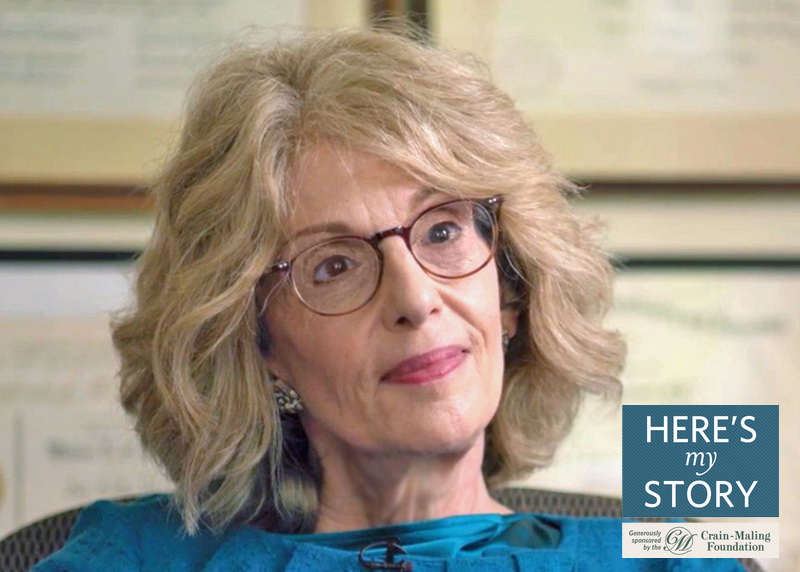
Dr. Miriam Grossman
Click here for a PDF version of this edition of Here’s My Story, or visit the My Encounter Blog.
I was raised in a secular Zionist household — we celebrated Passover and Chanukah but I don’t remember very much Torah observance beyond that. At the same time, I was brought up with a strong pride in being Jewish.
I recall that my father hung a painting of a chasid on the wall of our home and, underneath that painting, he hung a rifle. When I asked him about it, he said, “We have to have both. We need Torah and we need to be able to fight.”
I suppose that I identified with the chasid more because, from an early age, I wondered about religion and I even insisted on attending Hebrew school. In college — I went to Bryn Mawr outside Philadelphia — I majored in religion.
One of the classes I took as a freshman was on the Book of Genesis. It was taught by a man who looked to me like a rabbi, although now I wonder if he was. He maintained that the Torah had not been given by G-d, but was written by different people over time. I was a seeker and I was seeking a connection with G-d, not with something man-made, so I rejected that.
Since what I was seeking could not be found in Judaism — at least as far as I knew then — I decided to pursue studies in Eastern religions. After I graduated in 1974, I enrolled in medical school, but I already had in my mind that after I graduated, I would travel to India. I wanted to find there a person living on a level that was higher than this mundane world — a guru. I never made that trip, thank G-d, because I encountered Chabad-Lubavitch and the Rebbe.
It all began with a nurse at Beth Israel Hospital in Manhattan named Naomi Raphael. We met while I was interning in the neonatal intensive care unit; she saw something in me, I think, and she invited me to spend Shabbat in Crown Heights. And I will never forget that initial encounter with Chabad in July of 1979.
About two years before this, the Rebbe had suffered a heart attack, and that was the first time that he was able to hold a Shabbat farbrengen again. (He did hold farbrengens during the weekdays when he could use a microphone, but not on Shabbat until this day.) And the excitement among the chasidim who were streaming toward the Chabad Headquarters at 770 Eastern Parkway was absolutely electrifying.
After that, I kept coming back. I enrolled in a number of Chabad programs for people like me — seekers, who were exploring their Jewish roots — and all that learning brought me to a very emotional moment when I finally understood that what I had been seeking was in my own backyard. I didn’t need a Hindu guru, I needed my Torah-observant grandmother who I believe would have brought me to Yiddishkeit. But since she perished in the Holocaust, I had to go through a long, painful, multi-year process of finding it on my own.
This included time at Bais Chana Institute of Jewish Studies in Minnesota, where Rabbi Manis Friedman made a great impression on me, so much so that when I finished the program there, I craved even more learning. About then, I heard that the best place for this was the Gateshead Seminary in England. As I contemplated going there and giving up my previously planned career in medicine, I was advised that, before making such a big decision, I should ask the Rebbe’s opinion.
So I wrote a letter to him, saying that I wanted to stop being a doctor, because in the hospital environment there are many things to which a refined person should not be exposed.
The Rebbe responded in a letter written in Hebrew (the emphasis is mine):
Because you have invested so much time and effort etcetera into your studies to this point and you have succeeded … it is clear that you must utilize all this [for yourself] and also for the good of others … in every possible way. Obviously, you must endeavor to minimize the challenges as much as possible. G-d will assist you to be successful in all these matters — in particular, to be an example that it is possible to keep the Torah and mitzvot as commanded, even while earning a living in medicine.
To be completely honest, when I received that answer, I felt disappointed. The Rebbe was telling me that I had to return to the world that I had found challenging and empty, instead of encouraging me to devote myself to studying Torah. But that wasn’t meant to be my path — the Rebbe got the message across very clearly and in very strong words, without allowing for any gray areas.
For various reasons I did not want to continue in the specialty I had initially chosen, pediatrics; instead, I ended up in psychiatry, a specialty which would not demand as much of my time.
It was a good decision as it turned out — I have accomplished a lot and I have been successful in ways I couldn’t have imagined. Not only in my one-on-one sessions with patients and their families, but also because of the five books I’ve written and the attention and opportunities that resulted from those books.
For example, I testified before a committee of the US Congress a few years ago on the transgender issue, and my testimony has been viewed by ten million people. Can you imagine that? Ten million people, who posted more than twenty-five thousand comments, almost all positive! I could never have dreamt of having that kind of impact.
If I hadn’t asked for the Rebbe’s advice, I might have gone down a totally different path. I might have gone to Gateshead and buried my head in Torah books. That would have been very meaningful and elevating, of course, and that’s the right path for many. But the Rebbe must have seen a different potential in me; he must have seen I was someone who could reach a lot of people and expose them to life-changing truths.
He recognized, long before I did, that I have certain G-d-given talents. I never formally learned how to write and I never learned how to speak in public, but it’s something I do successfully all the time. The Rebbe wrote, “you must utilize all this,” meaning that I needed to put all my abilities to use.
It’s a huge blessing to feel that I am doing just that. I am invited to speak all over the world. I also do a lot of legal work and I testify in court. And so, I think I have fulfilled the Rebbe’s prescription to utilize my G-d-given talents for the benefit of others “in every possible way,” as he put it.
At the moment I got his advice, I was disappointed, but now, looking back on it, I’m so very grateful to have gotten that direction and that blessing for success.
Dr. Miriam Grossman is a board-certified child, adolescent and adult psychiatrist and the author of five books, including: The Wonder of Becoming You; Unprotected; You’re Teaching My Child WHAT? and Lost in Trans Nation. Her work has been translated into twelve languages. She was interviewed in January 2026.