


Across America, Jews Prepare to Mark a Once-in-250-Years Shabbat
by Yisrael Eliashiv – chabad.org
When the President of the United States signed a proclamation calling on Americans to observe a national Shabbat over the weekend of May 15-16, Rabbi Chesky Tenenbaum had one immediate reaction.
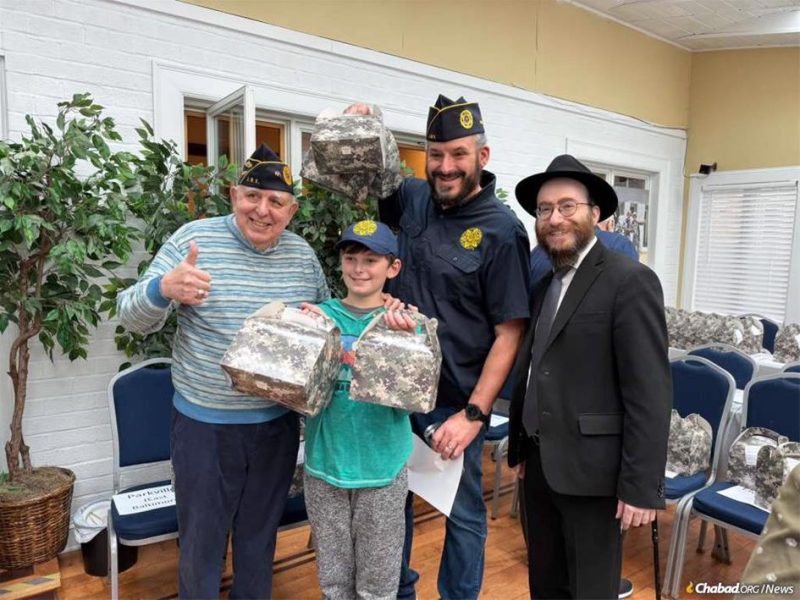
“Choosing this Shabbat to celebrate the United States is especially meaningful,” said the Baltimore-based chaplain and director of JUSA-Chabad (Jewish Uniformed Service Association Chabad). “It coincides with Armed Services Day. It’s a double reason for our community to come together.”
Shabbat 250 marks the first time in American history that a sitting president has invited the Jewish community to observe a dedicated Shabbat.
“In special honor of 250 glorious years of American independence and on the weekend of Rededicate 250—a national jubilee of prayer, praise, and thanksgiving—Jewish Americans are encouraged to observe a national Sabbath,” President Donald Trump wrote. “From sundown on May 15 to nightfall on May 16, friends, families, and communities of all backgrounds may come together in gratitude for our great Nation. This day will recognize the sacred Jewish tradition of setting aside time for rest, reflection, and gratitude to the Almighty.”

Providentially, the national Shabbat will take place on the weekend when Jews around the world will read the Torah portion of Bamidbar, which precedes the holiday of Shavuot. Forty years ago, on Shabbat Bamidbar 5746 (June 7, 1986), the Rebbe, Rabbi Menachem M. Schneerson, of righteous memory, suggested this particular Shabbat to be a global Shabbat achdut, or Shabbat of Unity. Shavuot marks G‑d’s giving of the Torah to the Jewish people at Sinai. Then, the master commentator Rashi wrote, the Jewish people accepted the Torah “as one man with one heart.” What better way to prepare for the giving of the Torah on Shavuot, the Rebbe pointed out, then Jews of all backgrounds once again uniting in a spirit of love in the days preceding the holiday?
“Loving your neighbor as yourself is not sufficient, if the friend remains a separate entity to whom you show your love,” the Rebbe explained at the time. “There must be a unity which unites all Jews to be part of one great body; when each limb views the other as part of itself.”
The Rebbe often described the United States as a medinah shel chesed, a country of kindness—a land where Jews have enjoyed the freedom to live openly as Jews, deepen their observance, and serve G‑d and their fellow man.
“…[T]here is no reason … in this free country, to hide one’s Jewishness, as if it were contrary or inimical to American life and culture,” the Rebbe wrote in the winter of 1981. “On the contrary, it is fully in keeping with the American national slogan of ‘e pluribus unum’ and the fact that American culture has been enriched by the thriving ethnic cultures which contributed very much, each in its own way, to American life, both materially and spiritually.”
Shabbat 250 is yet another way to give this appreciation a practical expression, and communities around the country are getting ready to celebrate their country this Shabbat.

Celebrating America’s Heroes
Tenenbaum, who alongside his wife, Chani, serves Jewish service members, veterans and first responders across Maryland, is hosting a Friday-night dinner bringing together active-duty personnel, reservists and the broader community. He’s also preparing a display of Jewish military artifacts, including a World War II prayer book with a personal letter from President Franklin D. Roosevelt. More than 550,000 Jews served in the U.S. Armed Forces during that war.
One story he tells captures why the weekend resonates so deeply. At a recent Passover seder for veterans, a Marine who had served in Iraq described missing his family’s Seder because his unit was on a nighttime mission clearing roads for advancing troops.
Tenenbaum looked at him and said, “You were a part of every Seder that was held in America that year. Because without what you did, no one would have been able to sit safely at their Seder.”
The timing, he noted again, means a lot to his community.
“Shabbat 250 is Armed Services Day, close to Memorial Day, and falls right before Shavuot, which reminds us of our global Jewish unity and oneness,” Tennbaum says. “For our military community, it reinforces that a Jewish service member is never alone.

Trivia and Flags in Pembroke Pines
In Florida, Rabbi Mordechai and Tzirel Andrusier of Chabad-Lubavitch of Pembroke Pines are marking the weekend with a USA-themed Friday-night dinner, complete with American flags, patriotic decor and trivia about Jewish Americans who helped win the Revolution, shaped the new government and served as early Supreme Court justices.
“The United States has allowed Judaism to rebound and prosper in ways we never had before in human history,” said Andrusier, whose grandparents fled Germany and Russia during the war years of the 20th century. “The idea of the United States is that all men are created equal. We all have shared values and the same rights.”

In his Shabbat remarks, he plans to draw on Parshat Bamidbar, which describes the Jewish people traveling together through the desert before receiving the Torah. A desert belongs to no single person or tribe—it is common ground, shared by all who pass through it. He sees in that image a direct parallel to the values binding a diverse nation together, from the fundamental 7 Noahide Laws to the national motto “In G‑d We Trust” appearing on American currency, to the Declaration of Independence’s affirmation that universal rights are granted by the Creator.
He will also point to the 13 colonies, which began as separate entities before uniting in the War for Independence, as a mirror of the Jewish people: Am Echad, one people with one Torah.
“As Abraham Lincoln said, a house divided cannot stand,” Andrusier says. “The idea of Shabbat 250 is highlighting the common ground we all share in our country. And that will allow the United States to endure forever.”

Shabbat in the Desert
Rabbi Mendel and Itta Super arrived in Lake Havasu City, Ariz., in 2022 to find the Mohave County region with little by way of organized Jewish life. He and his wife started their congregation in their living room, soon reviving a defunct Reform temple where services are now held in accordance with Halacha, and built a thriving Chabad center with regular community events and programs.
For Shabbat 250, he’s invited two guests to speak at a specially arranged Friday-night service and program, in addition to their standard bi-monthly Shabbat-morning service and lunch. Mohave County Sheriff Doug Schuster will join the community to speak on “The Promise and Dream of America,” recognizing Law Enforcement Appreciation weekend, while Arizona State Senator Hildy Angius, the only Jewish state senator in Arizona, will discuss “Jews in America: Our Place in the American Story.”

The community Super has helped build draws people from far beyond Lake Havasu City. Some attendees come from as far as 100 miles away.
“If Shabbat is a G‑d-given island of refuge in time, then America has served as a G‑d-given island of refuge in space,” he says. “This is a fitting way of fusing the blessings in our lives.”











Aliza
TRUMP SAID WHAT?
On May 4,2026
He wants Jews to observe their Sabbath the Jewish way.
And he wants those who aren’t Jewish to honor the Sabbath in their own way.
Trump lost a dear friend when Charlie Kirk was murdered. Prior to his horrific death
Charlie Kirk had recently completed his book “STOP IN THE NAME OF GOD,
WHY HONORING THE SABBATH WILL TRANSFORM YOUR LIFE”