
He Taught Them Alef-Bet in Kindergarten. Fifty Years Later, They Still Called Him ‘Rebbi’
by Yisrael Eliashiv – chabad.org
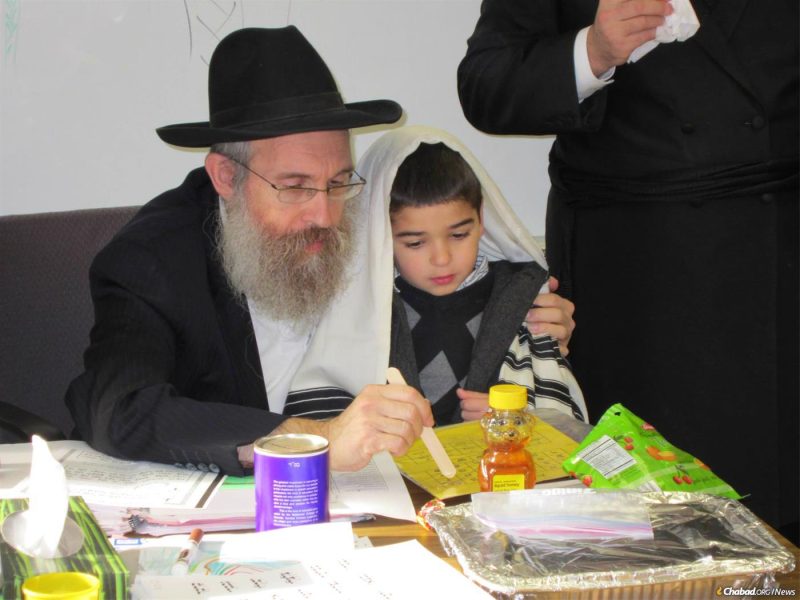
The lobby of Yeshiva Tomchei Temimim in Montreal hums with small voices, the shuffle of little feet, and boyish banter. It is an ordinary morning, the kind that has repeated itself for decades. Rows of boys, some barely 4 years old, stand in neat lines, their faces bright with anticipation. A Chassidic melody begins softly, which the young students will eventually learn to join. Then Rabbi Yossi Wilansky steps forward, Books of Psalms in hand, his warm smile lighting the space. He greets each child by name, offering a kind word, until finally leading his pre-1A class upstairs to begin another day of Torah education.
That daily scene, repeated thousands of times at the yeshivah on Westbury Avenue, came to an end this week, when Wilansky passed on Sunday night, April 13 (3 Iyar), at the age of 71.
Wilansky did not simply teach Alef-Bet, the Hebrew alphabet; he gave generations of children their first love of Torah and their Jewish heritage. For 52 years—the last 45-plus of them in the pre-1A classroom of Tomchei Temimim, Montreal’s Chabad-Lubavitch boys school—he made the beginning of a Jewish education feel joyful, personal and enduring. He also served as an emissary at Montreal’s Jewish Russian Community Center for more than 40 years and was deeply involved in that community.
Yet it was with the youngest children that his light shone brightest. Generations still call him simply “Rebbi.” These stories of his dedication and warmth paint a picture of an educator whose influence reached far beyond the classroom.

‘They Still Called Him Rebbi’
Born in Bridgeport, Conn., to Rabbi Yehoshua and Nechama Wilansky, Tzemach Yosef Yitzchok (“Yossi”) grew up in a home devoted to Jewish education. Following the advice of the Rebbe—Rabbi Menachem M. Schneerson, of righteous memory—the family moved to Brooklyn so their own children could receive an education close to their own standard.
Wilansky, whose father was a teacher, got his start in education while still young himself. While studying diligently in yeshivah, each Wednesday he volunteered for the Released Time program, which since 1941 has provided an hour a week of Judaic learning and practice for Jewish public school students in New York. Eventually he became the “borough president” for the Bronx chapter of Released Time program, spearheading new student enlistment, planning curriculums, and coordinating the commutes of the Crown Heights yeshivah student volunteers making the trek to and from the Bronx each week. “He treated all of us as equals,” a younger volunteer would remember.
As he grew into adulthood, he married Malke Hendel, the daughter of Rabbi Yitzchok Hendel, the longtime rabbi of Montreal’s Chabad-Lubavitch community, dean of the local branch of Tomchei Temimim, and senior dayan of the Vaad Ha’ir. The couple settled in Montreal, where Wilansky took a teaching position at the elementary school.
“From the moment I got to know him,” says Rabbi Yossi Sputz, who served as the principal of Montreal’s Tomchei Temimim yeshivah for 25 years and worked side by side with Wilansky, “I discovered a tremendous person. Someone with immense awe of Heaven, sensitivity and humbleness, who was always ready to do something for someone else.”
He always began the day by greeting his students in the lobby and leading them in a Chassidic melody before going up to their classroom.
“It set the tone for the entire day,” says Sputz.

Wilansky cared deeply for his young charges, and felt it was vital to foster warm and open communication with their parents. He insisted the principal review drafts of report cards to ensure the right messages were conveyed, and any sensitivities in family’s personal situations would be accounted for in his report. He wanted transparency, but also wanted to uplift. Every Thursday night, Wilansky prepared a newsletter containing a Torah teaching for students to share at their own Shabbat tables as well as something positive about each and every child in his class.
Rabbi Yekoutiel Cohen, now a Chabad emissary in Italy, recalls how, as a new student who arrived from France and did not speak English, Wilansky immediately put him at ease by greeting him warmly in French every day. Another former student, Zalmy Bernath, reminisced about arriving late to a Shabbat party with his father after walking for an hour through heavy rain. Although the program had ended, the rabbi lit up when he saw them, took out the candy he had set aside for him, and restarted the entire party for his sake.
Rabbi Ariel Stern, whose sons studied in Wilansky’s class, saw this care firsthand.
“He would always talk to me about very specific details about my sons,” Stern said. “He truly cared about each child.”

Wilansky’s classroom was alive with joy. He used rhymes, funny routines and songs to make learning exciting, and made a point of making parties with family members invited to celebrate accomplishments in learning. He went down the slides with the boys at recess, took them on outings, and sang with them every day. “It was like he was one with them,” Stern said. “He related to them in a very personal and fun way, always connected to Torah and mitzvot.”
The classroom itself was sacred to him: The little library he had made for the children, with books in reach; the child-level charity box on the wall. Once, when the charity box broke, he insisted that it be repaired as soon as possible so the children could continue putting on their daily coins.
“His classroom was like a whole world,” Stern noted. “It was very important to him to make sure that the classroom was a place of holiness, a place where the Shechinah could dwell.”
Pesach Nussbaum knew Wilansky for 47 years and considered him a close friend.
“They always called him ‘Rebbi,’” Nussbaum explained about former students. “Even though they started with him at the very beginning … All of his students, through the decades, called him Rebbi. Kids who were 15 years old … Thirty-year-olds … Even 50-year-olds still called him Rebbi, acknowledging his transformative impact on them decades later.”

A Lifetime of Service
Beyond the classroom, Wilansky lived a life of steady and humble service to his community. He helped sustain the weekday morning minyan at the now-shuttered Chevra Shas synagogue, even when it was inconvenient. For decades, beginning in the 1980s, he organized a Torah study group, ensuring the material was printed and that classes would continue even in his final months. In memory of his parents, he created the “Call Bubbe and Zayde” initiative, encouraging children to phone their grandparents every Friday. The project resulted in thousands and thousands of calls over the years.
At weddings and celebrations throughout the community, Wilansky made it his responsibility to show up and be counted at each and every one, often coming in dressed up as a “dancing bear.”.
He regularly visited elderly Jews in another community, including on holidays, bringing them Shabbat candles, dancing with them, and encouraging them, sometimes even wearing his bear costume to bring them joy. When illness recently prevented him from continuing the visits, he ensured that others would take his place.
In 2025, at age 70, the entire yeshivah honored Wilansky with a special birthday celebration. A video featuring 70 different messages from former students, now leading communities around the world, was broadcast.
When Wilansky fell ill in January of this year, his family asked the community to say Psalms, noting that he deeply believed in the power of children’s prayers. Former students banded together to perform mitzvot in his merit, and for months, a WhatsApp group buzzed with photos flooding in of men laying tefillin in his merit, each picture a personal expression of gratitude and encouragement.
“He cared about every student, and showed love to every student,” says Rabbi Levi Raskin, a former student who is today a Chabad emissary in Cote S. Luc, Montreal. “He had respect for every student and appreciated every one of them. My classmates and I are grateful to him to this day.”
In addition to his wife, Malke, Wilansky is survived by their children: Mendy Wilansky (Montreal); Dovid Leib Wilansky (Baltimore); Sarah’le Lesches (Montreal); Rivky Perl (Brooklyn, N.Y.); Eli Wilansky (Pittsburgh); Yaakov Wilansky (Roslyn, N.Y); Moshe Wilansky (Florida); Chaya Gottlieb (Brooklyn, N.Y.); Sholom Wilansky (Kingston, Pa.); Toby Wolf (Brooklyn, N.Y.); Boruch Wilansky (Las Vegas) ; Shmuel Wilansky (Puerto Rico); Noach Wilansky (Brooklyn, N.Y.); Yissachor Tzvi Wilansky (Brooklyn, N.Y.).









Rabbi Chaim Dalfin
Reb Yossi was truly a tzaddik. Ppl may go to his kever for tfila. It’s guaranteed that one’s requests will be answered. May his wife and kids have true consolation and merit Mashiach now! He lived Rebbe and Chasidus.