

The Boy From Moscow
by Levi Avtzon – chabad.org
There are people whose lives make no sense until we understand the pressure that shaped them. My uncle, Chaim Meir Chazan, who passed away this week at the age of 76 after a difficult illness, was one of them. Even many in the Chabad community hadn’t heard of him during his lifetime.
He was formed in Soviet Russia, and without that part of the story, we cannot really understand the gentleness, discipline, and stubborn Jewish strength that defined him—a Jewish boy who wanted to keep Torah, growing up in a system that had set itself against religion in general and Jewish religious life in particular.
When my grandparents were growing up in the 1920s and 30s, the price was heavy. Hunger. Fear. Arrests. Disappearances. When Stalin died in 1953, things eased up minimally. There was less blood in the streets and the Gulags mostly emptied out.
But this was still Soviet Russia. A person could be blocked, watched, failed, delayed, and worn down without anyone needing to say very much. You couldn’t leave the country, hold a job, or get into university without a wink and a nod from the higher-ups. It was the world’s biggest prison.
That was the world my uncle was born into in 1949, on the outskirts of Moscow.
His parents were my grandfather, Aaron Chazan, who later wrote a memoir called Deep in the Russian Night, and my grandmother Leah. By then, they had already buried more family than most of us will ever know. My grandfather had lost his parents, his brother, his sister, his nephews, and an entire world in the “Holocaust by Bullets” in Ukraine. My grandmother had lost three brothers, two murdered by the Communists and one killed on the Russian front in WWII, as well as nephews and nieces murdered in the open-air mass shootings that swept through Ukraine as the German army moved east. And my dear grandparents had buried their eldest son, Zusha, a little boy who died of typhus while the family was fleeing during the war, hiding in Uzbekistan, when there was no medicine, no food, and nowhere to turn.
They arrived outside Moscow in 1946 and stayed there for 20 years. And in that home, under that regime, my grandparents raised 13 children as religious Jews and somehow managed to marry off three daughters before finally receiving permission to leave the USSR in 1966.

That was the house in which Chaim Meir grew up.
Chaim Meir was gentle. Soft-spoken. The family always said he could not fight with a fly. And that is part of what makes his life so striking. The same boy who would not raise his voice held his ground against a system that had no place for boys like him.
At his bar mitzvah in 1962, he made a siyum (completion celebration) of the entire Talmudic tractate of Bava Metzia, a feat even for a child growing up in the best yeshivahs of the 21st century. And yet, a 13-year-old boy in Moscow, with no yeshivah around the corner, no Jewish school, no structure to support that kind of learning, accomplished it.
What he did have was a devoted father and dedicated brother-in-law, who got up with him at three in the morning to learn before the rest of the city woke up.

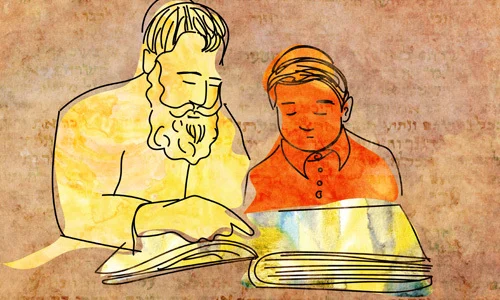
That was his routine. Up at three, sometimes half-past. Learning Gemara at the kitchen table while the rest of Moscow slept. Then out into the cold, onto the first of several buses, for a journey that took hours across the city. He did not attend the school near his home because that school required him to go to class on Shabbat. Instead, he traveled to a trade school on the far side of Moscow that, through some bureaucratic quirk, did not require Shabbat attendance.
Often, he arrived at school before sunrise, which can be quite late in the Moscow winter. So, after a few hours of school, he would go to the home of a simple Jewish family who lived nearby. The woman of the house would let him in. There, in her kitchen, he would put on tefillin and pray. The woman spoke about him with wonder. This young boy, she would say, woke up at an hour “when even G‑d isn’t awake.” An ungodly hour for the most G‑dly thing she had ever seen a young man do.
There was a teacher who had taken a particular dislike to him. One day, in front of the whole class, she pointed at him and said, “Look at this boy. He is still living as if it were the Middle Ages.” She meant it as an insult; he kept it as a compliment for the rest of his life. He had been raised by parents who knew exactly what the modern world was busy tearing apart, and he was not embarrassed to belong to older and deeper things.
In September 1966, the family finally received exit visas and left for the Holy Land. Chaim Meir spent some years in yeshivah there, and then traveled to Brooklyn to learn at the epicenter of Chabad, near the Rebbe, Rabbi Menachem M. Schneerson, of righteous memory. He married Chavi, whose family also had a history of defiance to Stalin, and they settled in Nachlat Har Chabad in Kiryat Malachi in Israel’s south. That is where he remained for the rest of his life, as they raised eight beautiful souls, all dedicated to the life their father sacrificed so much for.
He became a respected sofer (ritual scribe). For decades, he sat at a desk and checked, by hand, letter by letter, the very same alphabet the Soviet Union had spent decades trying to erase. The tefillin he once put on in someone else’s kitchen in hiding, he now checked and treasured for a new generation of committed young men.
That teacher was right about one thing. He did live as if it were the Middle Ages. He sat in Kiryat Malachi and formed each letter the way our people had been doing for generations.
What she failed to realize was: he kept Medieval company on purpose.











Nina Cohen
Expertly written, very moving memoir/ tribute. Sensitively written. Yasher koach. Thank you for sharing.