
What Was the Rebbe’s Pesach Seder Like?
by Motti Wilhelm – chabad.org
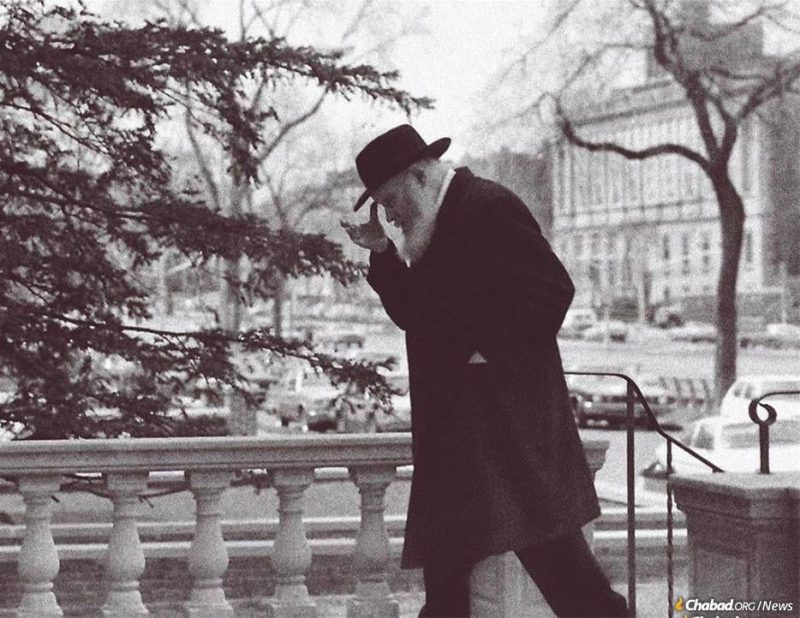
The Passover seder night is rich with once-a-year mitzvos, layered customs, and the recitation of the Haggadah, one of the most extensively studied texts in Jewish literature. The Rebbe, Rabbi Menachem M. Schneerson, of righteous memory, authored a masterful commentary on the Haggadah, which was published exactly 80 years ago. And across the globe, Chabad-Lubavitch seders draw hundreds, sometimes thousands, in each location. But what did the Rebbe’s own Passover nights look like?
It was mostly deeply private: Until 1970, his seder would take place in the home of his father-in-law and predecessor the Sixth Rebbe, Rabbi Yosef Yitzchak Schneersohn, of righteous memory, joined by a small group of elder Chassidim; from 1970 to 1988 he did the seder only with his wife, Rebbetzin Chaya Mushka; and after she passed away, entirely alone, in his personal study at Chabad World Headquarters in Brooklyn, N.Y.
And still, on that very night, the Rebbe made himself present for others.
After the evening prayers, when most hurried home to begin their own seder, throughout the years, the Rebbe would regularly visit several public seders throughout Crown Heights, giving attention to each detail and to each individual present.
Later, when Chabad facilitated the rescue of Iranian-Jewish children in the wake of the Islamic Revolution, the Rebbe visited their seder as well, taking special care to recognize their distinct customs and needs.
This is the story of the Rebbe’s seder night.

The Rebbe’s Private Seder
From when the Sixth Rebbe arrived on American shores, he established a unique model for holiday meals: semi-public gatherings. A select group of guests would be invited to join, while others would stand nearby, observing and absorbing the atmosphere from the sidelines. After the arrival of his son-in-law, the Rebbe, he, too, participated in these meals.
A separate room was designated for the women, including the Sixth Rebbe’s wife, Rebbetzin Nechama Dina; the Rebbe’s wife, Rebbetzin Chaya Mushka; and the Rebbe’s mother, Rebbetzin Chana.
Following the Sixth Rebbe’s passing in 1950, the format continued. A small group would join the Rebbe together with his brother-in-law, Rabbi Shmaryahu Gurary, known as “the Rashag,” in the dining room of the Sixth Rebbe’s apartment on the second floor of 770 Eastern Parkway. The Sixth Rebbe’s seat remained empty. The Rebbe and the Rashag sat to the left and right, occupying the same places they had held during his lifetime.
These meals were markedly different from the Rebbe’s public farbrengens, where he would speak at length, weaving together Torah insight and guidance for daily life. Here, the tone was restrained. The Rebbe spoke sparingly, responding when addressed or offering a few carefully chosen words, but never delivering extended talks.

Yet for Chassidim, these moments were no less precious. The brief exchanges and the opportunity to observe the Rebbe leading the holiday meal drew many to press into the small dining room, eager to catch even a glimpse or a word. After the holiday, the rich conversations and exchanges were carefully transcribed, later published in a two-volume set.
This was especially pronounced on Passover night. Drawn by the desire to witness the Rebbe perform the mitzvahs of the seder, recite the Haggadah, and share brief insights into the customs of the night, the crowds would swell, filling the room to capacity.
This continued until the January 1971 passing of Rebbetzin Nechama Dina, who had hosted the holiday meals. In her absence, the semi-public meals came to an end.
Though many would have eagerly joined, from then on the Rebbe held his holiday meals quietly and modestly, together with his wife, Rebbetzin Chaya Mushka. Following her passing in 1988, and despite invitations from Chassidim who would have accorded him every honor, the Rebbe conducted his seder alone, in his study at 770, insisting that even his secretaries return home to celebrate with their families.
Like so many other facets of the Rebbe’s life, his seder reflected a theme seen time and again: for himself, he chose what was most modest and reserved, while at the same time igniting a global renaissance of Judaism, touching hundreds of thousands and ensuring that others had what they needed, both materially and spiritually.
And before the Rebbe began his own seder, he had a few stops to make.

Visiting Students on Passover Eve
In 1952, the first Passover after formally accepting the leadership of the Chabad-Lubavitch movement, the Rebbe turned to one of the Chassidim and asked where the yeshivah students would be holding their seder.
Many of the students—who had come from across the United States, Europe and Israel—remained in Crown Heights for Passover, as travel was still costly and often impractical. Together, they koshered the yeshivah kitchen and arranged a joint seder.
They were not expecting any guests.
But then, instead of heading upstairs to his own seder on the second floor of 770, the Rebbe left the building and walked to the hall where the students had gathered. To their astonishment and joy, they realized that the Rebbe had come for a pre-seder visit.
The following year, it happened again. And the year after that.
The Rebbe would walk through the hall where the students’ seder was set, taking in every detail, pausing when something was missing, commenting when necessary, and ensuring that everything was in place.
For the students, this became the highlight of the night.

They would prepare with anticipation, waiting for the moment the Rebbe would arrive. Standing in the fully set hall, with a Seder plate, Kiddush cup and matzah at each place, they would line up respectfully as the Rebbe passed through, casting a careful glance at each setting.
The Rebbe would point out ways the seder could be enhanced: One year he asked that additional pillows be brought so the students could properly recline, as required; another year he noted that the wine bottles should be moved away from a heat source to prevent them from spoiling.
He made sure to stop in the kitchen as well, offering warm holiday greetings to the yeshivah’s cook, an elderly widow who had devoted her life to caring for the students. Musia, who had lost her husband in World War II and young child in its aftermath, would await the Rebbe’s visit for weeks, anticipating the moment when, as she would say, “the holy tzaddik will come.”
At the conclusion of his visit, the Rebbe would offer a brief blessing to the students, after which they would begin their seder.
This visit continued year after year, the Rebbe taking the time to visit students far from home, ensuring they had everything needed to celebrate properly, and offering his personal blessing.
And that was only the beginning.

Paying Attention to Refugees and Returnees
In the 1970s, as the Chabad community grew in Crown Heights, a number of organizations began hosting public Passover seders. Among them was Friends of Refugees of Eastern Europe (F.R.E.E.), established to assist Jews who had escaped from behind the Iron Curtain. In 1972, the organization purchased a building in Crown Heights and began holding public seders for Soviet Jewish refugees who had resettled there.
The Rebbe began visiting their seder as well. Notably, he delivered his blessing in Russian rather than Yiddish, so the participants could understand. He tailored his words to their reality, blessing them that they should soon be reunited with their families, many of whom remained behind the Iron Curtain. That first year, the Rebbe also walked through the entire building, visiting each room of the newly established center.
In 1975, the Rebbe added another stop: the recently opened Machon Chana, a seminary for young women just beginning their journey into Jewish life. Here, too, he paid careful attention to the participants’ specific needs, once even remarking that there were not enough mirrors for the students.
His blessing there, as well, was personal and precise: that by the following year, they should merit to celebrate the seder with their own families.
Another location the Rebbe would visit, though not every year, was the Hadar HaTorah yeshivah, the first-ever yeshivah established for young men who had grown up without a religious background and were now discovering their heritage for the first time.
Each of these visits carried its own stories. In every setting, the Rebbe’s sensitivity was evident, meeting each group exactly where they were, with care tailored to their circumstances.
One particularly memorable moment took place during a visit to Machon Chana. The Rebbe turned to a young boy, Mendel Feller, son of Rabbi Moshe Feller, regional director of Chabad of the Upper Midwest, who had come with his family to lead the seder for the students. The Rebbe asked, “Do you know the Four Questions? Do you know them by heart?”
When the boy, today a Chabad emissary in Minnesota himself, answered in the affirmative, the Rebbe turned to his father and asked, “But does he know the answers?”
Everyone present laughed, taking it as a lighthearted remark.
The next day, the Rebbe called the senior Feller to his office, and clarified:
“What I said last night in Machon Chana was not a joke. Everyone there took it as a joke, but I did not mean it that way.
“A child does not relate to ritual the way an adult does. A child is thinking, ‘We went through this last year, why are we doing it again?’ That is the question he carries inside. The task of the father is to convey that this is not a repetition of last year. It is something new, a fresh reliving of the experience.”

Welcoming the Children of Iran
In 1979, yet another group was added to this growing map of care. In the wake of the Iranian Revolution, Chabad undertook a dramatic effort to bring Jewish children out of Iran, rescuing them from a rapidly deteriorating situation. While their parents were, for the time being, unable to leave, the children were admitted to the United States as students.
Thousands were brought out in what is informally known as Operation Exodus. In Crown Heights, Chabad arranged homes for them or hosted them within the community, establishing dedicated schools and programs that respected their longstanding traditions and communal norms.
When Passover approached, that same sensitivity continued. The Rebbe took a personal interest in ensuring that the children would have the foods they were accustomed to. He even inquired specifically about rice—avoided by Ashkenazim on Passover as kitniyot, but a staple of the Iranian Passover table—making sure it would be prepared for them.
He also asked that some of the maror prepared for the students be brought to him.
And on the night of the Seder, the Rebbe came to visit them as well.
The Rebbe offered his blessing there as well, but first asked that someone fluent in both Hebrew and Farsi translate his words so the children could fully understand. At the conclusion, the boys responded loudly, “Amen, kein yehi ratzon,” in their Sephardic accents. Following their lead, the Rebbe repeated the phrase in Sephardic pronunciation and then began a joyful song.
These visits left behind many warm memories and singular moments. But more than anything, they offered a living example: that even on one of the busiest nights of the Jewish year, the Rebbe made time to ensure that students, refugees, young women far from home, and Iranian-Jewish children had not only what they needed in the most basic sense, but everything necessary to feel comfortable and to celebrate in the way they knew.
It is an example that continues to be carried forward by Chabad emissaries to this day.










So special
The Rebbe’s sensitivity is so pronunced. Hope the Iranians today who were rescued by the Rebbe and RABBI Hecht have some ” Hakoras Hatov” for all th expenses and for poshut saving their lives. I AM sure that there are Chabad Houses near them. It would be nice if they supported them.