


With Hundreds of Anglos Arriving, Chabad is a Beacon in Neve Shamir
by Leibel Kahan – Lubavitch.com
When Daniel Lubat and his family settled in Neve Shamir, Israel, they were struck by the energy and diversity of the young English-speaking community taking shape around them. “Everyone comes from different backgrounds,” he said. At times they felt that they didn’t fit into any specific synagogue or community group. Then a new Chabad opened. “What Chabad offers is a space where all of that blends together — a place that feels comfortable for anyone.”
Neve Shamir’s new Anglo community is mostly recent olim — without local family or friends to support them. There’s also a quiet stream of individuals who grew up ultra-orthodox but didn’t quite fit in back home, seeking a community that accepts them as they are. And since October 7th, the flow of olim has only intensified. “More Americans than ever have been moving here,” said Rabbi Danny Fordham, who, along with his wife Esther, opened Chabad for English-speakers in Neve Shamir this past summer. “They’re not only coming in spite of the situation, but often because of it.”
Chabad’s role in Neve Shamir is unconditional love and support. “Aliyah comes with real challenges,” said Rabbi Fordham, “and we’re going through the process right along with everyone else.”
They host families struggling financially, single mothers, divorced parents, and anyone finding aliyah harder than expected. “It’s like being the family member they don’t have,” he explained. “Sending over chicken soup, Shabbat candles, a bottle of wine — basic necessities.”
But for most, the biggest challenge for many is navigating the day-to-day: setting up a phone plan, WiFi, gas, electricity, purchasing appliances — and finding someone to install them; getting children into school, buying a car — the list goes on.
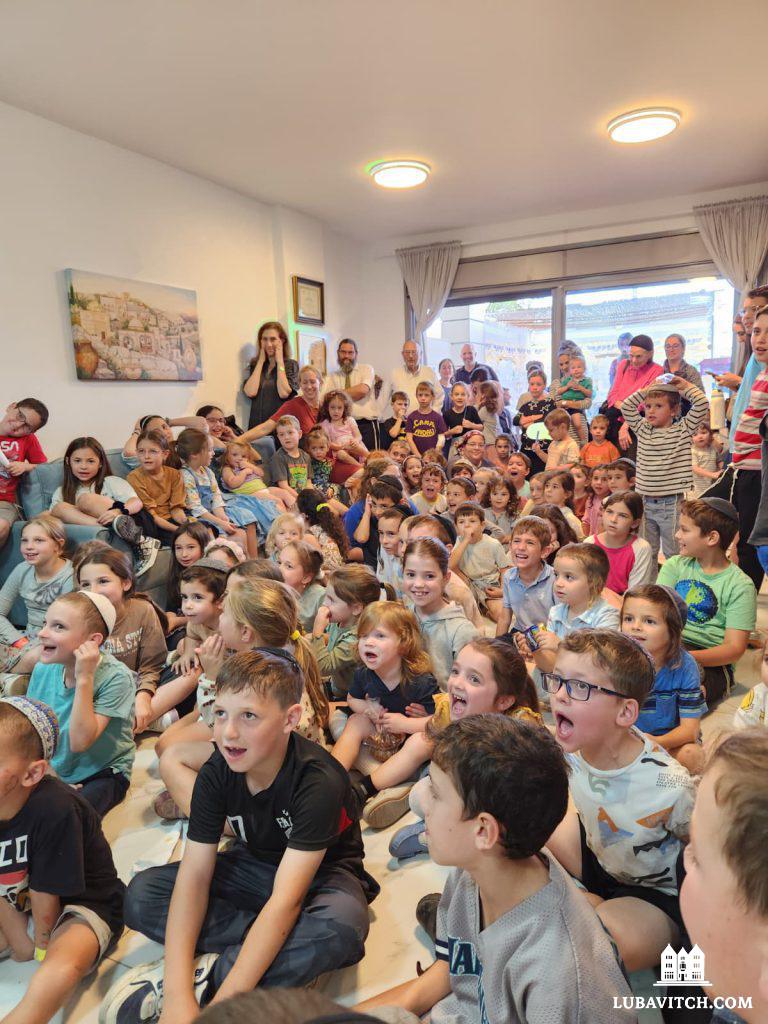
Their home is constantly full. “People come and go nonstop. Every time I walk in, there’s someone else on the couch. Our community really feels like one big family.”
Esther Fordham says their own aliyah experience helps them connect naturally with other families. “We’re adjusting together to new schools, a new language, and the rhythm of everyday life,” she said. “That creates a strong sense of connection.”
For people like Amanda Wernick, a school psychologist who made aliyah in 2022, the bond is vital. “Leaving family, adjusting to a foreign country, and a new culture are definitely the hardest parts,” she said. “The new Chabad here helps us feel part of a family again — like the familiar community we had before. We feel so lucky to have them here.”
Much of Esther’s work focuses on women and children through gatherings, Shabbos meals, and educational programming. “I try to give young mothers the confidence to realize how much power they have in raising the next generation,” she said.
Alongside practical support, the Fordhams are bringing Chasidic learning to the neighborhood through weekly classes, farbrengens, and holiday programming. On Sukkot, their children’s celebration drew over 100 families. For Chanukah, they’re planning a firetruck gelt drop.
Neve Shamir is just four years old, with its English-speaking population projected to reach 1,000 families. For now, they’re focused on being what so many olim need most: a warm landing, a judgment-free space, and a family that’s always available.
Do Donate to Chabad of Neve Shamir: Click Here









Jj
Mchayil el choyil!
Beautiful BH!
Very inspiring — hatzlacha rabba!