
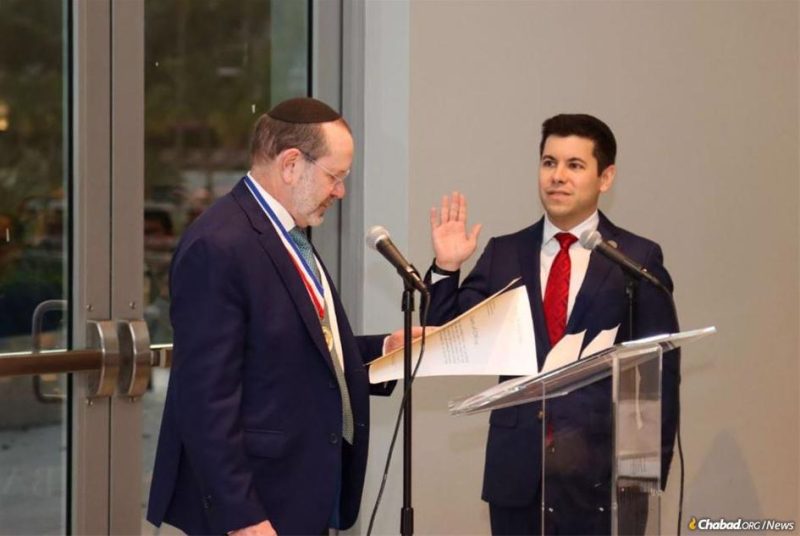
Father and Son Mayors of Bal and Bay Harbour, Fla., Heed the Rebbe’s Call
by Motti Wilhelm – chabad.org
When Seth Salver was sworn in as mayor of Bal Harbour, Fla., this past November, it was a proud milestone that resonated far beyond the village, and even beyond the state of Florida.
Salver is one of only a handful of Orthodox Jewish mayors in the United States, but even that wasn’t what made his election a rare chapter in American civic life: Swearing him in was his father, Isaac, who serves as mayor of neighboring Bay Harbor Islands. While children frequently follow their parents into public office, this is the first time in Florida history that a father and son serve as mayors simultaneously. It is also one of the only times nationwide.
The immediate path to this moment began in 1999, when Isaac Salver was first elected to the Bay Harbor Islands Town Council. But Isaac traces the roots of his family’s journey even further back, to the period when, with the encouragement of Rabbi Sholom Lipskar of The Shul of Bal Harbour, he and his family embraced greater Jewish religious observance. He often credits his decades of public service—he was awarded the Florida League of Cities’ prestigious municipal leadership lifetime achievement award in 2025—and, by extension, his son’s commitment to leadership, to a brief yet powerful 1989 encounter with the Rebbe, Rabbi Menachem M. Schneerson, of righteous memory: “Go and do great things in your city,” the Rebbe told him.

The Salvers with Rabbi David Yosef, Sephardic Chief Rabbi of Israel.
‘Go and Do Great Things in Your City’
Isaac was born in New York to Polish-Cuban emigres, just a short distance from Lubavitch World Headquarters in Crown Heights. Although the family felt a strong emotional connection to Jewish life and were ardent supporters of Israel, they were not particularly observant at the time. Following Isaac’s marriage to his wife, Bahee, in 1988, the couple settled in Surfside, Fla. He opened a CPA firm, and in what he later viewed as a moment of Divine Providence, his Miami Beach office was located directly above a yeshivah. One day, a rabbi from downstairs walked into the office and invited Isaac to come study some Torah.
“When he said that, I responded, ‘Torah? I don’t even remember the aleph-bet,’” Isaac recalls. “Unfazed, the rabbi smiled and said, ‘Don’t worry, we’ll learn in English, and I’ll walk you through it.’”
Around that time, he began putting on tefillin regularly. As his enjoyment of Torah-study grew, Isaac reached out to a close friend, Jerry Levine, and invited him to join the study sessions.
“Jerry told me, ‘Isaac, I’m open to the idea, but I’m going to find my own rabbi,’” Isaac remembers. “Three months later, he called me and said, ‘I found the rabbi.’” The rabbi Jerry Levine had found was the legendary Rabbi Sholom Ber Lipskar, who over more than 50 years played a central role transforming Miami into a thriving center of Jewish life.

Isaac Salver with Rabbi Sholom B. Lipskar.
Lipskar and his wife, Chani, had been sent to Miami Beach by the Rebbe in 1969, relocating to ritzy Bal Harbour and Surfside in the early 1980s to found The Shul of Bal Harbour. At the time, the oldest and nicest neighborhood in Bal Harbour village still had active deed restrictions forbidding sale of homes to people “with more than one-fourth Hebrew or Syrian blood.” The Lipskars persisted, with The Shul of Bal Harbour eventually growing into a sprawling synagogue and educational campus, and positively impacting generations of South Florida Jews. A powerhouse leader and innovator, around the time that Lipskar opened The Shul he also founded the Aleph Institute, the leading Jewish organization caring for the incarcerated and their families.
Isaac quickly began to see Rabbi Lipskar as his spiritual guide and mentor. Within just a few months of their first meeting, Rabbi Lipskar arranged for him to meet the Rebbe in New York at “Sunday Dollars,” the weekly gathering where the Rebbe would greet visitors, giving each person a dollar to distribute to charity and a blessing.
“Thirty seconds with the Rebbe at ‘Sunday Dollars’ was considered a lot of time, and I had about twenty,” Isaac recalls. “I began by telling the Rebbe my Hebrew name and my father’s name. Right away, the Rebbe stopped me and asked, ‘What’s your name in English?’ I told him, ‘My name is Isaac Salver. I’m from the Shul of Bal Harbour, Rabbi Lipskar’s shul. I’m the accountant for the Aleph Institute and for the Shul.’”
The Rebbe handed him a dollar for tzedakah (charity) for himself, a second for his family, and then said something unusual.
“He gave me an additional blessing,” Isaac says. “He looked at me and said, ‘Go and do great things in your city.’”
When the exchange took place Salver didn’t quite understand what the Rebbe had meant by those words. A decade later, in 1999, by this time living in the nearby community of Bay Harbor Islands, Isaac was elected to its Town Council. Four years after that, he served his first term as mayor from 2003-2004, followed by additional nonconsecutive terms as mayor in 2013-2014 and his current 2025-2026 term, as well as two terms as vice mayor.

Isaac quickly began to see Rabbi Lipskar as a spiritual guide and mentor, a relationship that continued to the next generation, with Seth and Rabbi Zalman Lipskar.
Like Father Like Son
In 1989, Issac and Bahee were blessed with their oldest child, Seth. He was born shortly after his parents moved to Surfside, and grew up as his parents were coming closer to observant Jewish life. Over his childhood, Seth and his two younger siblings witnessed their father’s dedication to public service and community responsibility, and joined their parents journey to a committed relationship with Jewish life.
After attending Jewish schools in Miami, Seth enrolled at the University of Maryland, where he was active in both Hillel and Chabad on Campus. After graduating, he spent two years working in Washington, D.C., regularly attending the Chabad center under the leadership of Rabbi Levi Shemtov.
After several years in the capital, Seth returned to Florida where he married his wife Perla in 2014. The same year, he was asked by members of the Bal Harbour Village Council to join their newly formed budget committee. “I’m a CPA, and the village wanted to emphasize transparency,” Seth explains.
Six months later, Seth ran for Bal Harbour Village Council and was elected in November 2016 at the age of 26. Two years later, he began serving as Vice Mayor.
In 2025, Seth decided to take his next step in local politics and ran for the office of mayor. Unlike Bay Harbor, where the mayor is selected from among and by the council members, in Bal Harbour, the mayor is elected directly by the general populace.
By the end of the day, the results were clear: Seth won with 70 percent of the vote. Later that month, he was sworn in by his father, making for one of the only times in U.S. history that a father and son have served simultaneously as mayors, and the first in Florida’s history.

Seth Salver, pictured at a commission meeting, got involved in local politics after spending several years in Washington D.C., and won his seat on the Bal Harbour Council with 70 percent of the vote.
Beyond the personal milestone, Seth and Isaac view the moment as the closing of a much longer historical arc. Just several decades prior, Bal Harbour had deed restrictions that barred Jews and blacks from owning property. Even after those restrictions were overturned, antisemitism lingered. When Rabbi Lipskar sought to purchase property in the area in the 1980s, he sent his wife to handle the negotiations, knowing that if he appeared in traditional Jewish dress, no one would sell to him.
Rabbi Lipskar and The Shul have continued to play a central role in Seth’s life. When Seth became vice mayor, it was Rabbi Lipskar who administered his oath of office. Sadly, the rabbi passed away a few months before Seth was elected mayor. It was the elder Lipskar’s son and successor at The Shul Rabbi Zalman Lipskar who addressed the swearing in ceremony. He also serves as chaplain for both of the Salvers’ municipalities.

Isaac and Bahee Salver greet Gov. Ron DeSantis.
‘I Respect Your Commitment To Your Faith’
While father and son share the title of mayor, their roles are not identical. In Bal Harbour, the mayor is elected directly by the voters, while in Bay Harbor Islands the mayor is chosen by the seven-member council from among their own ranks. Their formal authority and policy influence therefore differ as well. What they share, however, is more fundamental: both are proud, observant Jews who see the Torah as the guiding force in their civic and professional lives, just as it is in their personal ones.
For both, that visibility is a point of pride.
“The fact that a young, religious mayor was elected, especially at a time when some high-profile mayors are not exactly seen as friends of the Jewish community, caused my story to go viral,” Seth says. “I was recently in Los Angeles, and someone came over to me and asked if I was the new mayor of Bal Harbour. He said he’d seen me online, and after seeing so much antisemitism, it was refreshing to see an Orthodox Jewish mayor making a Kiddush Hashem by wearing his kippah in public.
“It’s just a breath of fresh air for a lot of people.”
Isaac agrees, and points to moments when his visible religious observance earned him respect well beyond the Jewish community.
“During my time with the Florida League of Cities—a statewide advocacy organization representing 2,500 elected officials from all 411 cities—I served as second vice president, then first vice president, and ultimately president in the year 2000,” says Isaac. “What I experienced was the exact opposite of antisemitism.”
The organization’s meetings were held throughout Florida and across the southeastern United States, and Isaac recalls a striking level of sensitivity to Jewish religious needs. “They were incredibly mindful of Shabbat and Jewish holidays,” he says.
As a result, there were times when Isaac stood in the middle of a packed room on Shabbat, speaking without amplification, while the entire audience sat in silence to accommodate him.
“And what would happen afterward,” he says, “is that people, guys from the middle of the state, would come over to me and say, ‘Man, I respect your commitment to your faith. G‑d bless you. G‑d bless you.’ That’s what I got.”

The Salver family
That sense of responsibility, Issac explains, is constant, particularly as a religious Jew. “Every word I say and every action I take, I’m thinking not only as an elected official, but as a representative of the community and of the Jewish community in particular. That means I have to be beyond reproach, and even more than that, extra sensitive, to ensure that the decisions I make are good for the entire community, and that the impact and ramifications of my words and actions reflect positively on the community at large.”
Coming from close to three decades in public service, Isaac reflects.
“Believe me, after 26-plus years in office, I understand why people can be reluctant to put themselves in a position where they become a lightning rod for complaints,” he explains. “Our official salary is a dollar a year, and I often joke that I’ve been accused of being overpaid.”
Still, he insists the rewards far outweigh the frustrations.
“For those who have the patience to sit through meetings, listen to the minutiae, and hear the complaints, there is real satisfaction in being able to lead and to make a tangible impact. Municipal government is the level closest to the people. You can actually help get potholes fixed, improve traffic flow and make daily life better. And when you see those changes happen, you realize it’s worth it.”
At the time being, neither is pursuing higher office. Isaac is closer to retirement age than the age most people start a new role, and Seth would find it challenging to commute to Tallahassee— where the state legislature meets—with his young family and job in Bal Harbour. But neither is ruling it out either.
“This type of thing is the right opportunity at the right time,” Seth says. “I’m not ruling out higher office, but I’m very happy where I am.”
“Look, if a situation dropped in my lap and all the stars lined up appropriately, I would certainly consider it,” Isaac says.
But no matter how far they go, they both remember where this all started.
“For me, the Rebbe’s blessing and impact was direct,” Isaac says. “He gave me a brachah, and I never forgo an opportunity to share that brachah with the community. As a matter of fact, at the council meeting where I was awarded one of my 25 years of service, I played the video of my encounter with the Rebbe, and I said publicly that I’m going to show the moment that led to my success and my ability to achieve 25 years in office.”

Isaac Salver hugs his son Seth after swearing him in as mayor of Bal Harbour.