Israel’s Only Paralympic Skier Skipped Two Races for Shabbat. She Has No Regrets
by Howard Blas – chabad.org
She was one athlete, representing one country, in five events. Two of them fell on Shabbat.
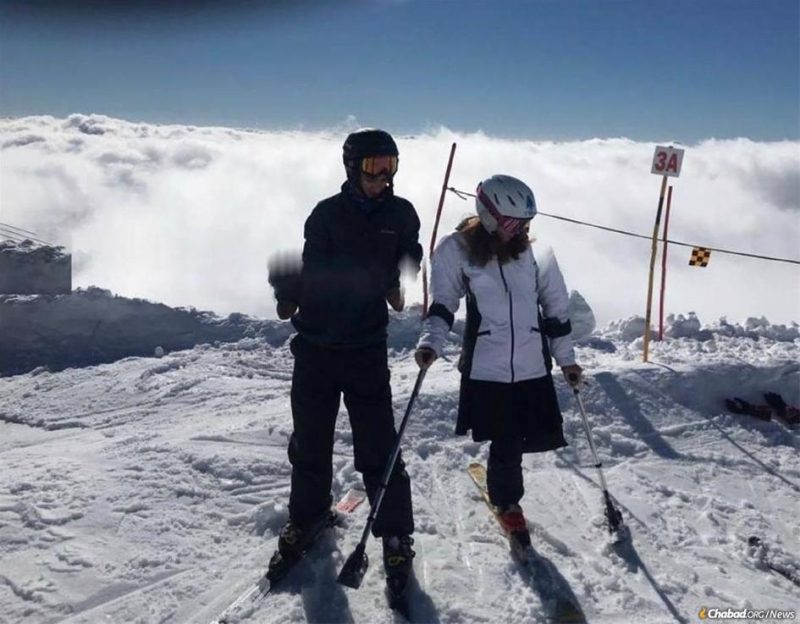
Sheina Vaspi, Israel’s sole representative to the Milano Cortina 2026 Paralympic Winter Games, did not ski in the women’s downhill on the Games’ opening weekend, nor in the slalom on the final Shabbat of the competition. For the 24-year-old native of Yesud HaMa’ala in Israel’s Galilee region, not skiing on Shabbat—even in such a prestigious event as the Paralympics—is not really a “decision.”
“More than Israel has kept the Shabbat, the Shabbat has kept Israel,” Vaspi told Chabad.org from her room at the Paralympic Village ahead of her second Shabbat there last week. “In a sport like skiing, you need that protection from Hashem.”
The slalom, Vaspi’s favorite event, was scheduled to begin on Shabbat. In the days before, Vaspi said she had been quietly hoping for a heavy snowstorm on Friday night—one severe enough to push the race to another day. The storm never came. Instead, she spent the morning in her room at the Paralympic Village celebrating Shabbat.
In the three events she did compete in, Vaspi missed a gate in the super-G (super giant slalom) and was disqualified, and finished 12th out of 15 in the super combined standing, a condensed competition format held in one day, combining one short run of a speed event—either downhill or Super-G—with one run of technical slalom.
Each result was absorbed with the same matter-of-fact composure she brings to the far larger obstacles she has faced.
Megillah in Paralympic Village
Vaspi lost her leg in a car accident when she was 3 years old. She picked up skiing at 16, a relatively late start even for able-bodied athletes and an especially unlikely one for a girl from a country with a single ski area. Her first time on snow was at Israel’s Mount Hermon, encouraged by her relative Amit Mizrahi, an Israeli alpine skier and volunteer for what is now the Shevet Foundation.
She has since put in the work to close that gap, spending four seasons training in Winter Park, Colo., and several months in Chile. The Milano Cortina Games marked her second Paralympics appearance; her first was in Beijing in 2022.
“For me, it is special to be here,” she said. “Others at this level came from countries with a lot of winter sports and have a lot of experience.”
Wherever Vaspi has trained or competed, Chabad-Lubavitch has been part of her support network. In Colorado, she spent four seasons going to Rabbi David and Nechama Araiev of the Ohr Avner Community Center in Aurora every Shabbat. “They were my second home there,” she said. In Chile, Chabad was similarly supportive during a three-month stretch.
“Everywhere I go, Chabad has been totally amazing,” she said. “They help me with organizing kosher food, Shabbat, and to just sit and talk in Hebrew. There is something familiar wherever I go.”

Rabbi Eli Edelkopf drove five hours to read the Megillah in the Paralympic Village for himself, his wife, Vaspi, and her physiotherapist.
The most recent example came on Purim. Vaspi mentioned to her contact at Chabad of Milan that she was hoping to hear the Megillah read in the Paralympic Village, a five-hour drive from Milan.
The contact reached out to Rabbi Eli Edelkopf, director of the European Jewish Development Fund. He agreed without hesitation, driving five hours each way to make it happen. Edelkopf read Megillah in the Paralymic Village for himself, his wife, Sheina and her physiotherapist, a Israeli-born Jewish woman from Colorado.
On the way, at Vaspi’s request, Edelkopf stopped to pick up a kosher microwave and a volume of the letters and correspondence of the Rebbe, Rabbi Menachem M. Schneerson, of righteous memory, known as Igrot Kodesh. He also brought homemade hamantaschen and mishloach manot.
Vaspi was speechless. She couldn’t believe the Edelkops made the trip especially for her, and her Israeli physiotherapist who joined them.
The microwave, said Vaspi, was a lifesaver. While she had access to plenty of kosher food, she had no way to heat it.
Vaspi was excited to have her parents watch her compete, but the war with Iran made that impossible.
“I keep it all in perspective,” she said. Nevertheless, she was happy that her sister made it, after a journey that took 36 hours instead of the usual three.
Looking back on her unlikely journey, Vaspi has one takeaway message: There’s no reason to compromise on your Judaism. “Go after your dreams and believe in yourself,” she said. “You can do anything.”

Sheina Vaspi