Weekly Story: America Iz Nisht Anderish – America Is Not Different
by Rabbi Sholom DovBer Avtzon
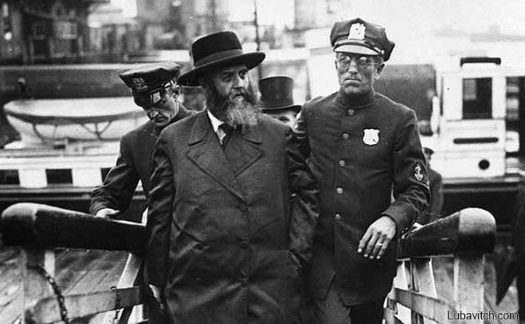
This week I am posting certain points that I heard as well as said at a farbrengen in connection to Tes Adar [Sheini], as it is 86 years since the Frierdiker Rebbe came to America to live.
As always, your feedback and comments are greatly appreciated and welcomed.
As an introduction I would like to relate the following story, once while the Rebbe Rashab was traveling, he was asked about all the various isms of groups and philosophies that were spreading out all over Russia. There was communism, Zionism and so on.
The Rebbe Rashab replied that since the life source of every entity and existence in the world comes from Hashem, there must be an aspect of Truth in each one of them. He then mentioned what the holy aspect is in each of those movements that he was asked about. However, he concluded, that just because there is an aspect of Truth in them doesn’t make the movement a truthful movement, in fact they are wrong.
With that said we have to understand why did the Frierdiker Rebbe have to declare upon his arrival to the shores of America, that America is nist Andirish – America is not different than Europe, and just as Judaism flourished there so too can it and it will flourish here in America.
After all, throughout our history of exile, America was not the first new frontier that Jews came to, and then when we came to those countries and continents, the leaders of the Jewish people of that time, didn’t have to proclaim that this country is not different than our previous situation, and here too Judaism can flourish. So why here in America did the Frierdiker Rebbe have to make this declaration?
Additionally, he had to say it as a reply to Jews who were completely observant! So evidently, they felt that America is different. So why specifically by America is there a thought that America is different, to the extent that even when people felt they were in daand had to escape from their predicament, Rabbonim advised them that it is better to deal with this danger than the danger of America! But as noted, there wasn’t this thought when the Jews first settled in every country in Africa, Europe and Asia?
Reb Leib Hoffman was one of the Rebbe Maharash’s outstanding chassidim, and he was a tremendous mekubal. He stated that Moshiach cannot come until one if the Rebbeim ([of Chabad] will settle in America. We have to understand, why is it necessary for a Rebbe to be in America in order for Moshiach to come.
The Alter writes that the revelation of Matan Torah did not affect the bottom half of the world. Being that the world is round and Har Sinai was the focal point where Hashem shined and revealed His essence upon it, therefore, that half of the globe [with Har Sinai on top] received the Torah in a revealed manner. While the other half of the globe did not receive it in a revealed manner.
Subsequently, being that the revelation of Matan Torah did not reveal itself openly in America, so therefore, even though great Rabbonim came to America and tried to the best of their ability to change America, America did not change. Yes, Boruch Hashem, they were able to help individuals or even a community to remain staunch and proud in keeping Torah and Mitzvos, but America as a whole was called the treifa medina where it is impossible to raise a family to remain frum.
However, when the Frierdiker Rebbe came here, he declared that Hashem sent him here on a mission. In other words he is not coming as an individual, but he is coming because that is Hashem’s Will and through the Chassidus which he would be saying here in America, he would be revealing Hashem’s greatness even in this part of the world. By revealing Hashem’s greatness in this part of the world that is what changed America and made it that America is not different.
To explain and clarify this concept clearer, perhaps we could connect this to the accomplishment of Matan Torah as compared to the era before Matan Torah. Yes, there was always yeshivos by our forefathers, and Yakov established a Yeshiva in Mitzrayim, and the Avos fulfilled all the mitzvos even before Hashem gave them to us. However, that was not able to change the world. The materialistic aspects of the world remained as they were, and even after the item was used to fulfill a mitzvah, it remained a physical item and was not permeated with holiness. Only when Hashem came down and revealed Himself by Matan Torah and gave us the Torah, that gave us – the Jewish people – the ability that when we [meaning every Jew, even one that seemingly is not so observant] fulfills a mitzvah and learn His Torah we elevate and change the physical world into a spiritual entity.
Subsequently, even those Rabbonim who tried to replant the seeds and trees of Judaisim in America, but their efforts were stymied before the Frierdiker Rebbe’s arrival, once he came, they too began seeing much greater success than before.
To bring this out in real life, I heard this past Shabbos from a son of one of the American boys that came to learn in 770 a few years before the Frierdiker Rebbe’s histalkus in 5710.
He said, “My father a”h said, do you think us religious American boys wanted to remain Yeshiva students until we married? Definitely not! Our ambition was to go college, and become doctors, lawyers and other highly regarded professionals, like so many of our Jewish neighbors did. So what caused us to remain in Lubavitch and forgo those dreams?
We saw the [Frierdiker] Rebbe’s face, and we immediately recognized that he is a maalach Elokim (an angel of Hashem), and that changed our entire perspective. When one stands in the presence of holiness, one aspires for holiness themselves.
This is just one aspect of how the Frierdiker Rebbe caused the thaw and change in America. Bezras Hashem in my upcoming biography on him, I relate it in much more detail.
A Taste of Chassidus
Simuhloi Tachas L’Roshi, V’yiminoi tichabkeinee Torah Ohr p. 86
In this maamar the Alter Rebbe explains this possuk somewhat differently than he explains it when he connects it to chodesh Elul and Tishrei. The simple translation is, His [Hashem’s] left hand is under my head, and He strengthens me with His right hand. Our sages learn from this possuk that a person should reprimand someone with their weaker hand, in a milder manner, while use your right hand, meaning utilize whatever tools you have to draw that person close.
The Alter Rebbe explains here that the possuk is telling us that the whole reason why there was a sign of a left hand, some warning, retribution and / or punishment, is only to elevate the person. Not merely to elevate the lower aspects or actions of the person – the “feet” of the person (i.e. that they no longer misbehave) but as the first possuk in this parsha states, elevate the “head” of bnei Yisroel, (i.e. the highest levels of bnei Yisroel), meaning that they should even go higher.
As the Mitteler Rebbe explains this concept, that the possuk isn’t saying that the ultimate goal of this retribution is in order to bring out an elevation some time later, and then we will have kindness or even that, we will see the kindness. But rather, at the moment we see and feel the pain, we see that it is really an act of kindness. [In other words, according to the Torah when one gives a reprimand, it shouldn’t be to punish someone for their wrong or bad decision and subsequent action. But it is only to be done in order to help guide that person to realize their mistake and rectify themselves. So, in essence Hashem never gives a punishment for our wrong actions, in reality it is kindness, as we will see.
He explains it with the following parable. A baby has a bad diaper rash and is crying out in pain. The parent picks up the baby to wash away the “dirt,” and cleans the baby. But as ss they begin, then the baby’s cry multiplies manyfold. Not only doesn’t the parent stop, but they completely ignore their child’s cry. Yet, no one is going to reprimand them for the “pai” they are inflicting on the helpless infant, that can’t protect itself, but to the contrary they will be encouraged, as the “pain” they are intentionally inflicting on their baby is a demonstration of their deep love and affection for this precious child of theirs.
The reason he discusses this concept this week is, the parsha begins with the words Ki Sisa es Rosh bnei Yisroel l’pikoodeihem, and because l’pikoodeihem is related to the words of B’yom pukdee, u’pukaditee – on the day I will punish you, I will connect that punishment to the punishment that you deserved to receive for creating the golden calf. Punishment as noted is connected to the concept of the left hand push away, but as explained in truth it is to bring out the deep love and bound that exists between Hashem and bnei Yisroel.
In the maamar, the Alter Rebbe notes that this explains that the reason Hashem made us feel that we are an independent entity, just we need Hashem’s help to live, while the malachim (angels) feel that they are connected to Hashem, which evidently demonstrate that they are closer to Hashem, is a false illusion.
Being that they feel that they are connected to Hashem, the malachim don’t feel or understand that they need to come closer. But us, who because of experiencing the distance as a result of being pushed away by Hashem’s left hand, we come to realize that we are separated from our source, and recognize that we must draw closer to Him. So the distance that Hashem created between us and Him, to the extent that we may consider ourselves an entity in by itself, is not to distant Himself from us, but to awaken within us the yearning to reconnect ourselves to Hashem on the highest level, in other words to reveal that there was no aspect of punishment, rather its entire purpose is to bring us closer to Hashem. And then our connection will be a much firmer one than those of the malachim.
Another interesting point that the Alter explains in this maamar, is that while normally we explain that His right hand hugs me, comes after His left hand, and is alluding that the right hand brings us to a higher level. Here he explains, that once our head is elevated, there can be a possibility that we may lose that recognition and fall back to our original level of being somewhat distanced. So he gave us the Torah and Mitzvos with his right hand, in order that it sustains us at that elevated level.
In that maamar, the Alter Rebbe also explains the three levels of serving and loving Hashem with all your heart, all your soul and all your might. But that requires a summary on its own.
Rabbi Avtzon is a veteran mechanech and the author of numerous books on the Rebbeiim and their chassidim. He can be contacted at avtzonbooks@gmail.com.