

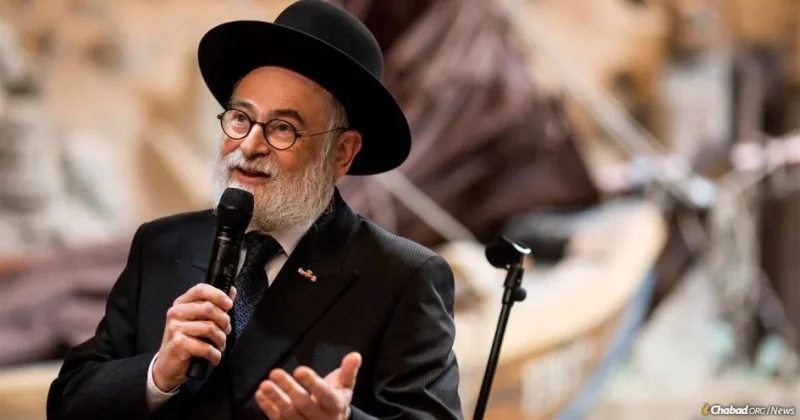
Despite the Odds, Rabbi Binyomin Jacobs Has Led Jews of the Netherlands for 50 Years
by Mendel Scheiner – chabad.org
In November 2024, following a Maccabi Tel Aviv football match, Israeli fans were ambushed across Amsterdam, the largest city in the Netherlands. Victims whom the attackers assumed were Jewish were chased, beaten and robbed. One man was heard begging, “I am not Jewish!” in a desperate bid to avoid the blows. When the night had passed, at least five Jews were hospitalized, and dozens more injured.
For Rabbi Binyomin Jacobs, chief rabbi of the Netherlands and regional director of Chabad-Lubavitch activities in the country, the violence was a lowlight in his 50th year of Jewish leadership in the European country. This year marks half a century since the rabbi accepted a narrow three-to-two vote to serve a small community in Amersfoort—a position none of the board members believed the young man would keep for six months. From that humble post, Jacobs has grown to become one of the most influential leaders of Dutch Jewry, leaving an indelible mark on the entire country’s Jewish community.
“Growing up after the Holocaust, my parents always told me: ‘Don’t be afraid, it will never happen again,’ ” says Jacobs. “Ten years ago I was told by the government not to use public transport. Today they provide me with a security detail whenever and wherever I go. It’s sad that it is needed, but I am thankful that the Dutch government takes our security concerns seriously.”
Yet when faced with a dilemma on how to address the growing problem of European antisemitism, Jacobs consistently offers one defiant message.
“I tell my community that we should not leave out of fear and never give in to blackmail.”
It’s a position that encapsulates five decades of quiet determination, of rebuilding Jewish life in a country that lost three-quarters of its Jewish population during the Holocaust and of refusing to surrender ground even as threats mount once again.

Born to Be a Rabbi
In the early spring of 1940, before the Luftwaffe would blitz Rotterdam, the Netherlands was home to 140,000 Jews. The meticulous Dutch bureaucracy made its records easy to seize, and the Jews were rounded up swiftly, most efficiently in the country’s dense cities.
By the end of the war, roughly 102,000 Dutch Jews had been murdered—three-quarters of the prewar population, the highest death rate in Western Europe. Binyomin Jacobs was born in Amsterdam in 1949 into what remained of the decimated Dutch Jewish community.
Jacobs came from a family that had survived what most had not. He grew up in Amsterdam in a middle-class Dutch Jewish family, active in Jewish youth movements. From age 13, he studied regularly at the local rabbinical seminary.
The Chabad-Lubavitch movement’s first large presence in Western Europe came after the war. Chabad Chassidim, refugees from the Soviet Union who had passed through displaced persons camps in Germany and eventually settled in France, turned it into a major European center for Chabad activities. In the Netherlands, the first Chabad representatives maintained regular contact with the Chassidim in France.
During his summer vacation, a teenage Jacobs visited the Chabad yeshivah in Brunoy, a suburb outside of Paris, where he formed a relationship with the director, the famed Chassidic teacher and mentor Rabbi Nissan Nemanov. After high school, Jacobs faced a choice: the yeshivah in Gateshead, strongly recommended by his teachers in Holland, or the Chabad yeshivah in Brunoy, which he was already familiar with.
He wrote to the Rebbe—Rabbi Menachem M. Schneerson, of righteous memory—asking for guidance, but received no response. He wrote again and still heard nothing in return. Eventually, he informed the Rebbe of his own decision to go to Brunoy. This time, the Rebbe immediately replied with an express letter and a blessing for success.
“I learnt from this that the Rebbe did not want me to ask about every decision,” Jacobs reflects. “He wanted me to take responsibility, and he would give his blessing once a decision was made.”
It became a lifelong lesson: The Rebbe shows you where to dig, but the digging you must do yourself.

Before his wedding, Jacobs had asked the Rebbe for a blessing during a private audience. The Rebbe advised him to continue studying Torah in a Kollel for at least three years. Rabbi Binyomin Klein, one of the Rebbe’s secretaries, later told him this was unusual—at the time, most students were supported while they studied for only one or two years. Rabbi Klein wrote a special letter to Rabbi Ephraim Wolf in Israel, instructing that, on the Rebbe’s directive, Jacobs should be supported for a longer period.
After his yeshivah years and newly married to his wife, Bluma, the young couple moved to the tiny town of Kiryat Malachi, Israel, a place with only one bus and a single phone for the entire local population.
At the Kollel in Kiryat Malachi, Jacobs studied under the directorship of Rabbi Zalman Nechemia Goldberg and the chief rabbi of Israel, Rabbi Isser Yehuda Unterman.
Kiryat Malachi was an immigrant town, each group bringing its own customs and traditions. Part of Jacobs’ studies required him to teach local Jews. Every Shabbat, Jacobs would move from one synagogue to another, giving short talks in the native languages of the congregants. With every speech, he picked up a new word or phrase.
“This taught me how to relate to people,” Jacobs later recalled. “You must speak their language. And language does not mean only words; you have to understand the person.”
Jacobs learned through experience. Every visit, every speech, prepared him for the path the Rebbe had set before him—a path that would take him far from Israel, back to the country of his birth.

Returning Home to Holland
During Jacobs’ time studying, Uri Cohen, the founder of a Jewish school in Amsterdam, approached him about moving back to the Netherlands to run his new school. Cohen believed Jacobs and his wife would be the perfect couple: Bluma came from an old Chabad family and had strong educational experience in London, while Jacobs, being Dutch, could serve as the bridge to Dutch society. But because the Rebbe had explicitly told him to study for at least three years, he declined.
After the three years had ended, a position opened in Amersfoort after the passing of the local rabbi. The Jewish community offered him a role as rabbi and cantor. Jacobs learned about the opportunity through Rabbi Daniel Meyers, founder of Chabad activities in the Netherlands, whose brother-in-law was treasurer of the Amersfoort community.
Jacobs turned to the Rebbe for guidance. The Rebbe wanted him to go to Holland and become part of the already active Jewish infrastructure throughout the country, without establishing his own independent organization. Answering Jacobs’ question about where to settle, to him: “Go to where the best conditions are.” Since Amersfoort was the only place where the community had offered him a salary, Jacobs understood he should accept their offer.

Jacobs soon found himself standing before a tense board vote in Amersfoort. When the votes were counted, it was three to two in his favor. None of the five board members thought he would last six months.
The move to Holland came with other uncertainty as well. Jacobs wasn’t sure where to begin. The local Jewish umbrella organization warned him sternly: Don’t inspire people to eat kosher, and don’t be outgoing or perform outreach. Essentially, they were looking for a figurehead, not a spiritual leader and rabbi.
There was also one condition to his being hired in Amersfoort: Sinai Hospital, the only Jewish psychiatric hospital in Europe, was in desperate need of a rabbi. It was a package deal; if he accepted the rabbinical job, he’d need to be prepared to minister to the psychiatric ward in Amersfoort as well. Jacobs agreed, and soon stepped into a world of medicine he had never imagined.
The clinic’s patients were, for the most part, Holocaust survivors, and what many rabbis might encounter in a lifetime, Jacobs faced in a single week.
“You get humbled seeing survivors of gas chambers continue living,” he says. “Who am I to complain?”
The intense cases he witnessed in the hospital gave him invaluable insight into dealing with everyday life, providing him with gratitude, empathy, and clarity in his rabbinic work. While the doctors prescribed medication, Jacobs approached the problems through a Jewish lens. He understood his patients in ways that even the most prestigious psychiatrists could not.

There was little glamor in the work, but here, too, Jacobs saw a lesson in leadership. “It’s very important to be humble and not need validation,” he says. “You should not work for the applause; you should work to help other people.”
Aside from his work in the hospital, Jacobs was also working on bolstering the Jewish community, proudly standing alone as a Chassidic rabbi in a city still hurting over its recent history.
The Jacobses were making a mark on Holland, reviving the Amersfoort community one Shabbat at a time. With lectures, services, kosher food and a proud Jewish presence, they offered something rare in Holland in 1975.
Jacobs quickly noticed a void: the youth. “People were coming from all over,” he recalls. “It was a generation after the war. The youth didn’t know anything about Judaism.”
So the couple began holding classes—Jewish law, philosophy, theology, whatever people needed to begin learning about their heritage. “I would be teaching on the third floor,” says Jacobs, “and my wife would be teaching on the second.”
As Jews traveled to Amersfoort to attend a lecture or join a service, Jacobs made a point of meeting them halfway. He began traveling to surrounding districts, developing relationships house by house, living room by living room, and slowly rebuilding Jewish life through classes, home visits and community work.
Some years earlier, Rabbi Mendel Futerfas, a Lubavitcher Chassid and survivor of Stalin’s labor camps in the Soviet Union, had visited the country. He came with a directive from the Rebbe to help strengthen Jewish education in the Netherlands.
Futerfas met with Cohen, a Dutch Jew known for his role in the wartime resistance, who took upon himself to establish the only Jewish religious school in Amsterdam. Now, seeing the young rabbi and his wife’s work in Amersfoort, Cohen approached Jacobs and asked him to take responsibility for the school’s fundraising. Jacobs agreed. It was the next step in his mission.

Jacobs’s presence and work was soon being felt throughout the country, and Chief Rabbi Eliezer Berlinger took notice. Rabbi Berlinger was by nature not very fond of Chassidism, and at first his relationship with Jacobs was an uneasy one. But as they proceeded to work together, Jacobs deferring to the elder rabbi’s opinion and wisdom, Berlinger, impressed by Jacobs’ willingness to act no matter the opportunity, began seeing things differently.
About five years into their relationship, they were driving in a car together. Rabbi Berlinger asked whether the Chabad community had done anything to mark the anniversary of the passing of the Sixth Rebbe—Rabbi Yosef Y. Schneersohn, of righteous memory. Jacobs downplayed the event Chabad had held to avoid upsetting his decidedly non-Chassidic elder colleague. To his surprise, Rabbi Berlinger said it was a shame they had not marked it more strongly, for the Sixth Rebbe had revitalized Jewish life in Europe. That was the moment Jacobs realized that their relationship had been completely transformed into a fully positive one.
After six years in Amersfoort, Jacobs was formally asked by Berlinger to serve as his assistant. The position would add to the plethora of work already undertaken by Jacobs. “I never looked for career opportunities,” he says. “I don’t think much about the past or the future. The question is always: What is needed today?”
He accepted the role with the same practicality that had gotten him there.

From Acting Chief Rabbi to Continental Leader
When Berlinger passed away in 1985, Jacobs was unanimously appointed to succeed him. But the formal appointment took time. For 23 years, he served as acting chief rabbi before the bureaucratic process was completed in 2008.
He did not expect much to change with the official title, but in reality, it opened many doors within the Jewish community, in government, and in broader society. “People respond differently to a recognized authority,” he explains. The title gave him openings to institutions and officials he could now assist on behalf of the community.
Jacobs uses the position to advocate for Jewish education, ritual slaughter, circumcision, and religious rights across Europe. He is regularly called to support communities and rabbis, often fellow Chabad emissaries across the continent, when facing national policy challenges. He sees the title not as personal status but as a responsibility and a tool for helping Jews, supporting Jews in the Land of Israel and strengthening Jewish life throughout Europe.
As the regional director of Chabad activities in the Netherlands, Jacobs has helped establish Jewish day schools and outreach centers across the country. He founded “Toda Raba,” a program to honor individuals who support Jewish life. As part of the award, he has brought recipients to Israel to deepen their understanding of Jewish history and identity. Many of the people he first engaged went on to become leaders in Dutch public life. Together with his close friend Rabbi Yitzchak Vorst, he founded “Mazel Tov”, a marriage bureau to help people find a Jewish partner, as well as “Jad Achat”, a cultural organization that developed modern programming for Jewish education across the country, in addition to many other initiatives.

In the decades since he assumed leadership of the Chief Rabbinate, Jacobs’ work has expanded beyond the Netherlands. He serves in the leadership of the Rabbinical Centre of Europe and works closely with the European Jewish Association, helping unify Jewish communities across the continent. His guidance has been sought in countries including Switzerland, Montenegro, Poland and Belgium, where he has assisted local rabbis and their communities. He has also led delegations of European civic leaders to German death camps, helping them confront antisemitism and its consequences.
In recent years, Jacobs has spoken frequently in public and before government officials, condemning the rampant antisemitism throughout Europe, particularly after the Palestinian massacre of Oct. 7, 2023, that led to Israel’s two-year war with terrorist organizations controlling Gaza.
Despite some Jews leaving the Netherlands for Israel, Jacobs feels he has a duty to stay. “Who says one person is less important than 100?” he says. As long as there are Jews in the country, the Rebbe’s direction to him still stands.
“The Rebbe showed us that we don’t run away when times get hard,” the rabbi says firmly. “A soldier stands at his post, and never abandons his mission. When we do that and focus on our mission of bringing every Jew closer to their Father in Heaven, we have full trust in G‑d that everything will work out for the best.”
Fifty years after that narrow vote in Amersfoort, Rabbi Binyomin Jacobs remains at his post—a leader of Dutch Jewry, a builder of communities and a man who has learned that the Rebbe shows you where to dig, but the digging you must do yourself.









Chani Farron
Truly inspiring!