
Weekly Dvar Torah: Hashem Energizes — And We Deliver
‘אָדָם כִּי יַקְרִיב מִכֶּם קָרְבָּן לַה
At first glance, the verse is striking. It begins in the singular, “When a man will offer”, and shifts into the plural, “you shall offer your sacrifice.”
The Alter Rebbe uncovers the inner meaning: when the “Adam Elyon,” Hashem Himself, draws a person close, He initiates an awakening from Above. But that is only the beginning. The response must come from below. What starts as a personal stirring must become a collective and internal offering, “Mikem,” from within you.
This is the essence of a Korban, not merely an external sacrifice, but an inner movement of closeness.
Every person experiences moments of awakening. A surge of inspiration. A clarity. A desire to be better, to come closer to Hashem. But that spark does not sustain itself. If it is not internalized, it fades.
And that is where the Torah directs us:
Bring the animal.
Not an animal from the field, but the animal within.
Sometimes that animal is like an ox, forceful, ego-driven, pushing, controlling.
Sometimes it is like a sheep, passive, drifting, uninspired, disconnected.
Both must be brought as a Korban.
If a person is an “ox,” the Avodah is to soften, to humble, to redirect strength toward serving Hashem.
If a person is a “sheep,” the Avodah is to awaken, to recognize one’s value, to live with purpose and direction.
Because the very fact that a person feels an awakening is itself a message:
Hashem wants you close.
But He does not do it for you.
Hashem energizes—
and we are meant to deliver.
The Torah adds another detail: every Korban required salt.
Salt does two seemingly opposite things: it extracts impurities, and it enhances flavor.
And in truth, both are necessary in our relationship with Hashem.
The first step in coming closer is to remove the “blood”, the raw, self-serving drives, the indulgence, the ego that pulls a person away from G-dliness. This is the work of refinement.
But refinement alone is not enough.
There must also be taste.
A person must feel the sweetness of Torah, the depth of connection, the pleasure of understanding and relating to Hashem. Otherwise, the entire experience remains dry and external.
This is the role of the inner dimension of Torah, Chassidus.
It is the “salt” that gives flavor to Yiddishkeit. It reveals the inner meaning, the “why,” the G-dliness behind the Mitzvos. It transforms observance into relationship.
And today, this “salt” is more accessible than ever, through learning, through teachers, through the global spread of Torah.
Because Hashem does not want a dry connection.
He wants closeness that is alive.
To understand this more deeply, we must look at what a Korban truly accomplishes.
A Korban is not about giving something up, it is about elevating.
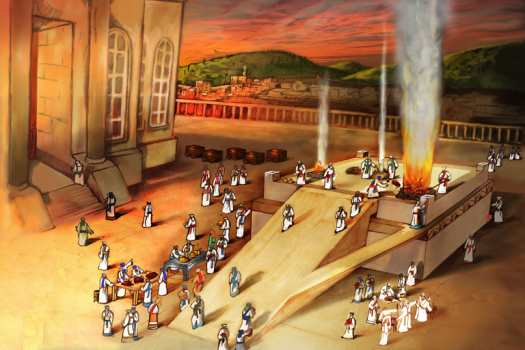
In the Beis HaMikdash, a Korban often involved three participants:
Hashem, the Kohanim, and the person bringing the offering.
Sometimes the offering was entirely consumed on the Mizbeach, completely for Hashem.
Sometimes it was shared with the Kohanim, representing Divine kindness.
And sometimes it was shared by all, Hashem, Kohanim, and the owner, in a Korban of peace.
Why this structure?
Because creation itself is built as a system of elevation.
The inanimate supports the vegetation.
The vegetation feeds the animal.
The animal sustains the human.
And the human elevates everything to Hashem.
The Korban completes this cycle.
Even the animal itself “desires” this elevation. At the Akeidah, the ram rushed forward, it wanted to become a Korban. The resistance came from forces that tried to hold it back.
And so it is with us.
Deep down, we want to grow, to rise, to connect. But something resists: habits, distractions, ego, doubt.
The avodah is to push through that resistance and allow ourselves to be elevated.
This is not a one-time experience. It is a daily reality.
Every morning, Hashem returns our soul.
And with it comes a quiet but powerful message:
“Let’s get close.”
We feel it in that initial freshness, that clarity, that hope that today will be different.
But as the day unfolds, that energy often fades. Routine takes over. Inspiration weakens.
The Torah’s answer is simple and profound:
Bring the Korban.
Take the ox within—and channel its strength into purposeful action.
Take the sheep within—and transform its calm into meaningful pleasure in Torah and Mitzvos.
Torah brings understanding.
Understanding brings pleasure.
Pleasure creates connection.
And Mitzvos anchor that connection in reality.
This is the partnership:
Hashem awakens
We respond
Closeness becomes permanent.
And this leads us to a subtle but powerful lesson at the very beginning of the Parsha.
The word “Vayikra” ends with a small Alef.
In contrast, at the time of creation, the word “Adam” begins with a large Alef.
The Alter Rebbe explained that Adam, aware of his greatness, allowed that awareness to lead to self-importance, and ultimately to failure.
Moshe, however, was fully aware of his greatness and yet remained completely humble. He understood that everything he had was a gift from Hashem.
And that is why his Alef is small.
This is not a contradiction; it is a balance.
A person must recognize their greatness. Every soul is a חלק אלוקה ממעל ממש, a spark of Hashem Himself.
But at the same time, one must recognize that this greatness is not self-generated.
It is entrusted.
When a person lives with that awareness, strength without arrogance, humility without weakness, they become a vessel for something extraordinary.
“Vayikra” Hashem calls to them.
And perhaps this is the deepest message of all.
We are not being asked to become something we are not.
We are being asked to use what we already have.
The awakening is already there.
The energy is already given.
The soul already longs to connect.
The question is only:
Will we respond?
So the Avodah is clear.
Refine the animal.
Add flavor to your Yiddishkeit.
Elevate the physical.
Live with humility and purpose.
And above all—don’t let the awakening pass.
Because it is not random.
It is Hashem calling.
Right now.
Hashem energizes—
and we deliver.
Have a warm, meaningful, and deeply connected Shabbos.
Gut Shabbos,
Rabbi Yosef Katzman