
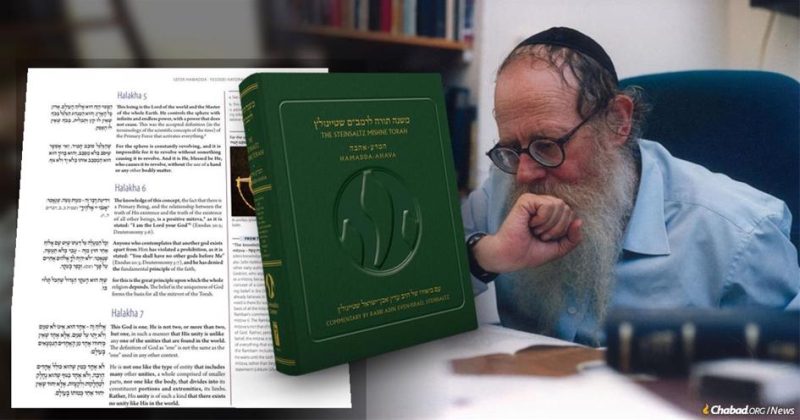
A Commentary on Rambam Was Rabbi Adin Even-Israel’s Final Mission. Now It’s In English
by Tzali Reicher – chabad.org
When the late scholar Rabbi Adin Even-Israel (Steinsaltz) completed his groundbreaking translation of the Talmud in 2010, he had achieved something that had occupied him for nearly five decades. His son, Rabbi Meni Even-Israel, remembers the l’chaims and the joy when the last volume was sent to the printer, and how his father approached the completion of the defining project of his life.
“He had a goal that kept him occupied for decades, and now he had a gaping hole in his schedule,” recalls Rabbi Meni. “Though he was fresh off a tremendous accomplishment, he was already looking for the next classic Jewish text ready to be explained for the contemporary Jew. This was even though he was already at an age when many are winding down their activities and retiring.”
For those who knew Rabbi Adin’s biography, the eagerness for his next challenge was not surprising. Born in Jerusalem in 1937 to avowed Marxists, he arrived at Torah study at a young age through his own intellectual restlessness and never stopped. After their first meeting, the Rebbe—Rabbi Menachem M. Schneerson, of saintly memory—wrote1 that he had found in Rabbi Adin “qualities that are even greater than what was told to me and written to me.”
In addition to translating and elucidating the entire Talmud into Modern Hebrew and then English, Rabbi Adin authored translations and commentaries on the Tanya, Tanach and Mishnah, writing more than 200 books and hundreds of articles on Chassidut, Kabbalah, Jewish philosophy, and many books in the Jewish canon, as well as a bestselling book about the Rebbe, aptly titled My Rebbe. Many of his books, recorded lessons, and writings can be found in the Steinsaltz Portal on Chabad.org, hosted in partnership with the Steinsaltz Center.
Time magazine would eventually call him a “once-in-a-millennium scholar,” and in 1988 he was awarded the Israel Prize for Jewish Studies. Rabbi Adin’s life’s work carried a single animating phrase, reflected in the Steinsaltz Center’s motto, “let my people know.”

Upon the completion of his translation of the Talmud, the elder Rabbi Even-Israel asked his son to draw up a list of works to consider for his next project. Despite his advanced age—he was 73 when he finished his Talmud project—he dismissed what he saw as shorter and simpler tasks. What remained on his short list was a commentary on the Tanach, finishing the English edition of his Talmud, writing a Hebrew commentary on the entire Mishnah, or authoring a commentary of the Rambam’s magnum opus, the Mishneh Torah.
Rabbi Meni expected his father to choose one. Rabbi Adin said he would do them all.
That conversation, 16 years ago, is the backstory to the first volume of the English Steinsaltz Rambam Mishneh Torah, now available in bookstores around the world. A stunning green hardcover running 1,140 pages and covering Sefer HaMadda and Sefer Ahava—the first two of the 14 books that make up the Rambam’s Mishneh Torah—it is a testament to Rabbi Adin’s enduring legacy and to his lifelong commitment to ensuring the accessibility of Torah to all.

Making a ‘Commotion’
The Mishneh Torah, composed by the Rambam—Rabbi Moshe ben Maimon (Maimonides)—in the 12th century, was among the earliest comprehensive codifications of Jewish law, organizing the entirety of halachah by subject matter into a single systematic work. In 1984, the Rebbe introduced a campaign encouraging daily study of the Rambam’s work, establishing three study tracks that would take participants through every commandment in the Torah in either one or three years—giving every person the ability to study the Torah in its entirety. The Rebbe saw the daily Rambam study cycle as a vehicle for both Jewish unity and Torah learning, with many countless people around the world covering the same pages on the same day.
Around the time of the completion of the second cycle of the Rambam study program, Rabbi Adin wrote a personal letter to the Rebbe seeking blessings for his family. The Rebbe’s response offered those blessings, but added a pointed instruction: surely, the Rebbe wrote, Rabbi Adin was making a “commotion” around the study of Rambam, and he should not worry about the Rambam’s own admonishment for people to pursue a quiet middle path, because they had not yet made a third of the noise the campaign required.

Reflecting decades later on the Rebbe’s direction to him, Rabbi Adin committed to tackling the daunting work of translating and authoring a commentary on the Rambam’s 14-book masterwork. He long believed it deserved a commentary that helped readers think through the material rather than simply absorbing conclusions.
“He viewed the commentary as an aid to helping the reader learn, not as something separate from the text,” says Rabbi Meni. “Instead of being a commentary that spoonfeeds and absolves the reader from having to study the original text, he wanted to help his readers study and understand what the Rambam is teaching in each chapter and halachah.”
That philosophy shaped every editorial decision in the Hebrew edition, produced in partnership with Rambam Yomi, an Israel-based organization dedicated to promoting the daily Rambam study cycle. The Hebrew set included a practical halachah section at the close of every chapter, drawing on the Shulchan Aruch HaRav of the Alter Rebbe, Rabbi Shneur Zalman of Liadi, the first Rebbe of Chabad-Lubavitch, and incorporating relevant teachings of the Rebbe.
He was particularly careful to include the Rebbe’s positions on modern questions of Jewish law contested today.
Rabbi Adin also included the glosses of the Raavad, Rabbi Avraham ben David, to the Hebrew edition. Many publishers omit the 12th-century scholar’s sharp critical annotations on the Rambam, but Rabbi Adin insisted on keeping them. In his view, the Raavad’s willingness to challenge the Rambam directly was what gave the commentary its standing as a serious interlocutor.

Remastered for an English-Speaking Audience
By 2018, in partnership with Koren Publishers—who have published Rabbi Adin’s works since 2009—the Steinsaltz Center had completed the Hebrew edition. It sold tens of thousands of copies and inspired the team to explore translating the series into English.
The resulting new English edition is built on the same scholarly foundation as the Hebrew, enhanced with additions unique to the English series.
Each section includes a breakdown of the subject matter being discussed, and a guide to each grouping of laws in every chapter. Rabbi Adin’s clear translation and commentary guides the reader through the Rambam’s Hebrew text in the accompanying column, while The Glosses of the Ravaad clearly explain where he differentiates from the Rambam’s halachic decisions.
Additionally, the English series has taken many more of the Rebbe’s copious teachings and insights on the Rambam’s Mishneh Torah and adapted them into the From the Lubavitcher Rebbe section, compiled by Rabbi Amechaye Even-Israel, seamlessly integrating the Rebbe’s contemporary commentary into each section.

Based on what is being discussed in each section, the Halachic Discussions box brings the practical halachah, drawn from Shulchan Aruch, and includes the legal rulings of the Alter Rebbe, the Tzemach Tzedek—Rabbi Menachem Mendel, the third Rebbe of Chabad-Lubavitch—and Rabbi Avraham Chaim Naeh, a famed Chassidic rabbi who was a prominent halachic decider in the early half of the 20th century. The Notes section adds more context and sources for the interested reader.
Detailed color images depicting the scenes, tools and locations referenced by the Rambam have been added throughout the book, and the daily and three-year Rambam study schedules are marked in the pages to aid those using the volume for their daily Rambam study.
The translation team draws from the same scholars who worked on the Steinsaltz Talmud in English and on the rabbi’s edition of Tanya, and several are also concurrently working on the English Mishnah—another of the projects Rabbi Adin mapped out that morning in 2010.

‘A Victory in Torah Learning’
In 2016, Rabbi Adin suffered a stroke. Though it limited what he could do, it did not stop him. The Rambam and the Mishnah were the final projects he worked on, and he continued contributing until he could no longer do so.
“Though he couldn’t write or speak, my father was able to edit what was produced and written based on his teachings and commentary,” says Rabbi Meni. “He looked over virtually every page, editing and noting what should be cut, and marking what was ready for print.”
After Rabbi Adin passed away in 2020, the decision to carry the project into English became, for Rabbi Meni, even more personal.
“Before his passing, I promised my father I would work to translate his works into at least one other language,” Rabbi Meni tells Chabad.org. “His whole mission was helping bring Jews closer to their Father in Heaven through studying His Torah, and making his commentary on the Rambam accessible to an English-speaking audience is surely bringing much joy to his soul.”
With Volume 1 now in stores, the full set will span eight hardcover volumes, with a softcover edition running to approximately 25 books. The final volume is scheduled to go to press in December 2027, with the softcover potentially completed earlier. Some 60% of the material is already in production, with the team working overtime to get the next volume to the masses.
“The Rebbe wanted people to achieve a victory in Torah learning,” says Rabbi Meni, “a tangible accomplishment to show they mastered an area of the Torah. Through the study of Rambam’s Mishneh Torah, learners will cover every law taught in the Torah, and we hope our new series contributes and helps even more people, in a whole new audience, achieve this goal.”
The Steinsaltz Mishneh Torah, Volume 1, is available now from Koren Publishers.

Footnotes
1. Rabbi Menachem M. Schneerson, Igrot Kodesh, vol. 26, #9827.