Weekly Story: Beis Nissan – The Rebbe Rashab
by Rabbi Sholom Dover Avtzon
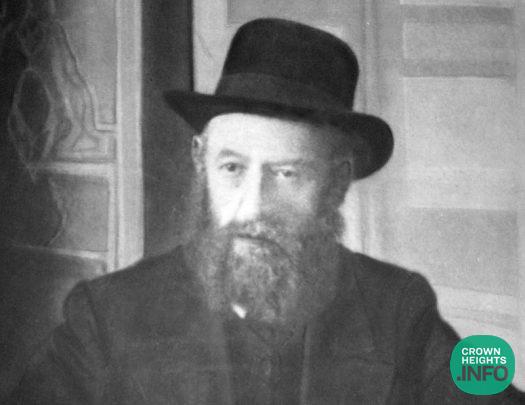
Being that next Friday is the yahrzeit of the Rebbe Rashab, I decided to post this week something which I will be mentioning at a farbrengen.
As always, your feedback and comments are greatly appreciated and welcome.
It is well known that before his histalkus, the Rebbe Rashab said, Ich gei in Himmel, uhn dee seforim Luz ich eich – I am going to the heavens (my soul is going to be leaving my body, but my books and manuscripts, I am leaving for you.
Now, when people pass on, their possessions don’t disappear together with them. So what exactly was the Rebbe Rashab saying to or informing his chassidim?
We see in the introduction to Toras Chaim, that the Mitteler Rebbe’s sons write that their father instructed before his histalkus that they should publish his manuscripts in order that his teachings would be learned perpetually. So evidently the Rebbe Rashab was telling us something deeper than a request that we should learn his seforim.
The first word of the Aseres Hadibros is Anoichi, which is an acronym for אנא נפשי כתבית יהבית I ]Hashem] wrote and gave over My essence in the Torah. Being that tzaddikim are similar to their Creator, so tzaddikim also put their entire essence in their teachings, especially those that they wrote in order that it be available for future generations.
So it is not merely that they put in their whole heart into their teachings, (because as an author I can say that is not singular to tzaddikim, but it applies to all artists and probably all entrepreneurs as well,) but that when we will learn his teachings, not only would we be influenced by them, but that we become connected to him, and he to us. That is something that doesn’t happen when one studies other people’s writings and seforim. While you may be influenced by them, the author doesn’t even know that you read their book etc., so obviously they are not becoming connected to you.
This explains what the Rebbe writes in HaYom Yom that hiskashrus to a Tzaddik is accomplished by learning their teachings.
So an obvious resolution on his yahrzeit, is that we should learn something of his teachings and in general we should make the effort to learn the Chassidus and teachings of all of our Rebbeim.
An additional point that we could learn from the Rebbe Rashab, is from what he told the chassidim by the Purim farbrengen, which was the last farbrengen before his histalkus.
During the farbrengen, soldiers entered the room and asked to check everyone’s papers. They wanted to make sure that everyone present was allowed to be there, because they lived in this house.
The chassidim became very nervous, as many of them did not have proper papers and almost all of them were not supposed to be in this house after curfew. In addition there were other illegalities such as having Mashke and large sums of money on the table, which could have caused dire consequences.
The Rebbe Rashab instructed everybody to ignore the soldiers completely and not even look at them.
He explained that if they don’t exist in your mind, then they cannot harm you, as klipa has no validity. Only, when you give them some credence, do they gain some power. This is something of a guidance for all of us in our day to day life. There are many times that we have fears and doubts because of something that might happen which never actually happens. Those fears and doubts hindered our progress and did not allow us to succeed as much as we could have. With the above guidance, the Rebbe Rashab is telling us that we are creating that power of obstruction, as it on itself is non-existent.
A Taste of Chassidus
Vayakhel Moshe, Torah Ohr. P. 172A
The Alter Rebbe asks why when Hashem told Moshe to instruct the Jewish people to build the Mishkan, he first commanded them to build the utensils, then the curtains and followed up by the law of Shabbos. However, when Moshe gave over the Commandment to the Jewish people, he began with instruction of Shabbos followed by the Commandment to put up the curtains, and only then did he tell them they also have to create the utensils.
The question is why did Moshe switch the order?
Chassidus often points out that Hashem tells us, you should build for Me a Mishkan and I will dwell in them. The question is, shouldn’t the wording have been and I will dwell in it (in a singular tense)?
And the explanation given is, that Hashem is telling us that we should all create a Mishkan in ourselves, and thereby causing that Hashem will dwell in each and every one of us.
That is informing us that the way to build our personal spiritual Mishkan is by following the guidelines of building the physical Mishkan. In other words, by understanding what the physical utensils and curtains symbolize we would then be able to understand what we have to do to create our personal Mishkan. And that will also explain why Hashem instructed us to first build the utensils and then the curtains followed by Shabbos and Moshe switch the order completely and begin with Shabbos followed by the curtains and then the utensils.
In other words Moshe made the switch, because that is the way we will succeed in fulfilling Hashem’s will.
A utensil is a vessel in which something can be received and contained. In Chassidic terminology that is called Ohr Hamimaleh, the G-dly sustenance that gives life to each entity according to its capabilities and limitations.
The curtains that surround the Mishkan are called in kabbala terminology a makif, while in Chassidic terminology that is called Ohe Hasoivev, The G-dly life force that is too powerful to be received internally, rather it hovers above us.
While Shabbos represents the source of life, Hashem Himself, because that is the day He rested and the day that is a bond between Hashem and His Nation, the Jewish people.
When Hashem decided to create the world, he wanted the world to exist as an entity that feels it is independent from Him, [in order to transform that mindset and come to the recognitaion that there is nothing besides Him]. Therefore, he had to limit and conceal the radiance that emanated from Him to such an extent that the receiver does not recognize that it is G-dly.
However, if we don’t receive anything, we wouldn’t exist. So Hashem gives a very small (minute) amount of His radiance to each entity in the amount that each entity can receive without becoming nullified by His sheer presence, and that gives each entity life.
This explains why Hashem began the instruction of building a place for Him to dwell in, by instructing us to build a utensil, a vessel that could receive His radiance. For if we don’t exist, we wouldn’t be able to fulfill his will and desire of preparing the physical world of becoming His dwelling place.
However, as noted we live in a world that doesn’t automatically feel our connection to Hashem, and we can only accept and contain a small amount of Hashem’s radiance. Yet, the goal is that we should refine and elevate ourselves and the world around us and reveal Hashem’s presence in this physical world.
In other words, the person should realize that the life force of G-dliness that they receive is only a small amount of G-dliness and there are much greater and powerful levels of G-dliness.
In Chassidic terminology the level of radiance that every entity is capable of receiving and containing, without becoming nullified, is Ohr hamimaleh. While the higher level that emanates from Hashem, one that we cannot contain, and therefore it hovers above us is Ohr Hasoivev. So first came the guidance to create vessels and then came the instruction to make the curtains.
However, the ultimate goal is to bring Hashem’s presence in an open and revealed way in this world and that is represented by Shabbos. [In the maamar the Alter Rebbe explains in great detail the essence of Shabbos, but that requires an essay on its own.]
However, when Moshe related these guidelines to the Jewish people he understood that in order for them to accomplish this they first have to recognize that there is a Creator and have a desire to be truly connected to Him.
Therefore, the first thing he mentioned was Shabbos, reminding us that there is a Creator who created us and we should strive to connect to Him. As the three Hebrew letters, Shin, Beis and Tuf, that spell the word Shabbos, when rearranged spell the Hebrew word of Tusheiv, which means return [to your source, (which is Hashem)]. The purpose of that is to draw Hashem down into our life.
Subsequently, after mentioning Shabbos first and giving us this general guidance, he mentions the higher level of radiance that emanates into this world (the Ohe hasoivev), and concludes with the radiance that we embrace and contain in ourselves and into this world.
This is the order of every blessing that we say, We begin the blessing with the word Boruch, which means to draw down. The next word is Atah which means You Hashem in Your essence, the source of all life. We then say the words Hashem Elokeinu, which means that this G-dly radiance should become part of us and we should recognize that it is G-dly itself.
Essentially, we are expressing that Hashem’s essence, which first reveals itself as Ohr Hasoivev, should become revealed openly in us and in the world around us. In other words we should refine and elevate ourselves that we won’t be nullified by the Ohr Hasoivev, and in the days of Moshiach, we will bask in Hashem’s essence, which is infinite higher than His glory and radiance.
However, this is speaking in spiritual terminology and was applicable when the Mishkan or Beis Hamikdash was standing. The question is being that the Torah is eternal and as noted Hashem wants and desires to dwell in each one of us, even when we are in exile and the Beis Hamikdash is not standing, the question becomes what represents the utensils and curtains nowadays? Or in other words, how do we draw down the radiance of Ohr Hasoivev into the Ohr Hamimaleh, that we will be able to contain it, and subsequently even down Hashem’s essence into this world?
Just as a utensil holds something inside of it, so too when we learn Hashem’s Torah, it becomes part of us, it is ingrained into our mind, and that reveals the Ohr Hamimaleh. While mitzvos are often referred to as garments, which like curtains are around us, but not part of us.
Subsequently, the way to draw down Hashem’s shechina that it should dwell in this world, is by fulfilling His mitzvos and learning His Torah.
Rabbi Avtzon is a veteran mechanech and the author of numerous books on the Rebbeiim and their chassidim. He is available to farbreng in your community and can be contacted at avtzonbooks@gmail.com.