Marko Dashev Spent Years Shooting Fashion. Now He Photographs Leading Rabbis
by Rena Vegh – chabad.org
The photograph of Rabbi Yoel Kahn captures him as he lived: bent over a text, absorbed in study, indifferent to the camera’s presence. It took photographer Marko Dashev four years to get the shot. Leah Kahn, wife of the ascetic scholar, who had spent his life as chief oral scribe of the Rebbe, Rabbi Menachem M. Schneerson, of righteous memory, had laughed when Dashev first pitched the idea, telling him plainly that it was never going to happen. When it finally did in 2018, the preeminent scholar of Chabad-Lubavitch Chassidism, who passed away in 2021, greeted Dashev with a handshake, then immediately returned to his studies.
“It was almost a relief that he was so disinterested in being photographed,” Dashev recalls. “If there was any character who was so incredibly dedicated to the Rebbe’s teachings—and little, if anything else—it was Reb Yoel. It was almost intimidating to bother such a special person. Fortunately, the portrait that I got captured him in his element, studying and explaining the Rebbe’s teachings long into his old age.”
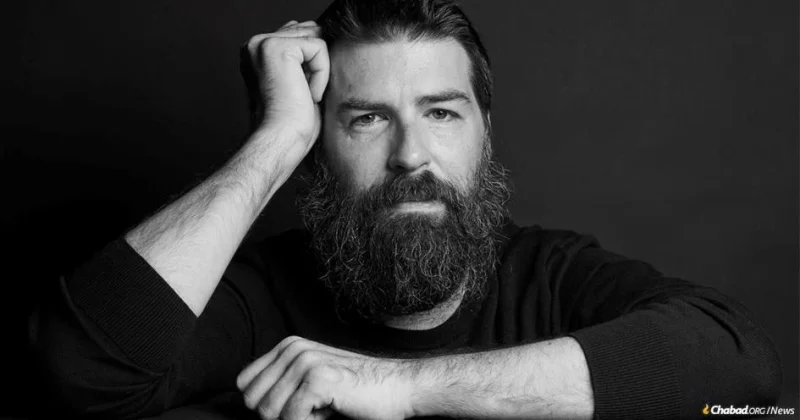
Dashev’s portrait of Reb Yoel is part of the photographer’s ambitious Rabbi Project: Some 200 portrait sessions conducted across more than a decade, creating what Dashev calls “an encyclopedia of contemporary Jewish rabbis and personalities.” A number of them have appeared in publications such as The New York Times.
To understand the journey of how the former fashion photographer got to documenting rabbis, one has to go back a step.

From Fashion to Faith
Dashev grew up in a Jewish home affiliated with the Conservative movement in Toms River, N.J.. From a young age, he says, he didn’t feel any particular attachment to his Jewish heritage.
“After my bar mitzvah, when I took the obligatory lessons and had the whole ceremony and celebration, my mother asked me if I wanted to continue attending services,” Dashev recalls. “I said no, without a second thought.”
Always creative, Dashev pursued art and film, studying at the School of Visual Arts in New York. By 1998 he was assisting photographers shooting for Neiman Marcus and Vogue magazine. It was during this time that he met his Israeli-born wife, Yael, and they started their life together in Manhattan before moving to Miami Beach, Fla.
Within a few tears Dashev had “made it” in industry terms, booking jobs with Ralph Lauren, J.Crew, Bloomingdale’s, Saks Fifth Avenue, DKNY and Burberry. Success in fashion photography is rare enough that most who achieve it never leave. But by then, Yael was being drawn to her latent Jewish faith. She began expressing an interest in learning more about Torah and mitzvahs, and began lighting Shabbat candles at home. Within two years, she was regularly attending synagogue services and Torah classes. But Marko wasn’t there yet.
“As a freelance photographer, weekends were just like any other day of the week in the fashion world. We really needed the money, and it was a challenge to even consider thinking about observing Shabbat,” says Dashev. “On top of that, I just didn’t feel that inspired in my Judaism. Yael was on a certain track and speed, and I was on another.”
With effort, they successfully navigated the difficulties of maintaining their relationship while juggling their shifting values. Nevertheless, as High Holidays approached in 2003, things came to a head.
Dashev was offered a job in the south of Spain, a fashion shoot in a picturesque location overlooking the Mediterranean. It sounded perfect—except the dates fell out over Yom Kippur. Despite his wife expressing her reservations about him working on the holiest day of the year, Dashev accepted the gig.
In the days between Rosh Hashanah and Yom Kippur, Dashev had a grueling work week, and by the time he arrived at the beach town near Malaga, for the shoot, it was already Yom Kippur and Dashev had come down with a bad stomach virus. He found himself bedridden for the next 24 hours. As Yom Kippur came to a close, Dashev was feeling better and able to resume working.
“It was clear to me G‑d was showing me there was room for me to be able to do what I love while learning more about my faith,” Dashev says unequivocally. “I needed that push and moment of realization, and from there my religious journey took off.”

The couple was living in the Park Slope section of Brooklyn at the time, and soon thereafter moved to nearby Crown Heights.
In Crown Heights, Dashev grew steadily in his Judaism. He began attending the Chassidut classes of Rabbi Yossi Paltiel, and found himself transfixed.
“I enjoyed it way more than I expected, and being in the heart of the Chassidic community for Shabbat took my appreciation for it to a whole new level,” he says. “I began learning Yiddish and studying the Rebbe’s teachings in their original language with a group of friends. I finally felt I had found my Jewish home.”
Dashev was still shooting women’s fashion—his primary source of income. Various rabbis had given him latitude on the matter, since it was his livelihood. His wife urged him to seek a more definitive answer.
He met with Rabbi Gavriel Zinner, a world-renowned Halachic decisor, who indicated that while it was OK for Dashev to continue, ideally he should pivot away. A lesson from Rabbi Paltiel, his primary teacher, on the importance of maintaining the soul’s sensitivity, sealed the deal.
In March 2018, Dashev pulled the trigger: Even if his income suffered, he resolved, it was worth it. When he informed his last client, they chose not to contract him for future work. He was unemployed.
The following month, he received a call: a major job opportunity offering half a year’s salary with a two-week timeline. “I tried to elevate this part of my life, and then this job suddenly came out of nowhere. We could say G‑d works like that. We do our best to serve Him, and He takes care of the rest.”

The Rabbi Project
For years, Dashev had viewed photography purely as craft, not art.
“I knew that I had nothing to say in photography except to make money,” he acknowledges. “And suddenly, I was making lots and lots more money. And still, I didn’t feel any kind of maturity as an artist.”
But fashion clients had begun requesting portraits alongside their standard work. This required a different skill set: drawing out personality, focusing on the subject as a person rather than a mannequin for merchandise. Dashev proved talented enough at this to book jobs alongside his
fashion work, and began finding his voice and style in the portraits he took.
Back in 2012, the fashion industry underwent seismic shifts, and the financial rewards dwindled amidst a new corporate atmosphere. Dashev sensed his time in that world winding down, though he would still be taking jobs for the next few years. He was 35, uncertain about next steps.
One day, paging through a book of Chassidic tales compiled by Rabbi Shlomo Yosef Zevin, Dashev turned to the back cover and studied Zevin’s photograph—the expression, the pose, the shadows. His immediate thought: “I can do that better.”
He set up a small studio on the corner of Carroll and Brooklyn Avenue in Crown Heights, offering subjects a simple deal: five minutes for a portrait session, a free copy for their use, while Dashev retained the image for his own projects, all while still maintaining his work in the fashion industry.
This style was new to him, as was the customer base.
“It really did feel like starting at zero, because as much as I was Jewishly involved by then, nobody knew me,” he explains. In the fashion world, access follows reputation—one major client vouches for you to the next. Dashev understood he’d need the same currency here, which meant setting his sights high from the start. He began by building a series of noted rabbis and Jewish personalities.
He took photos of Rabbi Paltiel, then Rabbi Dovber Pinson, which led to a session with Rabbi Moshe Weinberger of Woodmere, N.Y., among many others. The Rabbi Project was born.
“It was amazing to spend time with all these learned rabbis, but getting a photo of Reb Yoel Kahn—the quintessential Chassid of the Rebbe in our time—was the holy grail,” Dashev says with a smile.

He first connected with Leah Kahn in 2014, when she politely declined. Some time later, Yael began caring for an ill community member who typically attended the Kahn’s Passover seder, and Mrs. Kahn extended an invitation to the Dashevs. After Passover, she agreed to organize her husband’s portrait session.
Her warning proved accurate: “Reb Yoel will be learning, he won’t look at you, but take some pictures, and when you’re satisfied, you can leave.”
“I have done hundreds of portrait shoots, and the results are almost exclusively—besides the technical aspects—based on the personal interaction between photographer and subject,” reflects Dashev. “Even the most reserved and reticent people I’ve photographed engage in the process of crafting an honest portrait if not an intriguing one. For Reb Yoel, I was only a witness, and that seemed appropriate for the caliber of person he was.”
During a “Soul Encounters” symposium hosted by the Jewish Learning Institute in 2014, the Rabbi Project got traction. Until then, Dashev had only shot a handful of the rabbis that he specifically wanted to photograph. Going to that event that day, held at Queens College, he planned to capture as many of the speakers that he could.
Dashev set up a makeshift studio in a hallway, photographing speakers between lectures. It was there he encountered Rabbi Adin Even-Israel (Steinsaltz), the legendary scholar known for his commentaries on the Talmud, Tanya, Maimonides and countless other works.
“Every portrait I took leading up to my time with Rabbi Adin, my anticipation grew greater. I knew the image of him that I wanted to capture.”

Rabbi Even-Israel finished his talk around 10:30 p.m., and Dashev pulled him aside before the building closed.
The rabbi immediately launched into a monologue: “Photographers are the most powerful people in the world. It doesn’t matter if you’re a president or an emperor. As soon as you’re in front of the photographer, the photographer tells you what to do.”
As images appeared on the monitor, Rabbi Even-Israel began laughing. “You should have taken my picture when I was three years old. Before they cut my hair, I had this full head of curly blonde hair.”
“I probably should have been more intimidated,” Dashev admits, “but he was somehow not intimidating. He was so down-to-earth and accessible. I loved his look, and seeing it, you just know that the mind that lives in there is just spectacular.”

Rabbi Sholom B. Lipskar, the Rebbe’s indefatigable emissary in Miami, founder of the Shul of Bal Harbour and the Aleph Institute who until his 2025 passing had played a leading role establishing Jewish life in South Florida, sat for his portrait at the same Queens College event. The interaction was brief and serious, but left Dashev with a lasting impression of Lipskar.
“I think that’s who he was,” Dashev observes. “He needs to be doing his business. He does not need to be doing anything else. Just working as a rabbi; everything else was noise.”
It’s an accurate insight into the man whose epitaph quotes one of his most oft-repeated mantras: “Get it done.”

Another rabbinical scholar to accept Dashev’s proposal was Rabbi Nissen Mangel, who after surviving the Holocaust as a young boy became a renowned author and translator, including of the Tehillat Hashem prayerbook. Mangel invited the photographer to his Crown Heights home.
“I think we all approach Holocaust survivors with a sense of awe. We could never, and should never know what they have experienced. Rabbi Mangel built his life post war in family, Torah and Chassidut. He went from raging devastation, where many walked away from observance, to become a leading Jewish scholar and teacher,” Dashev says. “Entering the rabbi’s house and seeing the dining table set with several volumes of Hemshech Ayin Beit [a deep and encyclopedic Chassidic text authored by the fifth Rebbe, Rabbi Sholom DovBer, beginning in 1912] , I felt the gravitas of his character in the air. Despite the friendly and casual conversation that pervaded the portrait session, throughout, I felt humbled.”

‘Work With What’s in Front of You’
By now, Dashev has completed over 200 portrait sessions, “and my goodness, I would like to do another 200 at least.”
The shoots vary wildly; sometimes, they are elaborate studio set-ups with extended conversations and sometimes just lighting equipment in a quiet study.
“It’s usually a little more interesting when it’s their space, because they really live in it,” he notes. “But I learned long ago that you should never go into a photo shoot with a lot of expectations. You work with what’s in front of you.”
That flexibility extends to his assessment of the subjects themselves. “Definitely meet your heroes,” he advises. “With all the rabbis I’ve gotten to meet, they’re all pretty amazing people.”
For all the special moments he had with interesting figures, the session Dashev found to be the most poignant came in 2019. For years, Dashev had attempted to photograph Rabbi Moshe Kotlarsky, the energetic vice chairman of Merkos L’Inyonei Chinuch, the educational arm of the Chabad-Lubavitch movement, but Rabbi Kotlarsky always demurred.
In 2019, Dashev was diagnosed with a brain tumor requiring surgery, and Rabbi Kotlarsky had begun his own battle with pancreatic cancer.
“I told him, ‘That’s it. You’re being treated, and I have no idea where my brain’s going to be in six months.’”
There is a teaching that says if someone prays for salvation for another, he will merit that same salvation. Dashev proposed an exchange: “As a sick person, you can bless me to be healed, and I, as another sick person, will bless you for a speedy recovery.”
The shared battle opened the door.

“I still get choked up about this. It was a very unsettling time in my life, and the only thing that I could stick to at the time was taking more and more portraits. Even with a sense of desperation. Rabbi Kotlarsky had rebuffed my many requests over the years to take his portrait. He just wasn’t connected to the idea of a portrait sitting, not intellectually nor spiritually. It just wasn’t part of his being. Somehow, it took this awful commonality to make it happen. And yet, poetically, it seems right that this would be the only circumstance where he’d agree to sit.”
While Rabbi Kotlarsky succumbed to his illness in 2024, Dashev’s surgery succeeded, though the recovery was long. With no job prospects and a pandemic rising, the family relocated to Florida. Finances were tight. Two weeks later, government stimulus checks for self-employed business owners began.
“It was Divine Providence. I couldn’t work, and I was in a really bad place. With the timing of the benefits, G‑d was telling me, ‘here’s your money for recovery. You are taken care of. Everything’s fine.”

‘Shine a Light on the Observant Community’
At the outset of The Rabbi Project, Dashev contemplated his project’s purpose. He wanted to increase Jewish pride, to document impactful leaders and teachers within the world. He hoped to open a window into a world he’d come to love through a visual medium he felt was missing.
By the reception he’s received, it’s clear that it’s working.
“I want to shine a light on the observant community. I’ve been approached by every stripe of society about the project and how it has affected them,” he says. “Many go on to find out more about who was photographed and what they stand for, which is one of the project’s goals. Even among Orthodox Jews, who I assumed would be less interested, the response has been amazing to me.”
Four years ago, Dashev mounted a traveling exhibition featuring sixty images from the project. The show opened at Miami Beach’s JCC before moving to the Palm Beach and Aventura JCCs. Dashev envisions converting the exhibition into a book in the future.
“These past several years, I feel that the urgency to take more portraits has become compounded. We shouldn’t experience the loss of any individual, but time is marching on, and some of the people that I’ve photographed have moved on to the World of Truth. The necessity to document and celebrate our luminaries is only increasing over time.”
Dashev talks of his own motivations: “The Rebbe said innumerable times that we have to work our talents and abilities for the sake of Heaven, to help others, to spread the light of Judaism. I just want to serve my purpose, to serve the Creator. As long as portraits are how I can do this, I can only hope I do it with an even greater result and impact.”